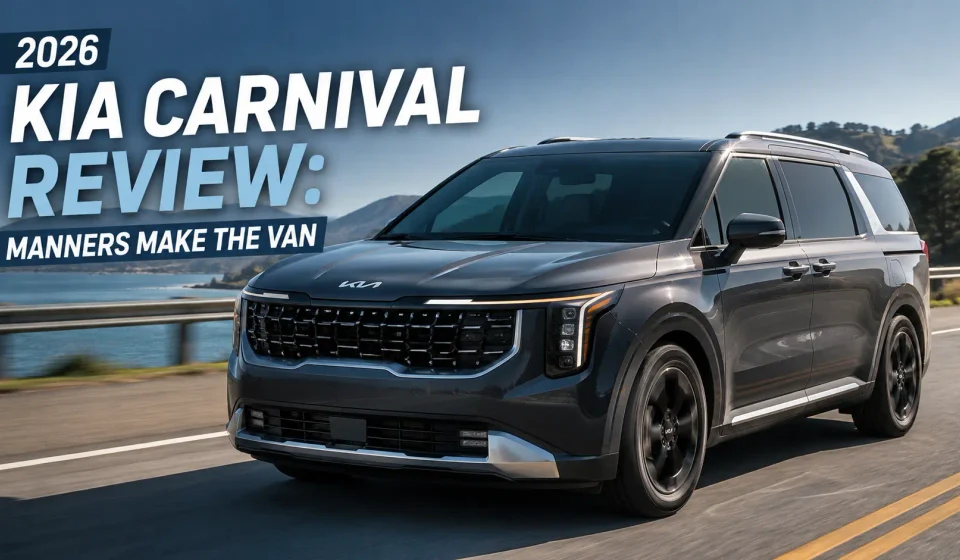

The Kia Carnival’s price dropped up to 4.49 lakh after the GST cut. Here’s an honest look at where its manners hold up, and where they don’t.
Nobody buys a Kia Carnival to feel a G-force. That’s not an insult, it’s the entire design brief. This is a nearly 60 lakh rupee vehicle built around the idea that the best thing a family MPV can do is stay out of the way, ride smoothly, keep noise down, and let whoever’s in the back genuinely relax. “Manners” is the right word for it, and the Carnival mostly earns that description.
What’s changed recently, and what most existing coverage hasn’t caught up to, is the price. A GST rate revision in September 2025 cut the Carnival’s cost by as much as 4.49 lakh rupees, and the single-variant lineup means there’s no confusing spec ladder to work through, just one very complete package at one number.
What “manners” actually means here
Kia builds the Carnival around a single 2.2-litre turbo diesel engine making 190 hp and 441 Nm, paired with an 8-speed automatic. Kia’s own claimed 0-100 kmph time is 11.1 seconds, unhurried by any modern standard, and that’s intentional. This isn’t a vehicle chasing quick overtakes. It’s tuned for composed, stable highway cruising, and reviewers consistently describe it as feeling planted and settled at speed, without the constant body roll you’d get in a similarly sized SUV.
There’s genuinely no direct rival for it in India. Kia and most reviewers position it as a luxury MPV alternative to something like a loaded Mahindra XUV700, or as a step below full luxury vans like the Toyota Vellfire or Lexus LM. It occupies its own space, which means less cross-shopping pressure but also fewer easy reference points if you’re trying to judge whether the price is fair.
The price today, after GST
| Milestone | Ex-showroom price |
|---|---|
| Original launch, October 2024 | ₹63.90 lakh |
| Before September 2025 GST revision | ₹63.90 – 64.90 lakh |
| After GST 2.0 rate cut (Sept 22, 2025) | ₹59.65 lakh |
| On-road, Mumbai (Aug 2026) | ₹75.29 lakh |
That’s a genuine, meaningful saving passed on to buyers, not a marketing rounding trick. If the price you remember from a year or two ago is closer to 64 lakh, it’s worth checking again, since today’s number is noticeably lower for the same fully loaded spec.
What you actually get for that money
| Feature | Detail |
|---|---|
| Engine | 2.2L turbo diesel, 190 hp, 441 Nm, 8-speed automatic |
| Seating | 2+2+3, 7-seater, powered Ottoman second-row seats |
| Safety | 8 airbags, Level 2 ADAS, 5-star ANCAP rating |
| Claimed mileage | 14.85 kmpl |
| Variants | 1 (Limousine Plus) |
The second row is genuinely the headline feature here, not an afterthought. The Ottoman seats are powered, ventilated, heated, and come with proper thigh support, built specifically for the kind of buyer who’s more likely to sit in the back than drive. Reviewers consistently flag this as one of the best rear-seat experiences available in India at any price, chauffeur-driven or otherwise, and the boot space, once you fold the third row flat, is genuinely vast for long trips or airport runs.
Where the manners actually run out
This is the part most brochure-driven coverage skips, and it matters if you’re planning to use this as more than a city-and-highway-only vehicle.
Owner and reviewer feedback consistently flags the ADAS suite as feeling too reactive in real Indian traffic conditions, prone to intervening or alerting more than genuinely necessary in crowded city driving or on busy highways, the kind of over-caution that can become an annoyance rather than a comfort over time. Rear seat noise insulation has also been flagged as an area that could be better, a slightly odd shortfall on a vehicle this focused on rear-passenger comfort.
The bigger practical issue is road conditions. Despite generally good bump absorption even on the 18-inch wheels, reviewers are consistent that bad roads and oversized speed breakers need to be taken slowly, especially when the vehicle is loaded with passengers and luggage. Given the Carnival’s size and long 3,090mm wheelbase, it’s also explicitly flagged as not ideal for buyers who deal with a lot of narrow roads or genuinely rough surfaces on a regular basis. This is a vehicle built for smooth arterial roads and highways, not rural stretches or tight old-city lanes.
Who this is actually built for
If your typical use case is smooth city roads, highway trips, and carrying family or being driven around in comfort, the Carnival delivers exactly what it promises, and the rear seat experience alone justifies a serious look at this price point. It’s genuinely one of the most spacious, practical options available for carrying more than five people with real comfort, not just seating capacity on paper.
If your daily reality includes narrow lanes, poorly maintained roads, or frequent rough-road driving, the Carnival’s size and low floor height work against you here, and the “manners” that make it so pleasant on good roads become a liability on bad ones. A smaller, higher-riding SUV would likely serve that use case better, even with less outright cabin space.
Before you book
- Take a test drive route that includes at least one stretch of genuinely bad road or an unmarked speed breaker, not just a smooth highway loop, to judge how the low floor height feels for yourself
- Spend real time in the second-row Ottoman seats specifically, since that’s the feature most likely to justify the price for chauffeur-driven buyers
- Ask your dealer directly about current waiting periods, since they’ve fluctuated meaningfully in the past, from short waits to as long as 6 months at points
- Confirm the current on-road price in writing for your city, given how significantly the ex-showroom figure has moved since the original 2024 launch
Verdict
If you’re buying primarily for rear-seat comfort, whether for family or for being chauffeur-driven, and your driving is mostly confined to good city and highway roads, the Carnival earns its price at the current post-GST number. The second-row experience genuinely stands out, and the highway manners that give this review its name are real, not just brochure language.
If narrow roads, rough surfaces, or frequent rural driving are a regular part of your life, this isn’t the right vehicle for that job, regardless of how comfortable the back seat is on smooth tarmac. Its size and low floor height work directly against you there.
If you’re specifically shopping on ADAS refinement, go in with tempered expectations. The system’s over-eager intervention in Indian traffic conditions is a real, repeatedly flagged niggle, not an isolated complaint.
FAQ
How many variants does the Kia Carnival come in? Just one, the Limousine Plus, diesel-only with an 8-speed automatic. There’s no trim ladder to choose between, the spec sheet is fixed.
How much does the Kia Carnival cost after the GST cut? Ex-showroom price now sits at 59.65 lakh rupees, down from 63.90 to 64.90 lakh before the September 2025 GST 2.0 revision, a saving of up to 4.49 lakh rupees passed on to buyers.
Is the Kia Carnival good on bad roads? Not particularly. Reviewers consistently note that bad roads and oversized speed breakers need to be taken slowly, especially when loaded, and the vehicle isn’t ideal for buyers who regularly deal with narrow roads or rough surfaces.
What’s the real complaint about the ADAS system? Multiple reviews describe it as feeling too reactive in typical Indian traffic conditions, intervening or alerting more often than feels necessary in crowded city or highway driving.
Is the Kia Carnival worth it for a chauffeur-driven buyer? Genuinely, yes. The powered, ventilated, heated Ottoman second-row seats with thigh support are consistently highlighted as one of the best rear-seat experiences available in India at any price point.
What’s the claimed mileage of the Kia Carnival? 14.85 kmpl on the ARAI cycle for the 2.2-litre diesel engine, a reasonable figure given the vehicle’s size and the smooth, unhurried way it’s tuned to drive.
The Carnival’s manners are genuine, not marketing spin. Whether they’re worth nearly 60 lakh rupees to you comes down to one honest question: are your regular roads smooth enough to let those manners actually show?