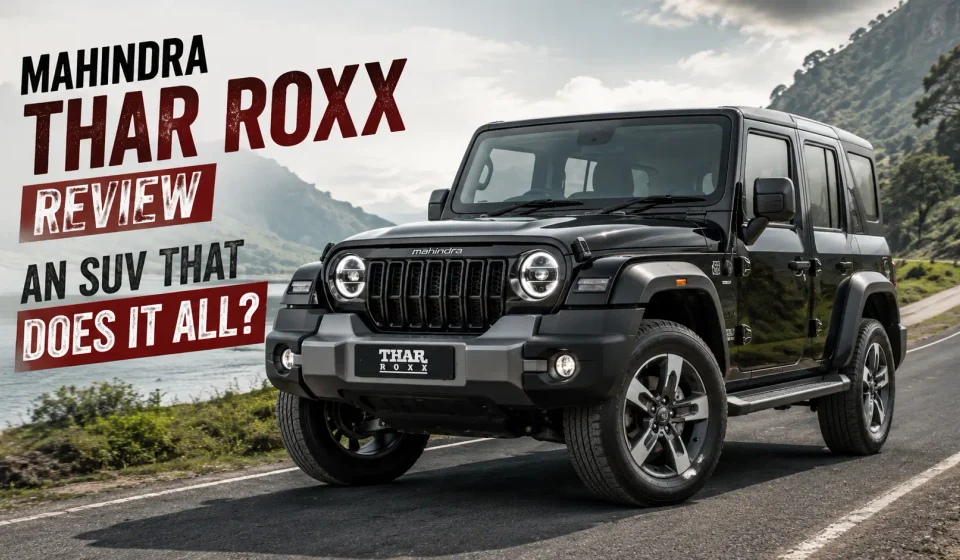

The Thar Roxx has been through two price hikes in 2026 alone. Here’s an honest look at whether it really does it all, or just mostly.
That’s a big claim for any single vehicle to make, and the Thar Roxx gets asked to prove it constantly. Weekend trail runs to Leh, Monday school drop-offs, Bangalore’s peak-hour crawl, an Aravalli hill climb on Sunday. One reviewer’s framing captures the pitch well: tackle a mountain trail on Sunday, then be a comfortable commuter on Monday. The bookings back up the appetite for that pitch, 1.76 lakh in the first hour when it launched in August 2024, and over 50,000 units sold through 2025 alone.
But “does it all” is a testable claim, not just a tagline, and the honest answer sits somewhere in the middle. This car has also been through two separate price hikes in 2026 alone, which is worth knowing before you fall for the pitch, and there’s a real, repeatedly flagged trade-off between its off-road ability and how it feels on an ordinary bad city road.
The price ladder, after two 2026 hikes
Mahindra revised Thar Roxx pricing twice within a single year, first in January 2026, then again in April or May, and the increases weren’t small.
| Milestone | Price change |
|---|---|
| January 2026 revision | +₹12,300 to ₹20,600 across variants |
| April/May 2026 revision | Up to +₹61,500 on top variants |
| AX5L 4WD 175PS (current) | Crosses ₹21 lakh for the first time |
| AX7L 4WD 175PS, top variant (current) | ₹22.81 lakh |
The steepest increases landed specifically on the top-end diesel 4WD variants, the ones running the higher-output 175 PS tune of the mHawk engine, exclusively automatic and four-wheel drive. If you were pricing out a fully loaded Thar Roxx even six months ago, that number has moved meaningfully since, and it’s worth getting a fresh quote rather than trusting anything you read before mid-2026.
Current ex-showroom pricing runs from 12.52 lakh for the base MX1 2WD petrol manual up to 22.81 to 23.53 lakh for the range-topping AX7L 4WD diesel automatic, with on-road prices in most cities landing somewhere between 14.5 lakh and 28.71 lakh depending on variant and state taxes.
Where it genuinely does it all
To be fair to the pitch, a lot of it holds up. Ground clearance sits at a genuine 219mm, and the underlying capability that made the original 3-door Thar a cult favourite carries through fully into the 5-door Roxx body. Level 2 ADAS on the 2026 lineup has reportedly been recalibrated specifically for Indian road conditions, with emergency braking tuned to intervene less intrusively than earlier versions, a genuine improvement if you’ve read complaints about overly reactive ADAS on other recent SUVs. Six airbags come standard across the entire range, not just top trims, and the 360-degree camera is described less as a luxury and more as a necessity, given the vehicle’s height and the blind spots that come with genuine off-road maneuvering.
In the city, despite its size, the light steering is repeatedly described as making the vehicle feel more agile than its dimensions suggest, and the five-door format has genuinely improved everyday usability over the original 3-door Thar, with rear seats that recline and boot space that’s a real step up.
Where the claim actually breaks down
Here’s the part that matters most if you’re weighing this against a more conventional SUV. The same 2026 review that’s most enthusiastic about the car is also the most direct about its limits: the ride can feel busy on uneven city roads, a real trade-off next to a monocoque SUV like the Creta, and that’s coming from a review that otherwise recommends the car strongly.
That’s a meaningful, honest caveat, not nitpicking. The Thar Roxx rides on a ladder-frame chassis built for genuine off-road capability, and that construction inherently trades away some of the smoothness a unibody family SUV offers on regular, imperfect city roads, the kind most owners actually drive on most days. If your daily reality is potholed streets and speed breakers rather than weekend trails, that trade-off shows up constantly, not just occasionally.
A few smaller but real niggles worth knowing:
- Claimed mileage on the petrol manual and automatic sits at just 12.4 kmpl, low even by SUV standards, and worth budgeting for realistically given how many owners will do mostly city driving
- White interior trim on higher variants is genuinely difficult to keep clean day to day, a small but real practical complaint from a recent hands-on review
- Higher variants have gotten noticeably more expensive through 2026’s price revisions, and the value case for the range-topping AX7L specifically is weaker today than it was even a year ago
The Star Edition value question
Mahindra launched the Star Edition on January 23, 2026, priced between 16.85 lakh and 18.35 lakh ex-showroom, positioned as a way to get the premium blacked-out look, roof, ORVMs, and grille, without paying AX7L prices. The trade-off is real: you lose the 4WD option entirely, since the Star Edition is RWD only, and you miss out on some of the top-tier tech available further up the range.
For buyers who mostly drive in cities and want the visual presence without the steepest price tag, this is a genuinely sensible middle option. If you’re actually planning to take the SUV off-road with any regularity, the Star Edition’s RWD-only limitation defeats a real part of what makes the Thar Roxx worth buying in the first place, and the AX7L 4WD remains the variant that actually delivers on the “does it all” promise.
Before you book
- Test drive on a genuinely bad stretch of city road, not just a smooth showroom loop, to judge the ride quality for yourself against whatever SUV you’re currently driving or considering
- Get a current, dated price quote directly from your dealer, given how much the range has moved through two separate 2026 revisions
- If off-road capability matters to you, confirm you’re looking at a 4WD variant specifically, since the Star Edition and several lower trims don’t offer it
- Ask about white interior trim maintenance if you’re considering a higher variant with that option, since it’s a small but repeatedly flagged real-world annoyance
Verdict: who this actually suits
If your life genuinely includes both weekend off-road trips and a daily commute, and you’re willing to accept a busier ride on bad city roads as the trade-off for real capability the rest of the week, the Thar Roxx earns its “does it all” reputation about as well as any single vehicle reasonably can. The safety kit, the recalibrated ADAS, and the genuine off-road ability are all real, not brochure language.
If you’re a pure city dweller without regular off-road ambitions, this is honestly not the most sensible choice anymore, even by the account of reviewers who otherwise like the car. A monocoque SUV like the Creta will ride better on the roads you’ll actually drive every day, and you won’t be paying for capability you’re not using.
If budget is a factor, know that the top variants have gotten meaningfully pricier through 2026’s two price revisions, and the Star Edition is worth serious consideration if you want the look and general everyday usability without stretching for the full AX7L 4WD price.
FAQ
How much has the Thar Roxx’s price increased in 2026? It’s been through two separate revisions, one in January adding 12,300 to 20,600 rupees across variants, and a larger one in April or May adding up to 61,500 rupees on top-end variants, pushing the range-topping AX7L 4WD past 22.8 lakh rupees.
Is the Thar Roxx comfortable for daily city driving? Partially. Steering is light and the car feels more agile than its size suggests in traffic, but the ride does feel busier on uneven city roads compared to a monocoque SUV like the Creta, a real and repeatedly flagged trade-off for its genuine off-road capability.
What’s the difference between the Star Edition and the AX7L? The Star Edition, priced from 16.85 to 18.35 lakh rupees, offers the premium blacked-out look at a lower price but is RWD only, missing 4WD and some top-tier tech. The AX7L is the range-topping, fully capable 4WD variant at a considerably higher price.
What mileage does the Thar Roxx give? The petrol variant is ARAI-claimed at 12.4 kmpl across manual and automatic, on the lower end for the segment, worth factoring into your running cost expectations especially if most of your driving is in the city.
Is the ADAS system good on the 2026 Thar Roxx? Reportedly improved. The system has been recalibrated specifically for Indian road conditions, with emergency braking described as less intrusive than on earlier versions.
Should a pure city driver buy the Thar Roxx? Most honest reviews suggest not, or at least not without accepting real trade-offs. If off-road use isn’t a regular part of your life, a unibody SUV will likely serve daily city driving more comfortably, without paying for capability you won’t use.
The “does it all” question doesn’t have a clean yes or no answer, and that’s actually the most honest thing you can say about this SUV. It does most of it, very well, as long as you’re honest with yourself about which “all” actually applies to your week.