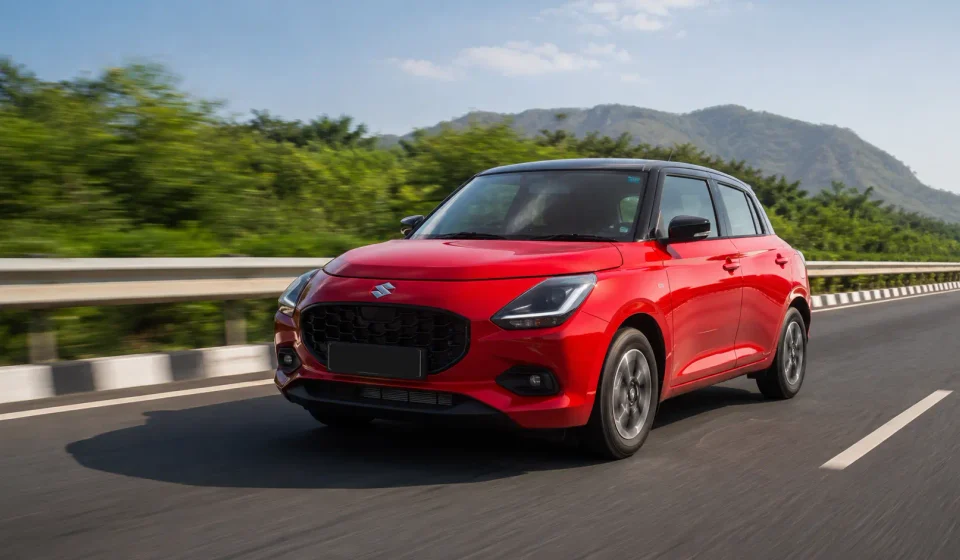

Maruti Swift CNG’s mileage claims contradict each other across sources. Here’s the real running-cost math and what you trade away for it.
Ask five different websites what mileage the Swift CNG actually gives, and you’ll get five different answers. One says 32.85 km/kg. Another lists 24.8 km/kg for what looks like the same car. A third ran their own city test and got 33.13 km/kg, higher than the official claim, which almost never happens with real-world testing. None of them explain why the numbers don’t match.
This isn’t a spec-sheet problem. It’s the exact number that decides whether the roughly 90,000 rupee CNG premium pays for itself in a year or three, so it’s worth actually sorting through rather than just picking whichever figure sounds best.
What the CNG premium actually gets you
Maruti sells the S-CNG kit factory-fitted, not as an aftermarket add-on, which matters for warranty and safety reasons alone. It’s only offered on the VXi and ZXi trims though, so if you want the fully loaded ZXi+ or the bare-bones LXi, CNG isn’t an option regardless of budget. The gearbox is manual only too. There’s no AMT-CNG combination, so anyone who specifically wants an automatic has to stick with petrol.
Under the CNG kit sits the same 1.2-litre, three-cylinder Z-series engine as the petrol Swift, running on 1197cc, but output drops to around 69 bhp in CNG mode, noticeably down from what the same engine makes on petrol. Ground clearance also comes in a touch lower at 163mm, and the fuel tank capacity is 37 litres. Ex-showroom pricing for the S-CNG currently runs roughly 8.20 lakh to 9.20 lakh rupees depending on trim and city, sitting about 90,000 rupees above the equivalent petrol variant.
Why the mileage figures don’t agree with each other
Here’s the honest breakdown of what’s actually out there, and why the spread is this wide.
| Source | Figure reported |
|---|---|
| Maruti’s own claim (company website, CarDekho) | 32.85 km/kg |
| One CarWale listing | 24.8 km/kg |
| V3Cars real-world city test | 33.13 km/kg |
The Maruti figure is the ARAI-tested laboratory number, the one you’ll see on the brochure. The CarWale figure looks like it may be pulled from an older variant or a different test cycle, since it sits well below Maruti’s own claim, and lower listed numbers like this are common when a site hasn’t updated after a spec revision. The V3Cars number is the genuinely interesting one. Getting a real-world result that beats the official claim is unusual, and it likely reflects a specific, favourable city test run rather than what you should expect on average. Real-world mileage almost always comes in below the claimed figure once you factor in AC use, traffic, and normal driving rather than a controlled test loop.
Treat 30 to 33 km/kg as the honest range to plan around in mixed city driving, and don’t assume you’ll match V3Cars’ test result on your first tank.
The running cost math, done properly
This is the number that actually justifies the premium, so it’s worth working through rather than taking anyone’s word for it.
| Fuel type | Mileage | Fuel cost (Delhi, approx) | Cost per km |
|---|---|---|---|
| CNG (claimed, 32.85 km/kg) | 32.85 km/kg | ₹80/kg | ₹2.44 |
| CNG (V3Cars real-world test) | 33.13 km/kg | ₹80/kg | ₹2.51 |
| Petrol manual (24.80 kmpl) | 24.80 kmpl | ₹100/l | ₹4.03 |
| Petrol AMT (25.75 kmpl) | 25.75 kmpl | ₹100/l | ₹3.88 |
Even using the more conservative real-world CNG figure, you’re looking at roughly 35 to 37 percent lower running cost per kilometre compared to petrol. On the 90,000 rupee premium, that math works out fastest for high-mileage drivers. Someone doing 15,000 km a year would recover that premium in a little under three years at these prices. Someone doing 25,000 km a year, closer to two.
What you give up for that saving
None of this comes free, and a few trade-offs are worth knowing before you commit.
- Power drops to around 69 bhp in CNG mode, noticeably down from the petrol engine’s output, and it shows most on inclines and while overtaking, where the car needs more frequent downshifting to keep momentum
- No automatic gearbox option, CNG is manual-only across the range
- You’re locked out of the top ZXi+ trim entirely, so features like the sunroof or higher-spec interior bits, wherever the Swift offers them, aren’t available on a CNG car regardless of how much you’re willing to spend
- CNG cylinder placement typically eats into usable boot space compared to the equivalent petrol car, worth checking in person if you regularly carry luggage
- Ground clearance sits a touch lower at 163mm, worth factoring in if you deal with a lot of speed breakers or unpaved stretches
Where CNG genuinely makes sense, and where it doesn’t
If your daily driving is mostly flat city routes with reliable access to CNG filling stations near home or on your commute, the running cost savings are real and the power deficit rarely matters in stop-start traffic anyway. High-mileage drivers, delivery use, or anyone doing long daily commutes will feel the savings fastest.
If you regularly drive on hilly routes, do a lot of highway overtaking, or want the flexibility of an automatic gearbox, the petrol AMT is the better everyday fit, even at the higher running cost. The performance dip in CNG mode is real, not exaggerated, and it’s most noticeable exactly where you’d want reserve power most.
If CNG filling stations aren’t reliably available where you live or work, none of the running cost math matters. Factor in real access before the price, not after.
Before you buy
- Check CNG station density specifically on your regular routes, not just your city in general, since coverage still varies block to block in many towns
- Test drive the CNG variant specifically, not the petrol one, so you feel the real power difference for yourself before committing
- Ask your dealer to show you the actual boot space with the CNG tank fitted, rather than assuming it matches the petrol car’s listed figure
- Confirm current on-road pricing in your city in writing, since CNG kit pricing and fuel rates both shift periodically
Verdict
If you drive enough kilometres a year in mostly flat, city conditions with good CNG access, the Swift CNG earns back its premium within two to three years and keeps saving after that. The math genuinely works in its favour for the right driving pattern.
If your driving includes regular hills, highway overtaking, or you specifically want an automatic, skip the CNG and take the petrol AMT instead. The fuel savings won’t offset how much you’ll notice the power difference in exactly those situations.
If boot space or the top-trim features matter to you, be aware going in that CNG locks you out of ZXi+ entirely and typically costs you some cargo room, regardless of how attractive the running cost looks on paper.
FAQ
What’s the real mileage of the Maruti Swift CNG? Maruti’s official claim is 32.85 km/kg. Real-world figures from independent tests have ranged from slightly above that to noticeably below it depending on driving conditions, so plan around 30 to 33 km/kg for realistic mixed city driving rather than assuming you’ll match the claimed figure every tank.
How much more does the CNG variant cost than petrol? Roughly 90,000 rupees more than the equivalent petrol trim, with the CNG variant’s ex-showroom price currently running about 8.20 to 9.20 lakh rupees depending on trim and city.
Can I get the Swift CNG with an automatic gearbox? No. The CNG kit is only offered with the 5-speed manual gearbox. If you want an automatic, you’ll need to choose the petrol AMT instead.
Which Swift trims are available with CNG? Only the VXi and ZXi trims. It isn’t offered on the base LXi or the top-spec ZXi+, so some features are simply unavailable regardless of budget if you want CNG.
How much power do you lose running on CNG? Output drops to around 69 bhp in CNG mode, down from the petrol engine’s figure, and it’s most noticeable on inclines and while overtaking, where the car needs more frequent downshifts to maintain pace.
Is the CNG premium worth it for a low-mileage driver? Less so. The running cost savings take longer to offset the roughly 90,000 rupee premium at lower annual mileage, so buyers doing under 10,000 km a year may find the petrol variant makes more financial sense overall.
The mileage number on the brochure was never the whole story here. What actually decides whether this is worth it is your own driving pattern set against real running costs, and that math holds up better than the confusing spread of claims online might suggest.