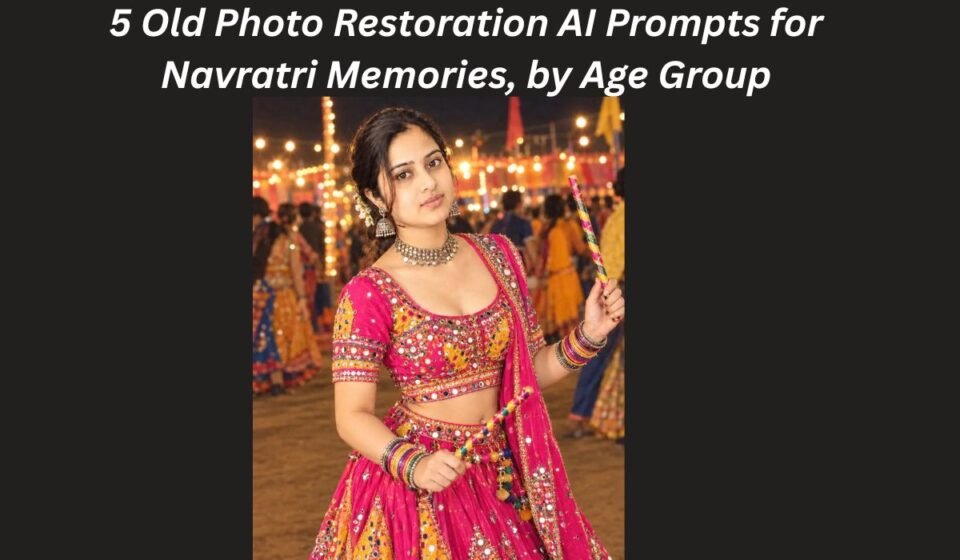

Almost every Indian family has an old Navratri photograph somewhere: a garba night in the 80s, an aarti at the local pandal, a dandiya circle from a college festival. These photos fade, crack and get stained. AI restoration can bring them back, but a generic “restore this photo” prompt tends to make faces look younger and smoother, which defeats the purpose.
The prompts below fix that. Each one is written for a different age group (30, 40, 50, 60 and 70), so the model knows to keep that person’s real age, wrinkles, grey hair and expression instead of “improving” them. Each also has its own Navratri setting, outfit colour and style, and pose.
What makes a restoration prompt work
- Lock identity first. Say that the face, age and expression must stay exactly as in the photo. Without this, models smooth skin and de-age faces.
- Name the damage specifically. “Scratches, a vertical tear on the left, yellow stains, faded corners” gives the model a clear repair list.
- State the age and what to keep. For older subjects, tell the model explicitly to keep wrinkles, grey hair and natural skin texture.
- Decide on colour deliberately. Black and white restored as black and white, or colourised with period-accurate tones. Don’t leave it open.
- Don’t invent missing parts. Where a face or object is badly damaged, tell the model to reconstruct conservatively, not create new details.
1. Age 30: Garba Night, Bright Chaniya Choli, 1990s
Outfit: rani pink chaniya choli with mirror-work and a gota border. Pose: mid-twirl with dandiya sticks raised. Location: a community garba ground under string lights.
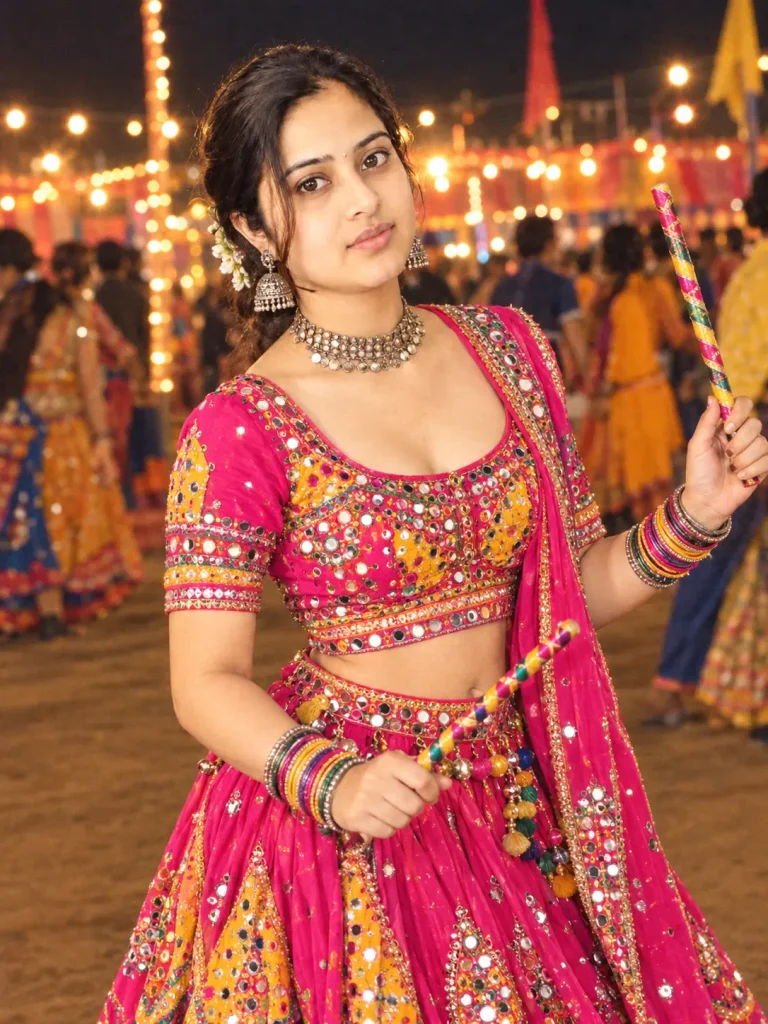
Restore this old photograph of a woman in her early 30s dancing garba at a Navratri ground. Preserve her original identity exactly: same face shape, features, skin tone, hairstyle and joyful expression. Do not make her look younger, smoother or more glamorous.

Repair scratches, dust, stains, creases and faded areas. Rebuild missing parts of the background conservatively, without inventing new details. Reduce excessive film grain but keep a natural analog texture.

Recover the fine detail in her rani pink chaniya choli, mirror-work, gota border, bangles and dandiya sticks. Colourise using period-accurate 1990s colours: saturated pinks, warm yellows and orange string-light glow. Improve contrast and sharpness naturally, and output a high-resolution, archival-quality photograph.
2. Age 40: Family Aarti at Home Mandir, 1980s
Outfit: emerald green silk saree with a gold border, and a man in a cream kurta. Pose: couple standing side by side holding an aarti thali. Location: a home mandir with a Durga idol, diyas and marigold garlands.
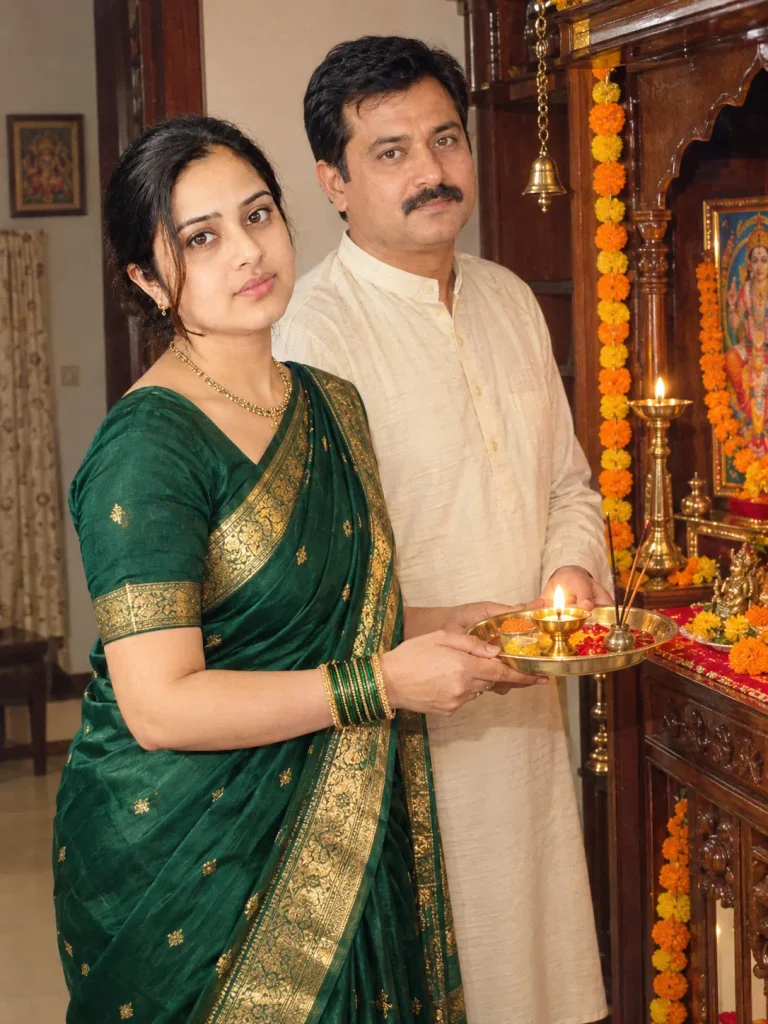
Restore this faded family photograph of a couple in their early 40s performing Navratri aarti at a home mandir. Preserve both identities exactly: faces, expressions, age lines, hairstyles and the man's moustache. Do not de-age or retouch their skin.

Fix fading, yellowing, cracks, a vertical fold line and water stains. Recover sharpness in the emerald green silk saree with its gold border, the cream kurta, the brass aarti thali and the diya flame. Rebuild the damaged corners of the mandir background naturally.

Colourise with historically accurate 1980s tones: deep green, gold, warm flame light on the faces and red-orange marigolds. Keep contrast soft and realistic. Output a clean, archival-quality, high-resolution restoration.
3. Age 50: Dandiya Night with Friends, 1990s Colour Print
Outfit: royal blue bandhani saree with an orange border, and a mustard kurta with a white dhoti. Pose: a small group posing mid-dandiya, sticks crossed. Location: a decorated club lawn at night.
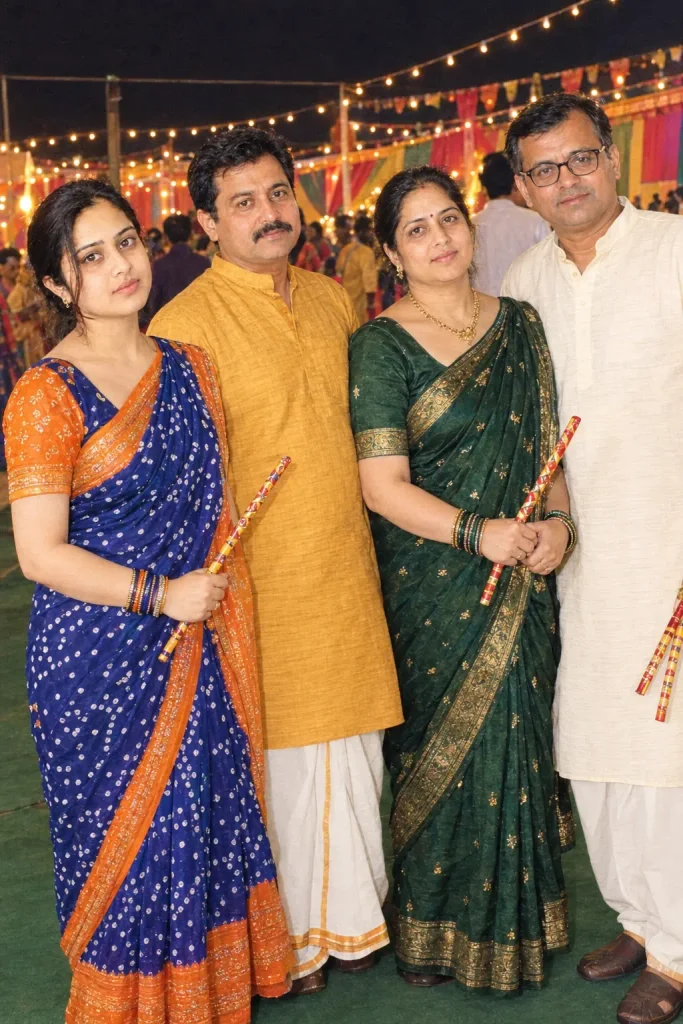
Restore this old colour print of a group of friends in their early 50s at a dandiya night. Preserve every person's identity exactly: faces, expressions, grey streaks in hair, natural wrinkles and body proportions. Do not alter or beautify anyone.

Remove scratches, dust, colour cast, fading and magenta shift typical of old prints. Repair a torn top-right corner by rebuilding the background conservatively. Restore the royal blue bandhani saree with orange border, the mustard kurta and white dhoti, and the crossed dandiya sticks.

Correct colours to look natural for a 1990s film print, keeping warm festive lighting and string lights. Improve sharpness, reduce grain without erasing it completely, and produce a high-resolution archival-quality photograph.
4. Age 60: Kanya Pujan or Garba Morning, 1970s Black and White
Outfit: plain white cotton saree with a thin red border, and a man in a white kurta-pyjama with a Gandhi cap. Pose: seated on a charpai or low stool in a courtyard, hands folded. Location: a village courtyard with a clay kalash and rangoli.
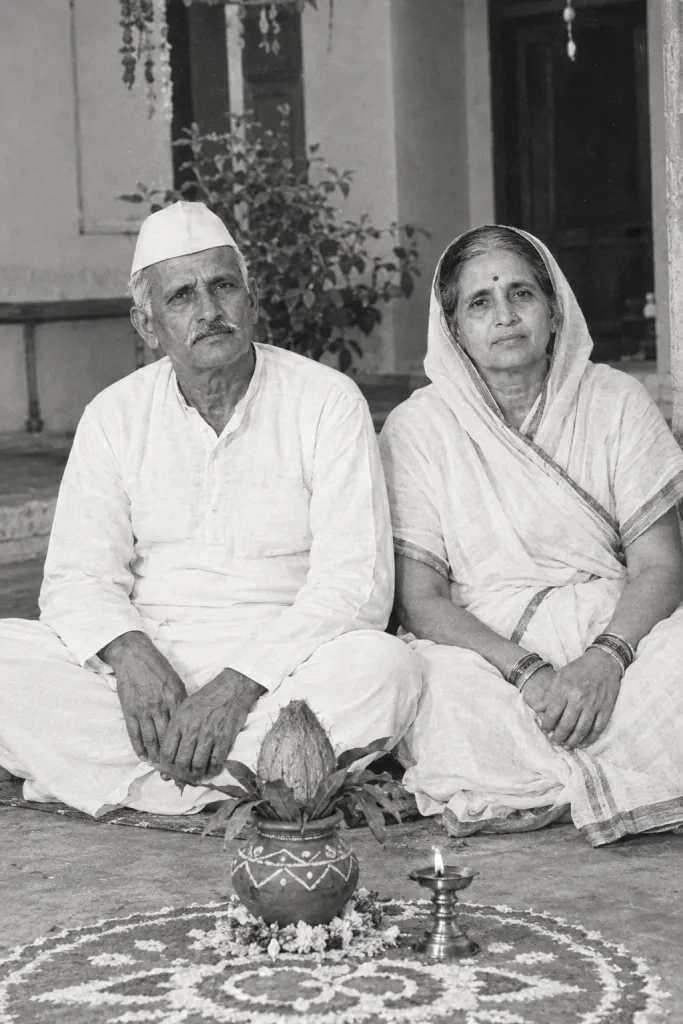
Restore this old black and white photograph of a couple in their 60s seated in a courtyard during Navratri, with a clay kalash and rangoli beside them. Preserve their identities exactly: faces, deep age lines, grey hair, the man's cap and the woman's calm expression. Do not remove wrinkles or smooth the skin.

Repair scratches, tears, white specks, fading, silvering and uneven exposure. Recover fabric texture in the white cotton saree with its thin border and the kurta-pyjama. Rebuild missing background areas with natural, minimal reconstruction.

Keep the photograph black and white, with rich but natural tonal range and improved contrast. Do not colourise. Enhance resolution and sharpness for an archival-quality restoration that still looks like a genuine 1970s print.
5. Age 70: Grandparents at the Pandal, 1960s Sepia Studio-Style Portrait
Outfit: a deep maroon silk saree with a temple border, and a man in a cream silk kurta with a shawl. Pose: seated portrait, the woman’s hand resting on the man’s shoulder. Location: in front of a painted studio backdrop with a Durga image and flowers.
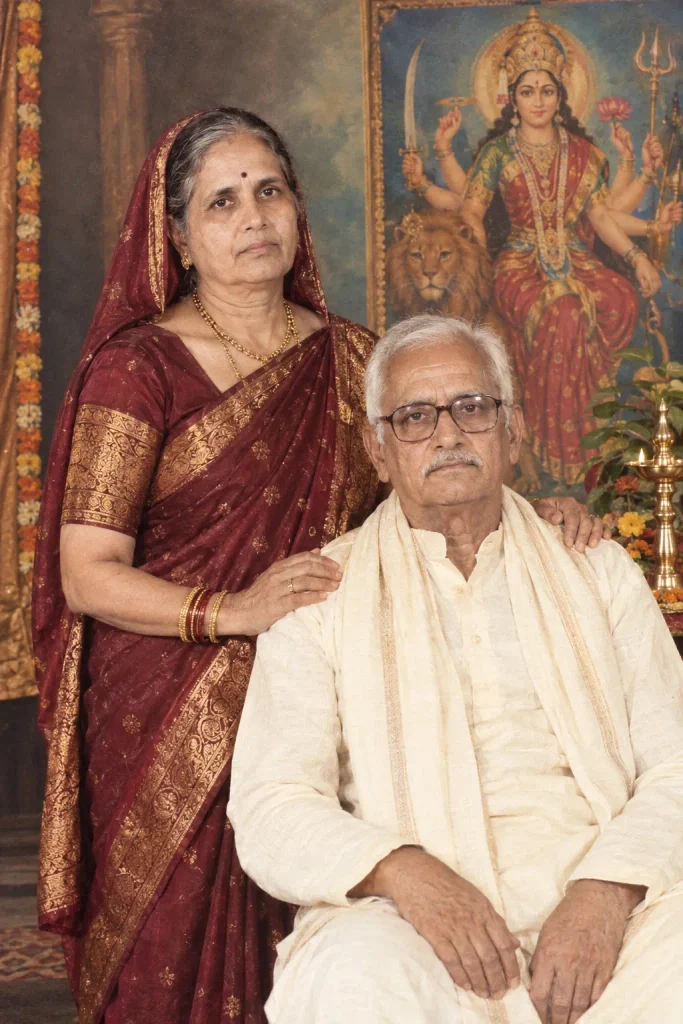
Restore this very old sepia portrait of an elderly couple in their 70s posed before a painted studio backdrop with a Durga image and flowers, taken during Navratri. Preserve their identities exactly: faces, age spots, deep lines, white hair, the man's glasses and their serious, dignified expressions. Do not de-age, smooth or add expression.

Repair heavy cracks, tears, stains, mould spots, faded areas and missing corners. Recover detail in the maroon silk saree with temple border, the cream silk kurta and shawl, the jewellery and the painted backdrop. Reconstruct only what is clearly implied by the surrounding image.

Optionally colourise with historically accurate 1960s tones: deep maroon, cream, gold and muted backdrop colours, keeping skin tones natural and subdued. If colourisation looks unnatural, keep the original sepia. Output a high-resolution, archival-quality restoration.
Tips for a better restoration
- Scan or photograph the old print well. Use even light, no glare, and the highest resolution you can. A flat, sharp scan restores far better than a tilted phone shot.
- Be honest about the 8K request. Models can upscale to very large sizes, but they add detail by guessing. If the face looks “too perfect” at high resolution, ask for a more conservative upscale.
- Name the damage you can see. Tears, fold lines, stains and fading each need different repair, so list them.
- Always say what must not change. Wrinkles, grey hair, glasses, moustache and expression are the things AI most often “fixes” by mistake.
- Check the face against the original. If the restored face looks like a different, younger person, rerun with “preserve exact facial structure and age, do not smooth or de-age.”
- Be careful with colourisation. Colours are guessed, not recovered. Ask family members what the saree or kurta actually looked like, and put that in the prompt.
- Compare Gemini and ChatGPT. Identity fidelity on damaged faces differs between them, so run the same prompt on both and keep the more faithful result.
I can also write a set for restoring Navratri photos of children and young couples, or a version that adds a gentle “colourise only” prompt for black and white family albums.