
Advertisement
A detailed head-to-head between India’s two best-selling electric scooters — range, charging, storage, build quality, warranty and running cost, with a clear verdict for each type of buyer
If you have narrowed your electric scooter search down to two names, there is a good chance they are these two.
Advertisement
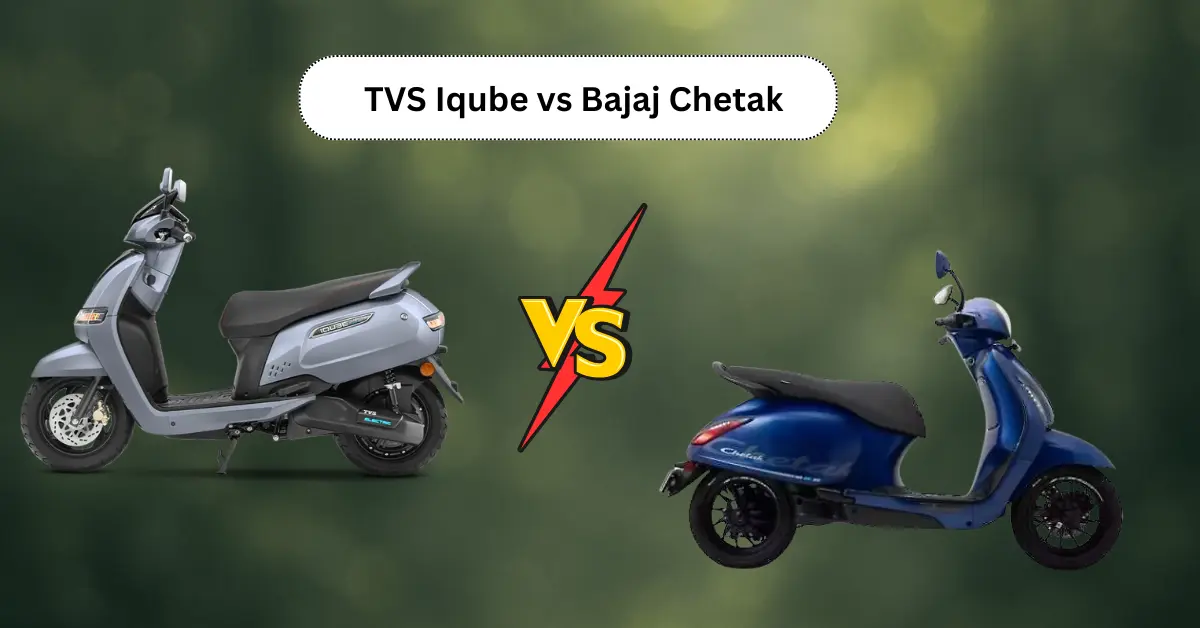
The TVS iQube and the Bajaj Chetak are the segment’s establishment candidates. Both come from manufacturers who have sold two-wheelers in India for decades, both target the buyer stepping up from a 110cc or 125cc petrol scooter, and both sit in roughly the same price band. On a specification sheet they look almost interchangeable.
They are not. They were designed around genuinely different priorities, and the right answer depends on facts about your life rather than facts about the scooters.
Here is the full comparison, followed by a verdict for each type of buyer.
A note on prices before we start
Both scooters are sold in several variants at overlapping price points, and quoted prices differ meaningfully between sources, cities and months.
Broadly, at the time of writing:
- The Chetak starts lower — entry variants have been quoted from around ₹96,500 — and extends to roughly ₹1.57 lakh at the top of the range
- The iQube typically starts around ₹1.13–1.16 lakh and runs to roughly ₹1.40 lakh for the 3.5 kWh variant
At the directly comparable 3.5 kWh level, the two land within a few thousand rupees of each other — close enough that price should not decide this.
All figures here are approximate ex-showroom prices. What you actually pay includes road tax, registration and insurance. Get a written on-road quotation for the specific variant before comparing anything.
Range: the Chetak leads, but read the fine print
This is where the specification sheets diverge most visibly.
| TVS iQube | Bajaj Chetak | |
|---|---|---|
| Base variant claimed range | ~94 km | ~127 km |
| 3.5 kWh variant claimed range | ~145 km | ~153 km |
At the entry level the Chetak’s advantage is substantial — a claimed 127 km against roughly 94 km is not a rounding difference. At the 3.5 kWh level the gap narrows to something closer to a tie.
But apply the standard discount. Certified range figures come from controlled testing: steady speed, one rider, moderate temperature, no traffic. Real-world range on either scooter typically lands 20–30% lower, and worse with a pillion or in summer heat.
So a claimed 94 km realistically means somewhere around 65–75 km. A claimed 153 km means roughly 105–120 km. Owner reports on the iQube 3.5 kWh commonly describe achieving figures in the 110–115 km region in mixed riding, which sits about where you would expect.
What this means practically: if your daily round trip is under 40 km, both scooters clear it comfortably in any variant, and range should not drive your decision. If you are doing 60–80 km a day, buy the larger battery variant of either — do not try to make a base variant work.
Performance: the iQube is the quicker scooter
The iQube’s 4.4 kW motor is the stronger unit. On higher variants it covers 0–40 km/h in roughly 4.2 seconds and tops out around 82 km/h.
The Chetak is tuned differently — smoother and more linear rather than urgent. It gets away from traffic lights perfectly adequately, but it does not have the iQube’s shove.
Whether this matters depends entirely on how you ride. In dense city traffic, quick acceleration from a standstill is genuinely useful for slotting into gaps safely. On a calm commute along a straight road, you will never notice the difference.
Advantage: iQube, if you value responsiveness. Neutral otherwise.
Build quality: the Chetak’s decisive argument
The Chetak has a metal body. The iQube uses high-grade plastic panels.
In a market obsessed with touchscreen sizes, this is the specification that will still matter to you in year five.
Consider how scooters actually live in India. They are parked in crowded lots where other vehicles brush past them. They get knocked over. They sit outdoors in the sun. Plastic panels crack on impact and must be replaced as whole units. Metal dents, and a dent can often be worked out at modest cost.
Over a long ownership period, the metal body affects your repair bills and the scooter’s appearance at resale. The Chetak’s finish also holds up visibly better against years of sun exposure.
The iQube’s build is not poor — TVS uses good-quality plastics and panel fit is solid. But this is a category the Chetak wins outright.
Advantage: Chetak, and it is the strongest single argument in its favour.
Storage: the iQube wins on volume
The iQube offers a 32-litre under-seat compartment, large enough to take two half-face helmets. That is class-leading and genuinely useful — it means you can leave helmets with the scooter instead of carrying them.
The Chetak offers less under-seat space, though it counters with a front glove box that is convenient for a phone, wallet or documents.
If your scooter regularly carries shopping, a laptop bag, or two helmets, the iQube’s larger boot is worth real money to you. If you mainly need somewhere to put small items within reach, the Chetak’s glove box arrangement may suit you better.
Advantage: iQube on outright volume.
Charging: close, with the Chetak slightly ahead
Both scooters charge from a standard home socket, and both take meaningfully longer on base variants than on higher ones.
The Chetak 3501 reaches roughly 80% in about three hours. The iQube’s high-spec variants reach 0–80% in around three hours using the 1.5 kW portable charger, but slower variants take considerably longer.
Charging speed is the most common complaint in iQube owner feedback — not that it fails, but that it takes longer than expected. If your usage pattern involves topping up during the day rather than charging overnight, ask specifically about charging times for the exact variant you are considering.
Advantage: Chetak, narrowly, and mainly at the entry level.
Technology: the iQube is the more connected scooter
Higher iQube variants carry a 7-inch TFT touchscreen with an extensive connected feature set and voice assistant integration. It is the more impressive dashboard, and for buyers who enjoy that, it delivers.
The Chetak’s instrumentation is cleaner and simpler. Depending on your temperament that is either a shortfall or a relief.
Be honest with yourself here. Connected features are heavily marketed and lightly used. Most owners settle into using the speedometer, the battery indicator and perhaps navigation. Before paying a premium for a larger screen, ask which features you will actually open twice a week.
Advantage: iQube on capability, though its practical value varies by buyer.
Battery chemistry and warranty
Both scooters use NMC (Nickel Manganese Cobalt) cells. This gives good energy density — more range from a lighter pack — but NMC begins experiencing thermal stress above roughly 40°C and typically manages 1,000 to 2,000 charge cycles.
This is worth understanding if you live somewhere that crosses 40°C for months. Across large parts of northern and western India, summer temperatures routinely exceed that threshold, and heat is what ages a battery fastest. Neither of these scooters uses the more heat-tolerant LFP chemistry that some rivals offer.
Both manufacturers typically warrant the battery for around three years or 50,000 km. Some LFP-based competitors offer longer — five years or 75,000 km is available in the market.
Two things to do at the dealership:
- Read the actual warranty document. A warranty covering only total failure is much weaker than one guaranteeing minimum capacity retention.
- If you park outdoors in a hot region, consider whether shade is available. Parking in direct summer sun daily will shorten battery life on either scooter.
Advantage: neutral. Both are equivalent here, and both are beaten by LFP-based rivals on longevity.
Service and after-sales
Both brands have deep, long-established dealer networks built over decades of petrol two-wheeler sales. This is their shared advantage over newer entrants, and it is a large one.
TVS has been the volume leader in electric two-wheelers, crossing 34,000 units in a single month in early 2026. Higher volume generally means better parts availability and technicians with more hands-on familiarity with the specific model.
Bajaj’s network is comparably deep, and the Chetak name carries particular weight with buyers who have never owned an EV.
Advantage: roughly even. Check which brand has a closer service point to your home — that specific fact matters more than any national comparison.
Running cost
Both are inexpensive to run, and the difference between them is negligible.
Charging either scooter at typical Indian residential electricity tariffs works out to somewhere in the region of ₹0.25–0.40 per kilometre depending on model efficiency and your local tariff. A comparable 110cc petrol scooter runs closer to ₹2.30 per kilometre.
At 30 km a day, that is a difference of roughly ₹1,700–1,800 a month.
Servicing is also cheaper on both — no oil changes, no spark plugs, no clutch — though electric scooters are not maintenance-free. Brakes, tyres, suspension and software updates still need attention.
Advantage: neutral.
The verdict
Neither scooter is better in general. Each is better for a specific buyer.
Buy the Bajaj Chetak if:
- You intend to keep the scooter five years or more. The metal body’s advantage compounds over time.
- You park in a crowded space where knocks and scrapes are routine.
- You want the longer claimed range at entry level — this is the Chetak’s clearest specification win.
- You prefer simple instrumentation over a large touchscreen.
- Resale value matters to you. Metal panels and a strong brand name both help here.
Buy the TVS iQube if:
- You want the quicker, more responsive scooter for dense traffic.
- You need maximum under-seat storage — two helmets, shopping, a laptop bag.
- You will genuinely use connected features and the larger display.
- TVS has the closer service point to your home.
- You charge overnight at home, so slower charging never inconveniences you.
Consider neither if:
- You cannot charge where you park. Both have fixed batteries. Look at removable-battery models instead.
- You live somewhere very hot and park outdoors permanently. Both use NMC chemistry. An LFP-based scooter with a longer battery warranty is the more sensible choice.
- Your daily distance is under 15 km. At that usage the fuel savings take a long time to repay the higher purchase price. Run the numbers before committing.
Frequently asked questions
Which is cheaper, the iQube or the Chetak?
The Chetak’s entry variant is typically cheaper, with quotes from around ₹96,500 against roughly ₹1.13 lakh for the iQube. At the comparable 3.5 kWh level the two are within a few thousand rupees of each other. Compare on-road prices for the same battery capacity, not headline starting prices.
Which has better range?
The Chetak leads at entry level with roughly 127 km claimed against about 94 km for the base iQube. At 3.5 kWh the gap narrows considerably — around 153 km against 145 km. Expect real-world figures roughly 20–30% below all of these.
Which is better built?
The Chetak, because of its metal body. This is its strongest advantage and it matters most over long ownership and in crowded parking.
Which has more storage?
The iQube, with a 32-litre under-seat compartment that fits two half-face helmets. The Chetak offers less under-seat volume but adds a front glove box.
Which charges faster?
The Chetak has a slight edge, reaching about 80% in roughly three hours on the 3501. Higher iQube variants are comparable, but lower iQube variants are slower — and charging time is the most frequent complaint in iQube owner feedback.
Do either qualify for the government subsidy?
Variants priced up to ₹1.5 lakh ex-factory qualify under PM E-DRIVE, at ₹2,500 per kWh capped at ₹5,000. The terminal date for electric two-wheelers is 31 July 2026 and the scheme is fund-limited. Confirm current status and eligibility for the specific variant with the dealer.
Which holds resale value better?
Too early for definitive data on either, as the electric resale market is still maturing. Available industry estimates suggest electric two-wheelers currently retain somewhat less value than comparable petrol scooters. The Chetak’s metal body and brand recognition are reasonable arguments in its favour, but treat any resale projection as an estimate.
Prices, specifications and range figures in this article are approximate and were accurate at the time of writing. They vary by variant, city and state and change frequently. This article is general information for prospective buyers and not a recommendation to purchase any specific product. Verify current details with an authorised dealer before purchase.
Sources: manufacturer specifications, published dealer pricing, industry sales data and aggregated owner feedback, as of July 2026.