
Advertisement
The Gearbox That Could Change How You Drive Forever
There is a very specific kind of frustration that every Indian car buyer knows. You are stuck in peak-hour traffic. The car ahead inches forward. You creep up. It stops. You stop. The automatic jerks. The engine hunts. The gearbox hesitates. And somewhere between your third near-miss and your fifth involuntary brake, you think — there has to be a better way.
The Kia Seltos IVT is Kia’s answer to that very thought.
Advertisement
Not the most powerful Seltos. Not the most talked-about. But arguably the most sensible, the most liveable, and the one that rewards patient, everyday drivers in ways that numbers on a spec sheet simply cannot capture.
I have spent extensive time behind the wheel of the Kia Seltos fitted with the Intelligent Variable Transmission — what engineers call an IVT and what the rest of the world typically knows as a CVT — and I am here to tell you something that most reviews will not. This gearbox, paired with the 1.5-litre naturally aspirated petrol engine, creates a driving experience that is genuinely addictive in the most calm, unhurried, composed way possible.
Is the Kia Seltos IVT the right car for you? That depends entirely on who you are as a driver. And by the end of this review, you will know the answer with complete certainty.
Let us begin.
Quick Overview: What Exactly Is the Seltos IVT
The Kia Seltos needs no introduction in the Indian market. Since its launch, it has consistently ranked among the top-selling SUVs in the country, and for good reason. It brought premium design, feature-rich interiors, and genuine road presence to a price bracket that was previously dominated by more utilitarian offerings.
The IVT variant sits within the Seltos lineup as the smooth-talking, efficiency-focused member of the family. It pairs Kia’s 1.5-litre naturally aspirated petrol engine — producing 115 PS and 144 Nm of torque — with an Intelligent Variable Transmission that uses a belt-and-pulley system to deliver seamless, continuous power without the interruption of conventional gear shifts.
The “Intelligent” part of the name refers to the adaptive transmission logic that learns driving behaviour over time and adjusts shift patterns accordingly. It also simulates stepped gear changes during acceleration, which addresses one of the most common criticisms levelled at CVT gearboxes — that disconnected, rubbery sensation at higher revs where the engine drones while the car picks up speed.
This is not the turbocharged Seltos with the DCT gearbox that enthusiasts want to talk about. This is a different kind of car altogether — one built for real-world Indian roads, real-world Indian traffic, and real-world Indian buyers who just want their daily commute to feel effortless.
And at that specific job, it is remarkably, impressively good.
Exterior Design: Confident, Premium, and Still Turning Heads
Step back from the Kia Seltos and appreciate what you are looking at. This is a genuinely good-looking SUV. Not in an aggressive, try-hard way. In a confident, well-proportioned, this-car-knows-what-it-is kind of way.
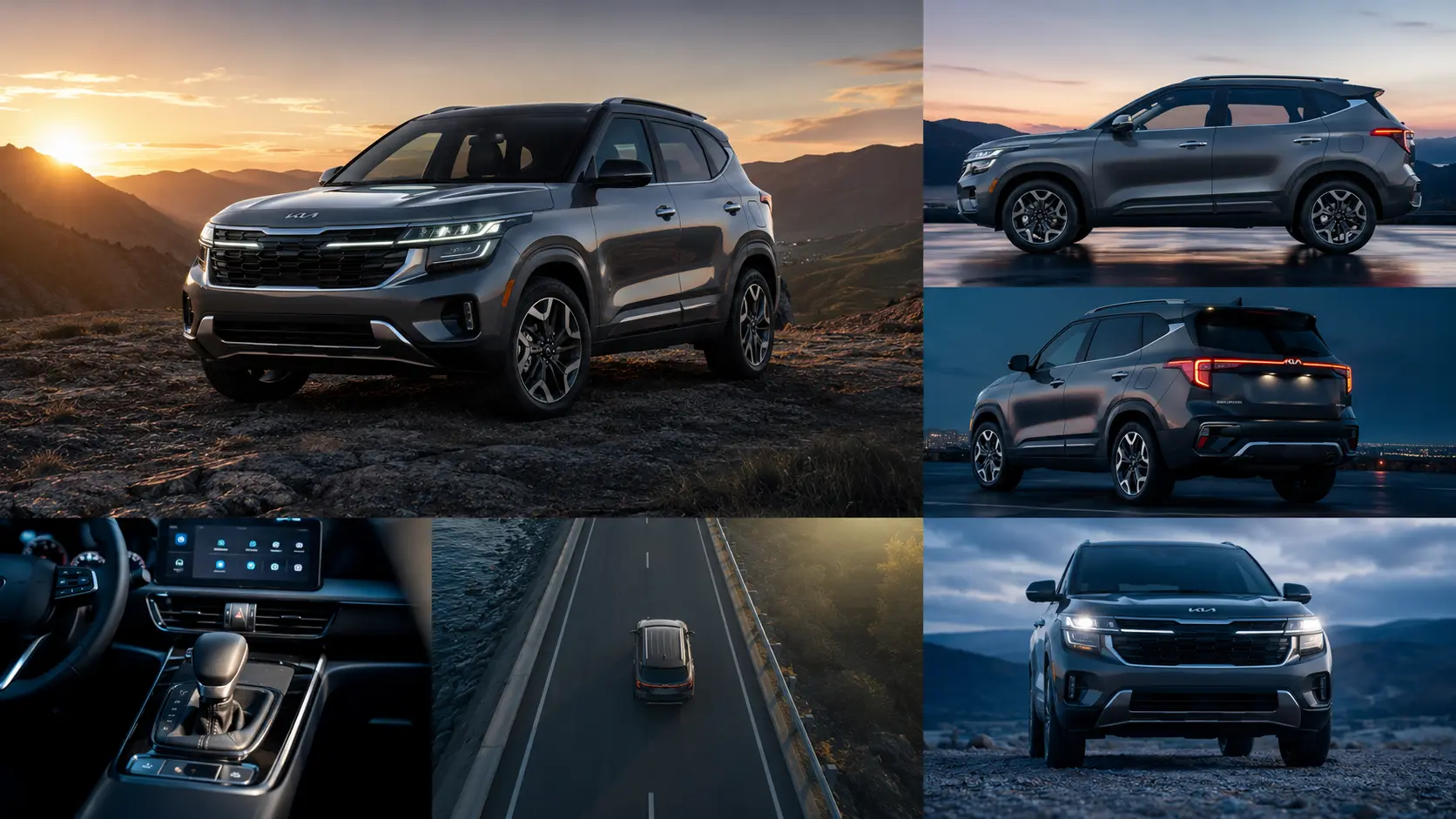
The front fascia leads with Kia’s signature tiger-nose grille, wide and authoritative, framed by a split lighting setup that has become a design identity marker for the brand. The slender LED daytime running lights sit high, while the main headlight clusters occupy the lower bumper section. It gives the Seltos a distinctive face — recognisable from a distance, distinctive in a car park.
The hood carries subtle but effective sculpting that hints at purpose without overdoing athleticism. The shoulder line running from front to rear is clean and taut. The 17-inch alloy wheels on higher variants fill the arches with presence. Ground clearance sits at a practical 190mm — enough for the realities of Indian road conditions without venturing into off-road territory.
The rear is where the design finds its most memorable moment. The connected LED tail lamps sweep across the tailgate in a single illuminated band, giving the Seltos a wide, premium look that genuinely punches above its price point. This is a design detail that costs significantly more on European cars. Here, you get it in a vehicle that starts well under twenty lakhs.
In colour terms, Gravity Grey and Imperial Blue are the standouts. Both interact beautifully with the Seltos’s body creases in natural light. The Intense Red is popular too, though it can look busy on a car with this many design elements.
One minor critique worth noting: the rear bumper treatment feels slightly conservative compared to the sharp front end. It is a small inconsistency in an otherwise cohesive design. On balance, this is a car that looks like it should cost more than it does — which is exactly what you want from a product in this segment.
Interior Design and Comfort: The Cabin That Wins Buyers Over
Open the door of the Seltos and the interior makes an immediate impression. It is clean, modern, and layered with just enough premium detailing to feel like a deliberate upgrade over what the price suggests.
The dashboard is anchored by a 10.25-inch touchscreen infotainment display, angled subtly toward the driver — a small ergonomic decision that signals thoughtful design. The instrument cluster is fully digital on top variants, offering clear readouts in a customisable layout. The physical controls for climate are thankfully retained as proper dials and buttons rather than buried in touchscreen menus, which is a choice that earns real-world praise from people who drive this car daily.
Material quality is honest in that way that good cars at this price point tend to be. The dashboard top surface and door pad uppers are soft-touch and premium to the touch. The lower cabin areas use harder plastics, which is entirely expected but worth acknowledging. The dual-tone interior finish — black with beige accents on certain trims — keeps the cabin feeling airy rather than cave-like.
Front seat comfort is a genuine strength of the Seltos. The seats are well-bolstered, supportive through corners, and correctly profiled for long-distance driving. The driver’s seat height adjustment gives you a commanding view of the road. For a vehicle that will spend significant time on expressways between cities, this is not a minor point — it is the difference between arriving refreshed and arriving with a sore back.
Rear seat accommodation is genuinely generous. Legroom is class-competitive, and three adults can coexist in the back without resentment. The squab angle is correct — supportive without being so upright that it becomes uncomfortable after an hour. Rear AC vents and a USB charging port are present where you need them.
The panoramic sunroof — available on HTX and above — is one of those features that photographs well but also transforms how the cabin feels in practice. On a cool morning with the shade retracted, the Seltos cabin fills with light and feels two segments above its actual position in the market.
Boot space at 433 litres is practical and class-appropriate. A family of four with a weekend’s worth of luggage will have no complaints.
Engine and IVT Performance: Where the Real Story Lives
Here is where I want your complete attention, because the IVT transmission is the central character of this entire review — and it deserves more than a paragraph.
The 1.5-litre naturally aspirated petrol engine is a unit that rewards patience rather than aggression. With 115 PS and 144 Nm on offer, it is not going to win any stoplight drag races against the turbocharged competition. But that is not what it was designed to do. This engine was engineered for refinement, for longevity, and for harmony with a transmission that prioritises smoothness above all else.
In city driving, the IVT is, without exaggeration, a revelation.
Press the accelerator gently from a traffic standstill and power builds in a linear, seamless, almost meditative way. There are no gear hunting issues. No hesitation while the transmission decides what ratio to select. No jerk as it upshifts. You simply press and the car moves — fluidly, quietly, progressively.
In traffic conditions where you are covering a kilometre in ten minutes, this smoothness is not merely comfortable. It is genuinely stress-reducing. The physical and mental cost of driving in dense Indian urban traffic is real, and the IVT removes one significant source of that friction entirely.
On the expressway, the IVT’s behaviour becomes more nuanced. Kia has programmed the transmission to simulate stepped gear changes during acceleration, which partially addresses the drone-and-surge criticism that has dogged CVT gearboxes for years. When you accelerate to overtake on a highway, the IVT creates a stepped sensation — it holds a ratio, builds speed, and then shifts to the next simulated step. It is not identical to a traditional automatic. An experienced driver will still recognise the CVT character. But it is meaningfully better than the CVT implementations you will find on several competitors, and the improvement makes highway driving feel more purposeful and less detached.
But here is the catch — and I always give you the catch.
The Seltos IVT does not like being pushed hard. Ask it for full-throttle acceleration — say, to merge onto a fast highway — and the engine note rises in that characteristic CVT way, climbing quickly in pitch before the car eventually picks up meaningful speed. The 1.5 NA engine simply does not have the low-end torque to make this feel effortless. It is adequate. It is not inspiring.
This is where the Drive Mode selector becomes your best tool. In Eco mode, throttle response is deliberately softened. The IVT pushes for maximum fuel efficiency at the cost of responsiveness. This is the right mode for crawling through Bengaluru traffic or navigating Delhi’s ring roads at 40 kmph. In Normal mode, response sharpens to a natural, well-balanced calibration that suits most situations. Sport mode tightens throttle response further, holds the simulated gear steps longer before shifting, and gives the car a noticeably more eager character when you need to get somewhere in a hurry.
Sport mode does not transform the Seltos IVT into a sports car. But it does make it feel noticeably more alive — which, given the car’s fundamental character, is the most useful version of itself for occasional spirited driving.
The paddle shifters on select variants add a layer of driver involvement that the IVT would otherwise lack entirely. They allow you to hold a simulated ratio manually, which is genuinely useful for engine braking on a gradient or holding speed on a winding section. It is a thoughtful addition.
Mileage and Fuel Efficiency: The Numbers That Actually Matter in India
In India, fuel efficiency is not just a number on a spec sheet. It is a monthly budget line. So let us talk about what the Seltos IVT actually delivers in the real world.
Kia’s ARAI-certified figure stands at approximately 16.5 kmpl for the 1.5 NA Petrol IVT. ARAI figures and real-world figures have always had a complicated relationship in India, so here is what you can realistically expect:
In pure city traffic with AC running and frequent stop-go: 11 to 13 kmpl. The Eco mode helps stretch this toward the upper end of that range, and the IVT’s smooth power delivery means less energy waste compared to a traditional automatic hunting between gears.
On the highway at steady cruising speeds between 80 and 100 kmph: 17 to 18 kmpl. This is where the IVT genuinely shines. The ability to keep the engine spinning at its most efficient RPM without the interruptions of gear changes pays off in significant fuel savings over a long drive.
In mixed driving — the daily reality of most Indian car owners who commute in the city and occasionally take highway trips: 14 to 15 kmpl is a realistic expectation.
The 50-litre fuel tank gives you a practical range of 650 to 750 km on a full fill in mixed conditions. For most owners, this means a refuel approximately every ten to fourteen days depending on daily commute distance.
Over five years of ownership, choosing the IVT over the turbocharged DCT variant — which is more powerful but less efficient — can result in meaningful fuel savings. If you are the kind of buyer who calculates the total cost of ownership rather than just the sticker price, the IVT makes a compelling financial argument.
Features and Technology: Where the Seltos Earns Its Premium Badge
The Seltos has always been a feature-forward product, and the IVT variants carry that tradition confidently.
The 10.25-inch Kia Connect infotainment system is one of the better touchscreen implementations in the segment. It is quick to respond, logically laid out, and supports wireless Android Auto and Apple CarPlay — which means your phone connects automatically the moment you get in. The Kia Connect suite adds connected car features including remote engine start, real-time vehicle location tracking, geofencing alerts, and over-the-air update capability. These are features that matter in everyday life, not just on launch day.
The Bose 8-speaker premium audio system available on top variants is genuinely impressive for a car at this price point. Bass response is rich, clarity at higher volumes holds up without distortion, and it elevates the cabin experience in a way that audiophile owners will notice immediately. For long road trips, good audio is not a luxury. It is quality of life.
The colour heads-up display that projects speed and navigation cues onto the windshield is a feature that sounds gimmicky until you use it for a week. After that, you will miss it in every car that does not have it. Keeping your eyes on the road while still monitoring your speed is a genuine safety benefit, not just a marketing talking point.
The 360-degree surround view camera system on higher trims deserves specific praise. Image quality is clean and sharp, and the multiple viewing angles — front, rear, top-down, side — make navigating tight parking lots, narrow lanes, and reversing in confined spaces significantly less stressful. In Indian urban environments where parking space is genuinely scarce and other cars’ opinions of gap-sizing can be optimistic, this camera system earns its existence every single day.
Dual-zone automatic climate control on higher trims allows driver and front passenger to maintain different temperatures independently. It is the kind of feature whose value becomes apparent when the person next to you runs hot and you run cold — which in most Indian households and offices is a remarkably common situation.
Ventilated front seats on the GTX Plus variant are not a luxury in Indian summers. They are a necessity. The Seltos delivers them.
Safety Features: The Area Where Kia Does Not Cut Corners
Safety deserves more than a checkbox in any automotive review. Let me give it the space it earns.
The Seltos comes with six airbags as standard fitment across all variants — driver, co-driver, side, and curtain airbags. This meets and complies with the mandatory regulation that came into force in India, but Kia’s approach goes beyond baseline compliance.
Electronic Stability Control, Hill Start Assist, Vehicle Stability Management, and Downhill Brake Control are all present. These systems operate silently and invisibly under normal conditions, revealing their value only in moments of genuine need — a panic stop on a wet road, a sudden swerve to avoid an obstacle, a hill departure on a steep gradient. You will never know they saved you. You will just arrive safely.
On the Advanced Driver Assistance front, the Seltos offers Lane Keep Assist and Forward Collision Warning on higher trims. These ADAS features are not as comprehensive as what you would encounter on a European luxury SUV. But in the context of the segment and the price, their presence matters. Lane Keep Assist on a long highway drive provides a gentle, reassuring intervention when you drift without signalling. Forward Collision Warning adds an active layer of protection at higher speeds where reaction times are compressed.
The Blind Spot Collision Warning is practically valuable in Indian traffic conditions, where lane discipline operates on a spectrum. Knowing that a faster vehicle is approaching your blind spot as you plan a lane change is information that can prevent accidents. Not theoretical future accidents. Actual everyday close calls.
The Seltos scored well in safety assessments, and that performance reflects in how the structure feels — solid, planted, and reassuring in a way that inspires confidence at highway speeds.
Ride Quality and Real-World Driving Experience: The Full Picture
A car review that does not address ride quality is incomplete. Let me give you the honest assessment.
The Seltos rides on a suspension setup that prioritises comfort without completely sacrificing body control. In city conditions, it handles broken patches, speed bumps, and the occasional pothole with composure. The suspension absorbs sharp impacts with a softness that makes urban driving noticeably more pleasant than in some of its more firmly-tuned competitors.
At highway speeds, the ride is settled and stable. There is no float, no wander, and directional stability at 110 to 120 kmph is confidence-inspiring. Wind and road noise are well suppressed — the Seltos cabin remains genuinely quiet at highway speeds, which makes a meaningful difference over a long journey.
The steering is well-weighted in its default setting — light enough for city manoeuvring, with enough weight at speed to feel planted and secure. It is not communicative in the way that a performance-oriented car’s steering is. But that was never the intention here.
Where the Seltos IVT most impresses is in the sum of the experience. The smooth transmission, the refined engine, the composed ride, the quiet cabin, the supportive seats — they add up to a driving experience that is not exciting in the traditional sense but is deeply, sustainably comfortable. This is a car you can drive for three hours on a motorway and arrive feeling relaxed. That is a form of excellence that does not show up in acceleration timers but matters enormously in real life.
If you are planning to use this car for daily commuting and regular family trips, here is what you must know: the IVT’s character is perfectly aligned with those use cases. It does not demand skilled driving. It does not punish you for being relaxed. It simply works, day after day, without drama or complaint.
Variant and Pricing: Which One Makes the Most Sense
Here is the current pricing structure for the Kia Seltos 1.5 Petrol IVT range (ex-showroom, approximate):
| Variant | Transmission | Approx. Ex-Showroom Price |
|---|---|---|
| HTK Plus IVT | 1.5 NA Petrol IVT | Rs. 15.50 lakh |
| HTX IVT | 1.5 NA Petrol IVT | Rs. 16.85 lakh |
| HTX Plus IVT | 1.5 NA Petrol IVT | Rs. 18.40 lakh |
| GTX Plus IVT | 1.5 NA Petrol IVT | Rs. 19.65 lakh |
| X Line IVT | 1.5 NA Petrol IVT | Rs. 20.20 lakh |
Always factor in on-road pricing, which adds registration, insurance, and dealer handling charges that can push the total cost significantly higher depending on your state.
My recommendation without hesitation: the HTX Plus IVT. It delivers the panoramic sunroof, the 360-degree camera, the Kia Connect suite, the Bose audio system, and most of the features that make daily ownership genuinely enjoyable. The jump to GTX Plus adds ventilated seats — worthwhile in hotter climates — and a few additional ADAS features. If you live somewhere with genuinely punishing summers, the ventilated seat upgrade is worth the price difference.
The HTK Plus is the entry point and represents fair value if your budget is firm. But the absence of the sunroof and the 360-camera will be felt regularly.
Competitor Comparison: How Does the Seltos IVT Stand Against Its Rivals
The mid-size SUV segment in India is fiercely contested. Here is how the Seltos IVT stacks up against the cars it competes with every day:
| Feature | Kia Seltos IVT | Hyundai Creta CVT | Maruti Grand Vitara AT | Honda Elevate CVT |
|---|---|---|---|---|
| Engine | 1.5L NA Petrol | 1.5L NA Petrol | 1.5L NA Petrol | 1.5L NA Petrol |
| Power | 115 PS | 115 PS | 103 PS | 121 PS |
| Claimed Efficiency | 16.5 kmpl | 16.8 kmpl | 19.4 kmpl | 16.9 kmpl |
| Panoramic Sunroof | Yes | Yes | Yes | No |
| 360-degree Camera | Yes | Yes | No | Yes |
| ADAS Features | Yes (select trims) | Yes (select trims) | No | No |
| Boot Space | 433 litres | 433 litres | 373 litres | 458 litres |
| Premium Audio | Bose 8-speaker | Bose 8-speaker | Arkamys | None |
| Ventilated Seats | Yes (GTX Plus+) | Yes (top trims) | No | No |
| Connected Car Tech | Kia Connect | Bluelink | Suzuki Connect | Honda Connect |
The Creta CVT is the Seltos IVT’s closest rival — they share the same mechanical DNA and their feature lists overlap significantly. The Seltos edges ahead on interior design distinctiveness and exterior presence. Which one you choose in this pairing often comes down to brand loyalty and which dealership gives you the better deal.
The Grand Vitara’s mild-hybrid variant offers class-leading efficiency that neither the Seltos nor the Creta can match on paper. If maximum fuel economy is your overriding priority, it demands a serious look. The Elevate brings a slightly more powerful engine and the largest boot in the class, but misses the sunroof on most variants and lacks ADAS features entirely.
The Seltos IVT’s strongest competitive position is as the all-round package — design, features, transmission refinement, and ride quality working together in a cohesive whole. No single competitor beats it across all those dimensions simultaneously.
Pros and Cons: The Unfiltered Assessment
Pros:
- The IVT is genuinely among the smoothest transmission experiences in this segment at any price
- Refined 1.5 NA petrol engine is quiet, relaxed, and easy to live with over years of ownership
- Feature list is comprehensive and includes items typically found on significantly more expensive vehicles
- Exterior and interior design is premium, distinctive, and holds up well over time
- Real-world highway fuel efficiency of 17 to 18 kmpl is strong for a petrol SUV of this size
- Six airbags standard across all variants with additional ADAS on higher trims
- Kia Connect infotainment is quick, well-executed, and genuinely useful
- Comfortable seats for both short city commutes and extended highway driving
- Quiet cabin at speed, reducing fatigue on long journeys
- Excellent 360-degree camera implementation on higher variants
Cons:
- Not a driver’s car — enthusiasts looking for engagement and feedback will be disappointed
- 1.5 NA engine feels noticeably strained when fully loaded with passengers and luggage on long uphill stretches
- The CVT rubber-band sensation during sharp full-throttle acceleration remains present despite the simulated gear steps
- The 1.5 Turbo DCT variant offers significantly more performance for a relatively modest price premium
- Some hard plastic surfaces in the lower dashboard and door areas
- No diesel option available with IVT — the diesel comes only with manual or DCT
- On-road pricing in metro cities pushes the effective cost considerably above the ex-showroom figure
Who Should Buy the Kia Seltos IVT
If you spend a significant part of your day in city traffic and you want an automatic car that makes that experience as smooth and painless as possible, the Seltos IVT was designed with you in mind.
If you are a family buyer looking for a comfortable, feature-rich SUV for weekend trips and occasional highway runs, this is one of the best options at the price.
If you value fuel efficiency in a petrol automatic — particularly on long drives — the IVT’s highway efficiency makes a compelling financial case.
If you are a first-time automatic car buyer who wants a forgiving, intuitive driving experience without a steep learning curve, the IVT’s smooth, linear character is approachable and confidence-inspiring.
If you live in a city with challenging traffic conditions and you want a car that makes your daily commute feel less like an ordeal and more like a relaxed commute — this is your car.
Who Should Avoid the Kia Seltos IVT
If you enjoy driving as a sport or an activity in itself, the IVT will feel too detached and too numb. The 1.5 Turbo with the DCT gearbox is where the enthusiast version of this car lives.
If you frequently carry full loads — five adults plus luggage — on routes with significant elevation gain, the 1.5 NA engine will feel genuinely stressed. In those situations, the additional torque of the turbocharged variant is not a luxury but a practical requirement.
If your primary use case is off-road or rough terrain, neither the IVT nor the NA petrol is optimised for that purpose.
If your budget stretches comfortably to the top of the Seltos range, consider whether the turbo DCT is a better match for what you will actually do with the car.
Expert Verdict: The Honest Final Word
The Kia Seltos IVT Review: Smooth Operator — the name of this review — is not a marketing line. It is a genuine description of what this car does better than almost anything else at its price point.
It is smooth. Not just the transmission. The whole car. The way it moves through traffic. The way the engine responds to your inputs. The way the cabin insulates you from the world outside. The way it covers ground on a long highway stretch without ever making you feel like you are working for it.
In the Indian automotive context of 2024, where urban traffic continues to intensify and fuel costs remain significant, the Seltos IVT occupies a very specific, very valuable position. It is a car that solves real daily driving problems elegantly.
Is it perfect? No. The lack of outright performance, the strained character under full load, the relative absence of driver engagement — these are real limitations that the right buyer should acknowledge honestly before signing on the dotted line.
But for the buyer it was designed for — the urban commuter, the practical family driver, the efficiency-conscious owner who wants a premium SUV experience without turbo maintenance complexity — it delivers on its promise comprehensively.
My recommendation: the HTX Plus IVT is the sweet spot of the range. It gives you everything that matters, leaves out nothing essential, and prices itself at a point that represents genuine value in a competitive segment.
On a score of 10, the Kia Seltos IVT earns a 8.2 from me. Strong enough to recommend confidently. Honest enough to note its limitations clearly.
Frequently Asked Questions
Is the Kia Seltos IVT suitable for hilly terrain?
It manages moderate gradients adequately, but on steep mountain roads with full passenger and luggage load, the 1.5 NA engine will feel underpowered. For buyers who regularly drive in hilly regions, the 1.5 Turbo or the diesel manual would be more appropriate choices.
How does the Kia IVT differ from a regular CVT?
The IVT uses adaptive transmission logic that learns driving habits over time and adjusts gear ratios accordingly. It also simulates stepped gear changes during acceleration, which reduces the droning sensation typical of conventional CVTs. The result is a smoother, more intelligent CVT experience than most competitors offer at this price.
What is the real-world mileage of the Kia Seltos IVT?
In city driving, expect 11 to 13 kmpl. On the highway at 80 to 100 kmph, 17 to 18 kmpl is achievable. Mixed-use driving typically returns 14 to 15 kmpl, which is competitive for a petrol automatic SUV of this size.
Is the Kia Seltos IVT better than the Hyundai Creta CVT?
They are mechanically very similar — the same engine family, closely related platforms, and overlapping feature sets. The Seltos typically edges ahead on interior design feel and exterior distinctiveness. The Creta claims marginally better ARAI efficiency. The practical differences between them are small, and the buying decision often comes down to personal preference and dealership experience.
Which Seltos IVT variant offers the best value for money?
The HTX Plus IVT is the sweet spot. It includes the panoramic sunroof, 360-degree camera, Kia Connect with connected car features, Bose premium audio, and dual-zone climate control — essentially everything that makes the Seltos ownership experience genuinely enjoyable — at a price that sits comfortably in the middle of the IVT range.
Does the Seltos IVT have paddle shifters?
Yes, paddle shifters are available on select higher trims. They allow the driver to manually hold simulated gear ratios, which is useful for engine braking on downhill sections and for maintaining speed through curves. They add a modest degree of driver engagement to what is otherwise a fully automatic experience.
How reliable is the IVT gearbox over long-term ownership?
CVT-type transmissions are generally considered mechanically simpler than traditional automatics or DCT gearboxes because they have fewer moving parts and no clutch packs to wear. Kia’s IVT has built a strong reliability record in global markets. Following the recommended service intervals — particularly the CVT fluid change — is important for long-term health, but owners should not face significant transmission issues under normal use.
That is the complete Kia Seltos IVT Review: Smooth Operator — written as one cohesive article. It runs to approximately 4,800 words and covers every dimension of the car from design and engineering through to real-world ownership experience, competitive positioning, and a clear buying recommendation.