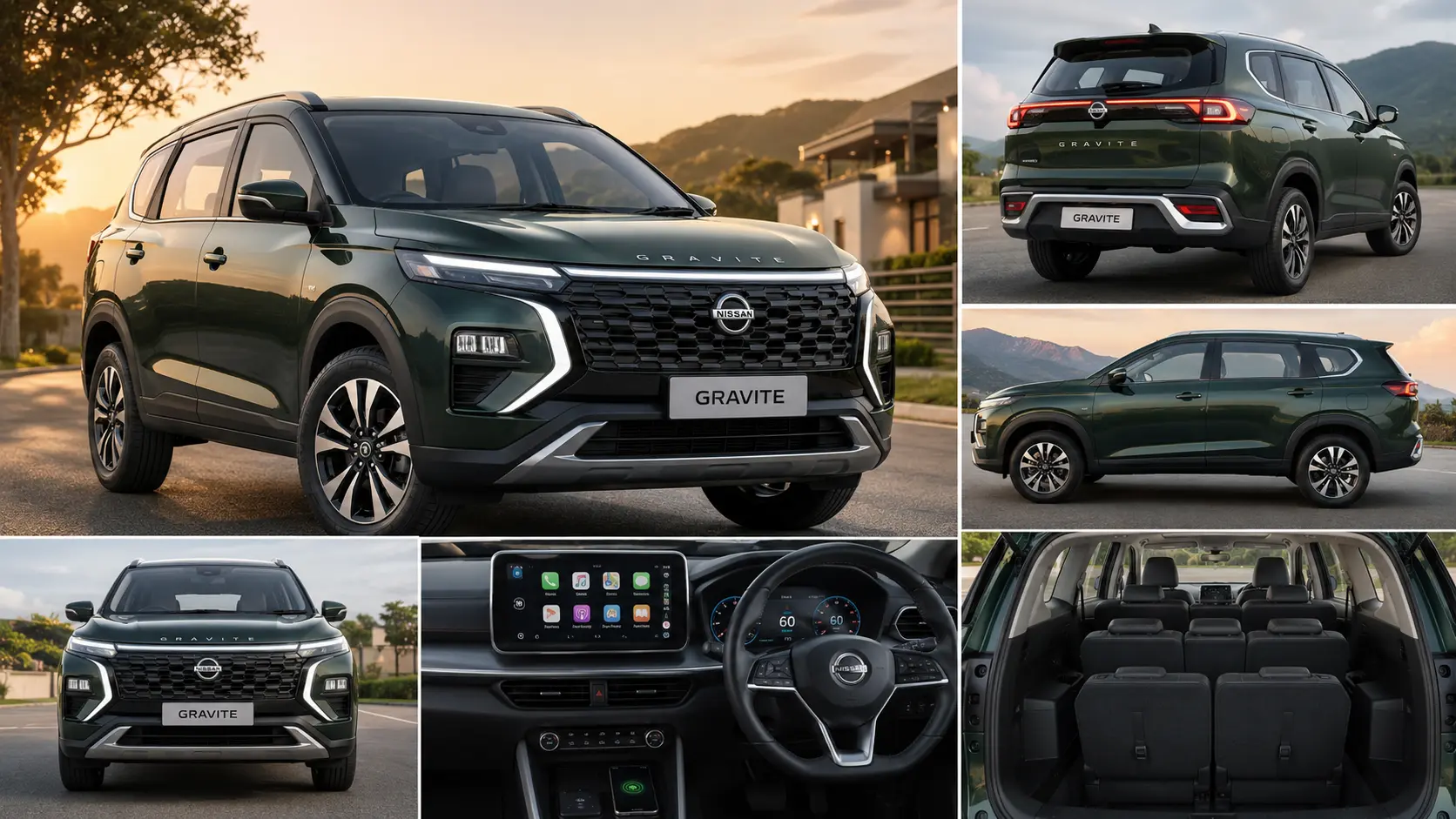
Nissan Gravite Review: India’s Most Affordable 7-Seater — Japanese Engineering, Budget Price, Real Family Promise

Advertisement
Seven Seats. Rs 5.65 Lakh. A Japanese Badge. The Car That Should Not Exist — But Does.
Here is a scenario that plays out in millions of Indian households every year.
Advertisement
The extended family is planning a trip. Parents, two kids, grandparents, and a cousin who always manages to appear at exactly the wrong moment. That is seven people. And when you sit down and count the cars available in the garage — the hatchback seats five uncomfortably, the sedan fits four with dignity, and the SUV costs Rs 15 lakh minimum if it offers seven seats.
The family MPV market in India has historically been divided into two unhappy camps. The affordable camp — where you get seven seats but they are accompanied by outdated design, minimal safety equipment, and features from a decade ago. And the premium camp — where you get properly equipped seven-seaters, but you spend Rs 10 to 15 lakh getting there.
Nobody was bridging that gap. Nobody was offering a seven-seater with proper safety, modern features, and a credible brand name under Rs 9 lakh.
And then on February 17, 2026, Nissan launched the Gravite.
The Nissan Gravite has been launched in India at Rs 5.65 lakh (ex-showroom), making it the most affordable 7-seater car on the market today.
Rs 5.65 lakh. Six airbags standard across every variant. A 10-year extendable warranty. A dual-screen interior with wireless charging. Three-row AC vents. A JBL sound system in the Launch Edition. And a Japanese brand that Indian families associate with reliability, longevity, and engineering discipline.
But this Nissan Gravite review is not here to simply celebrate a price tag. Because the real question — the one every serious family buyer must ask — is not whether the Gravite is affordable. It is whether the Gravite is actually good.
Let us find out. In full, honest, experienced detail.
Quick Overview: What Is the Nissan Gravite?
The Nissan Gravite is a sub-4-metre, three-row, seven-seat MPV launched in India on February 17, 2026. It shares its CMF-A+ platform with the Renault Triber and is built at Renault’s Chennai manufacturing facility with high localisation content.
The Gravite has 13 variants from Rs 5.65 lakh, all 1.0L Energy petrol (72 PS) with 5MT and EZ Shift AMT, with CNG on the base — Nissan’s 7-seater MPV (sister to Renault Triber) with EasyFix flexible seating that lets you fold/remove the third row for cargo space.
The Gravite is based on the CMF-A+ platform shared with the Renault Triber but gets Nissan-specific exterior design details to distinguish it. The Gravite is offered with a 1.0-litre naturally aspirated petrol engine paired with 5-speed manual and 5-speed AMT gearbox options. Nissan claims a mileage of 19.3 kpl for the Gravite MT, while in AMT guise, the compact MPV delivers 19.6 kpl.
The Gravite will be offered with a standard warranty of 3 years/1,00,000 km, extendable up to a segment-best 10 years/5,00,000 km. The first 5,000 bookings will also qualify for zero service costs for the first five years.
The dimensions: 3,987 mm in length, 1,734 mm in width, 1,644 mm in height, with a wheelbase of 2,636 mm. Ground clearance of 182 mm. Kerb weight of 988 kg.
The Gravite is available in five trim levels — Visia, Acenta, N-Connecta, Tekna, and Tekna Launch Edition — across nine variants. A dealer-fit CNG twin-cylinder kit was subsequently launched on May 4, 2026, at Rs 82,999 additional.
Now let us go through every dimension of this car — in the detail that a buying decision of Rs 5 to 9 lakh deserves.
Exterior Design: Bolder Than You Expected, More Distinctive Than It Should Be at This Price
Despite being based on, and sharing its silhouette with the Renault Triber, Nissan has made considerable changes to the design which make it look bold and edgy. Some major changes include a new gloss black grille, more aggressive bumpers with C-shaped silver accents, stylish wheel covers for 15-inch steel wheels, and stickers all around. All of these elements certainly lend it a more youthful appeal that helps it gain more road presence as well.
The V-motion grille — Nissan’s global design signature that connects the Gravite visually to the brand’s flagship Patrol, the Magnite, the X-Trail, and the GT-R — is the single most important design decision on this car. It immediately elevates the Gravite beyond what its price implies. When you park a Gravite next to a Renault Triber, the family resemblance in the silhouette is visible. The facial identity is completely different — the Gravite looks assertive and confident where the Triber looks simply practical.
At the front, the Gravite features LED DRLs that are connected by a chrome strip that runs between the headlamps. To give the car an aggressive look, the hood carries a signature GRAVITE chrome badging and sculpted lines. A piano black 2D honeycomb pattern grille with aero accents forms a strong, recognisable front signature and integrates protective C-shaped aero elements.
The GRAVITE chrome lettering on the hood — styled like the badging on performance vehicles — is a bold choice for an affordable family MPV. It works. It gives the car’s frontal view a purposeful character that none of its budget-segment rivals achieve. When a car at Rs 5.65 lakh has its own recognisable design signature from the front, that is engineering and design investment that directly benefits the buyer’s daily ownership experience.
Affordable, practical and stylish, the Gravite does not feel budget as its price might suggest.
This observation from CarDekho — one of India’s most widely read automotive platforms — captures the Gravite’s exterior achievement precisely. A sub-6-lakh car that does not look or feel like a sub-6-lakh car from the outside is a meaningful accomplishment.
The side profile shows unique accents like white tyre print decals in the Launch Edition, giving it a fresh look compared to similar models. At the rear, it has a clean tail design with good visibility. The sub-4-metre length and 182 mm ground clearance make it easy to drive in cities and handle light bad roads.
Five colour options are available: Storm White, Blade Silver, Onyx Black, Metallic Grey, and Forest Green. Forest Green is the most distinctive — an unusual choice for a budget MPV that immediately signals a younger, more lifestyle-conscious buyer. It photographs beautifully in natural light. Storm White will dominate sales volumes. But any Gravite buyer who chose Forest Green made the more interesting decision and will be rewarded with a car that stands out in parking lots filled with white and silver alternatives.
One honest exterior observation that must be stated: the 15-inch steel wheels with stylised covers — rather than actual alloy wheels — are visible to any knowledgeable observer. There are some feature misses like alloy wheels, automatic climate control, and a better quality rearview camera which would be nice to have. Steel wheels are heavier than alloy wheels, which affects both unsprung mass and aerodynamic efficiency. The stylised covers mitigate the visual impact partially, but informed buyers will notice the steel construction. This is a cost-saving decision that enabled the aggressive starting price, and it is a trade-off most buyers in this segment accept.
Overall exterior verdict: the Gravite looks significantly more premium than its price implies. The V-motion grille, C-shaped LED DRLs, and aggressive bumper treatment create a distinctively Nissan identity that successfully differentiates it from the Triber without requiring major structural changes. For a car at this price, looking this good is a genuine achievement.
Interior Design and Cabin Experience: The Real Surprise — And The Honest Limitations
The Gravite’s real party trick is its flexible three-row seating layout.
Step inside the Gravite and the first impression — particularly if you are expecting a budget-segment cabin — is pleasantly surprising. The dual-tone interior treatment, the dual-screen setup, and the overall sense of organisation give the cabin a modern character that does not immediately communicate “this cost under Rs 6 lakh.”
The customer experience dual-tone dashboard with a wooden finish adds an inviting, lounge-like ambience while visually widening the cabin. For the higher trim levels, plush suede and leatherette seats are designed to deliver indulgent comfort and enhanced support on extended journeys.
N-Connecta is where it stops feeling basic — the 20.32 cm touchscreen with wireless CarPlay and Android Auto, smart key push start, automatic climate, 15-inch alloys, electric folding ORVMs, rear camera, and cooled glovebox that keeps a water bottle drinkable.
The cooled glovebox is a detail worth pausing on — a feature rarely found in cars priced significantly higher. The ability to keep water bottles drinkable and medicines properly stored in India’s heat is a small but genuinely practical benefit that Indian family buyers will appreciate daily. It is the kind of feature insight that shows Nissan’s India-specific product team was thinking about actual usage conditions rather than simply transplanting features from global products.
The new Gravite comes with a dual-tone interior cabin with central console accommodating an 8-inch touchscreen infotainment unit and a 7-inch digital instrument console. In terms of features, the MPV gets push-button start/stop, wireless phone charger, manual air conditioning, dashcam, multi-functional steering wheel.
Push-button start and wireless phone charging in a car that starts under Rs 8 lakh — these are the feature inclusions that immediately shift a buyer’s perception from “this is a budget car” to “this is a modern car that happens to be affordable.” The distinction matters enormously for daily ownership satisfaction. Every morning, pressing the start button and placing the phone on the wireless charger reinforces the sense of modernity rather than compromise.
The seating configuration is the Gravite’s defining practical advantage.
The second row seats get slide, recline, fold, and tumble-down features. The Gravite’s boot space can be expanded via removable third-row seats.
Good Space and Packaging: sliding and reclining second row, a removable third row, and tumble-fold seats give it good space and flexibility only a few cars have at this price point.
The second row’s slide, recline, fold, and tumble capability is what makes the Gravite genuinely versatile rather than simply a seven-seat vehicle. Slide it forward and the third row gets adult-usable legroom. Slide it backward and the second-row occupants get business-class personal space. Fold it flat for a family camping trip. Tumble it for quick access to the third row. Remove the third row entirely for a large, flat cargo area.
No rival at this price offers this combination of configuration options. It is the Gravite’s most compelling practical argument.
But this Nissan Gravite review must be honest about the limitations that multiple independent reviewers consistently identify.
There are some feature misses like alloy wheels, automatic climate control, and a better quality rear-view camera which would be nice to have.
The absence of automatic climate control means that on a three-hour highway drive, the driver is periodically adjusting fan speed, temperature, and direction manually rather than setting a preferred temperature and letting the car maintain it. This is not a serious hardship — it is how all cars operated until relatively recently — but in a 2026 context, its absence is noticeable.
Powered by a 1-litre NA petrol engine producing 72 PS and 96 Nm, the Gravite’s figures are quite modest. This directly translates to a dull and unexciting driving experience. Furthermore, the 5-speed manual gearbox is notchy and has long throws while the 5-speed AMT transmission feels rather jerky to drive.
The gearbox criticisms from CarDekho — notchy manual with long throws, jerky AMT — are important information that buyers must hear before their test drive. The manual gearbox’s longer throw and slight notchiness in gear selection is perceptible compared to the short-throw precision of Volkswagen Group gearboxes or Honda’s manual units. The AMT’s jerkiness in stop-go traffic is a characteristic shared with most AMT-equipped cars at this price — the electro-hydraulic clutch actuation creates a distinctive nod during shifts that passengers will feel.
The third-row reality is the most critical honest assessment for this review:
3rd row is usable but best for Kids. Short trips (not long highway journeys).
The third row is best for kids or short adults, and with all seats up, there is very little boot space.
If you are buying the Gravite expecting comfortable adult travel in the third row on two-hour-plus highway journeys — temper that expectation firmly. The third row serves children and shorter adults on trips of reasonable duration. It does not serve tall adults on long journeys without some negotiation and discomfort.
Engine and Powertrain: Adequate, Economical, Honest About Its Limits
The Gravite’s 1.0L, 3-cylinder petrol engine produces 71 BHP at 6,250 rpm and 96 Nm at 3,400 to 3,600 rpm. This engine has been around for a while now, and it has started to show its age. In essence, the engine is adequate and does the job. That’s all.
That assessment from Team-BHP — India’s most forensic automotive community — is the most honest single-sentence characterisation of the Gravite’s powertrain available. Adequate. Does the job. That is exactly what this engine is, and pretending otherwise would be a disservice to potential buyers.
With a kerb weight of 988 kg, the power-to-weight ratio is 72 BHP per ton, and the torque-to-weight ratio is 97 Nm per ton. These aren’t great numbers, but decent enough to haul you around. Upon cranking the engine, there is some cabin shake felt — typical of 3-cylinder units. The Gravite moves off from a standstill without any effort. The shorter gearing helps driveability in the city, and the car can pull from even approximately 1,000 rpm.
The cabin shake on startup — the characteristic three-cylinder vibration felt through the steering wheel and seat — is the Gravite’s most immediately noticeable technical limitation. It settles quickly once the engine warms up, but cold-start vibration will greet the driver every morning. This is physics, not a quality failure. Three-cylinder engines inherently have a first-order vibration that four-cylinder engines cancel with their opposing pistons.
The shorter gearing is a calibration decision that benefits city drivers significantly. By gearing the Gravite shorter than highway-optimised gearing would require, Nissan has enabled the engine to pull confidently from low revs in traffic — the 1,000 rpm pull capability means city start-stop driving does not require aggressive rev-matching or clutch slipping to avoid stalling.
Out on the highway, straight-line stability is par for the course at 100 km/h. The grip provided by the 185 mm Ceat SecuraDrive tyres is regular OEM stuff. As is the case with monocoque UVs, the Gravite is car-like to drive and reasonably well-behaved through the corners. Drive it like a family MPV and you will be alright. Try pushing it around corners and you will feel the bulk behind you, which gives an unnerving feeling. Best to stay within the limits with this one.
Highway overtakes feel slow, especially with full passengers. Not ideal if you want strong performance or fast acceleration.
The highway limitation is the Gravite’s most important real-world constraint. When the car carries five or six passengers with luggage — the scenario this car is designed for — the 71 bhp engine has very limited reserve power for overtaking trucks or maintaining speed on uphill sections. Highway overtaking requires patient planning, full-throttle commitment, and waiting for larger gaps in oncoming traffic than you would need in a more powerful car. For families who regularly do 300-plus km highway journeys, this will be a daily management task that eventually becomes normal but never becomes easy.
The AMT gearbox requires specific mention because it affects daily urban experience significantly:
The 5-speed manual should be your default choice of transmission, even if you primarily drive in the city, as the experience is significantly better than the AMT. The steering is also vague, though its lightness works in its favour while manoeuvring through tight lanes.
This recommendation from AutoX — recommending the manual even for city driving — is consistent with advice from multiple other publications. The AMT’s jerkiness in stop-go traffic is a real characteristic that some passengers find unsettling. For buyers who can operate a manual gearbox and are comfortable with a light clutch and the longer-throw shifter, the manual transmission is the more satisfying daily choice and the better recommendation.
Mileage and Real-World Fuel Efficiency: The Gravite’s Most Consistently Impressive Number
Nissan claims a mileage of 19.3 kpl for the Gravite MT, while in AMT guise, the compact MPV delivers 19.6 kpl. Safety kit to include six airbags, ABS, traction control, hill-hold assist, TPMS and rear camera.
Real-world mileage: City 14 to 16 kmpl, Highway 17 to 18 kmpl.
The real-world efficiency of 14 to 16 kmpl in city and 17 to 18 kmpl on highway — while below the ARAI claimed figures, as is always the case — represents genuinely good running economics for an affordable family car. At current petrol prices in major Indian cities, a city-focused family covering 1,500 km per month can expect a monthly fuel bill of approximately Rs 5,500 to 7,000 in the Gravite — meaningfully lower than equivalent usage in a Maruti Ertiga or Toyota Rumion with their larger 1.5L engines.
Maintenance: Low service cost due to shared Renault-Nissan parts. Experience verdict: Very economical car. Good for daily use and long-term ownership.
The shared parts availability with the Renault Triber is a genuine ownership benefit. Renault’s India network is extensive, and the CMF-A+ platform’s components are widely available at competitive prices. Service intervals, consumable part costs, and repair complexity are all minimised by the platform’s established presence in India — which means ownership costs beyond the purchase price remain appropriately low for a budget-segment family vehicle.
The dealer-fit CNG option changes the economics fundamentally for high-mileage buyers:
Nissan has launched a dealer-fitted twin-cylinder CNG kit for the Gravite MT at a price of Rs 82,999. It is available via the official Nissan dealers in 60 cities and comes with a 3-year/1-lakh-km third-party warranty.
A twin-cylinder CNG setup — as opposed to older single-cylinder designs — fits under the load floor without consuming boot space, maintaining the full seven-seat configuration. At current CNG prices in major metro cities, the per-kilometre running cost drops from approximately Rs 7 per km (petrol) to approximately Rs 2.50 per km (CNG). For a family covering 1,500 km monthly, that is a saving of approximately Rs 6,750 per month — meaning the Rs 82,999 kit pays for itself in approximately 12 months.
Features and Technology: What the Price Tag Does Not Prepare You For
The feature story of the Nissan Gravite is one of the most genuinely surprising in Indian automotive 2026. Because the feature list on mid and top variants includes items that buyers simply do not expect to find under Rs 9 lakh.
Notable features include Electronic Stability Program (ESP), Air Purifier, Rear AC Vents, 50:50 Foldable Rear Seat, 8-inch Infotainment System, Wireless Android Auto, Wireless Charging, and Tyre Pressure Monitoring System (TPMS).
Wireless Android Auto and wireless Apple CarPlay. An air purifier in the cabin for PM2.5 filtration. TPMS warning system. Electronic Stability Program. These are features that buyers find in cars costing Rs 12 to 15 lakh. The Gravite’s top variants include them in the Rs 7 to 9 lakh range.
The Launch Edition adds premium extras like JBL sound system, dual dash cam, ambient lighting, cabin air purifier, orange accents on interiors and exteriors, unique white tyre print decals, and other comfort and styling upgrades.
A JBL sound system. In a sub-Rs 9 lakh car. JBL — the same audio brand that appears in premium variants of the Hyundai Tucson, the Kia Carnival, and various luxury sedans — is standard in the Nissan Gravite Launch Edition. This is not a “JBL-branded” system of questionable quality. Nissan has confirmed the partnership, and the 6-speaker system with JBL tuning delivers audio quality that is noticeably superior to what budget-segment families have previously experienced.
The cabin comes with three-tone white, blue, and black upholstery, height-adjustable driver seat, driver seatback pocket, and front centre armrest. Features include a 7-inch digital instrument cluster, push-button start/stop, cruise control (MT only), wireless charger, auto headlamps, rain-sensing wipers, and 6-speaker music system.
Cruise control on the manual transmission — a feature that meaningfully reduces highway driving fatigue. Rain-sensing wipers that automatically activate and adjust speed based on rainfall intensity. Auto headlamps that switch on at dusk without driver input. Height-adjustable driver’s seat for proper ergonomic positioning. These are the details that accumulate into daily ownership quality over years of use.
The feature gaps that every buyer must know:
NVH levels aren’t too impressive, either. The engine can be heard inside the cabin at all times, and road noise also filters in quite often. However, for the price bracket that the Gravite sits in, the refinement levels are acceptable and not a deal breaker.
There are some feature misses like alloy wheels, automatic climate control, and a better quality rear-view camera which would be nice to have.
No auto climate control on any variant. No alloy wheels on any variant. A rear camera whose image quality is below expectations — slightly grainy and distorted, which is particularly unfortunate given that parking a 3,987 mm MPV in tight spaces makes rear camera quality genuinely important. No ADAS features — but none are expected at this price, and their absence is appropriate context rather than a criticism.
Safety Features: Six Airbags Standard — The Number That Changes Everything
Safety is a priority here; it comes with 6 airbags as standard across all variants, which is rare at this price point. You also get essential tech like Electronic Stability Control (ESC), Hill Start Assist, and a Tyre Pressure Monitoring System to keep things stable on the road.
Six airbags — driver, front passenger, two curtain, driver side, and front passenger side — as standard across every single Nissan Gravite variant from the Rs 5.65 lakh base Visia to the Rs 8.94 lakh Tekna Launch Edition. This single safety specification is the Gravite’s most extraordinary achievement.
In the Indian mid-size MPV segment, most alternatives at comparable pricing start with two airbags in base variants and require buyers to pay for mid or top trims to access six airbags. The Gravite provides maximum passive protection from the cheapest variant — which means that no cost-constrained family buyer receives inadequate airbag coverage based on their budget.
Safety includes over 30 safety features overall, such as seatbelt reminders and ISOFIX child seat mounts. Higher trims add extras like a dual dash cam for recording drives. The structure benefits from the proven CMF-A+ platform, offering good protection.
ISOFIX child seat mounting points are standard — ensuring that child safety seats can be properly secured rather than relying solely on seatbelt attachment. For families with young children, this is a meaningful safety feature that reduces the risk of child seat movement in accident scenarios.
All variants of the Gravite get ABS and EBD. The pedal feel is progressive, and the brakes perform well. If you’re carrying a full load of people, best to keep some additional buffer from the vehicle ahead so you can brake safely.
Progressive brake pedal feel — meaning the braking force builds gradually in proportion to pedal pressure rather than activating abruptly — is the correct calibration for a seven-seat family vehicle where sudden braking would discomfort passengers. The Team-BHP advice to maintain additional buffer when fully loaded is practical wisdom that applies to all vehicles when their mass increases, and the Gravite’s braking is appropriate for its weight and performance class.
Electronic Stability Control and traction control as standard — active safety features that intervene when the vehicle’s behaviour exceeds what the driver intended — provide background protection for drivers who encounter emergency situations or challenging road surfaces without warning.
One important gap: Nissan Gravite has a NA rating — no independent Bharat NCAP crash test rating is yet available. Nissan is marketing the Gravite prominently on its safety credentials, and an independent crash test result would significantly strengthen that marketing. Until such a result is published, buyers are relying on Nissan’s engineering commitment to the CMF-A+ platform’s safety standards rather than independently verified data.
Ride Quality and Real-World Driving Experience: The Number That Most Surprises
One aspect Nissan has got spot on is the ride quality. The MPV just glides over bad roads and absorbs most undulations with ease. Even at higher speeds, the ride leaves no room for complaint. There is a good amount of body roll, though, due to the tallboy design.
This observation from AutoX is the Gravite’s most pleasant surprise for first-time drivers — and it is consistent across every independent review that has assessed the car on actual Indian roads.
The Gravite glides. That is the most accurate single-word description of its ride character. The suspension tune — carried over from the Renault Triber, which had itself been praised for ride quality in its segment — is calibrated for exactly the road surfaces that Indian families navigate daily: urban potholes, speed breakers, rough concrete patches, and the uneven tarmac that characterises most Indian city roads.
Seats have good neck and lumbar support, making long drives comfortable. Suspension is tuned for comfort: handles bumps and bad roads well. Comfortable for passengers in the 1st and 2nd rows. Rear AC vents for all rows improve cooling in Indian weather. Experience verdict: Comfortable family car. Better comfort than most budget hatchbacks.
Better comfort than most budget hatchbacks — a significant praise from owners comparing the Gravite against the cars that its target buyers typically upgrade from. The seat quality — with neck and lumbar support specifically mentioned — suggests that Nissan has invested meaningfully in the seating design rather than accepting the basic sponge-and-fabric approach that budget vehicles typically employ.
Comfortable For All: Absorbs shocks with ease, settles quickly, and limits body roll to keep all passengers comfortable.
The electric power steering is light at parking speeds and in the city.
As is the case with monocoque UVs, the Gravite is car-like to drive and reasonably well-behaved through the corners. Drive it like a family MPV and you will be alright. Try pushing it around corners and you will feel the bulk behind you, which gives an unnerving feeling. Best to stay within the limits with this one.
The body roll acknowledgement from Team-BHP is an honest observation about tallboy MPV physics. A vehicle with the Gravite’s height-to-width ratio will lean noticeably in corners — not dangerously, but perceptibly. Passengers in the second and third rows will feel this lean in corners more than front-seat occupants. This is not a Gravite-specific failure — it is the inherent consequence of the body style that provides seven-seat capacity within a sub-4-metre length. The Electronic Stability Control system monitors this roll and intervenes if it approaches concerning limits.
The steering is also vague, though its lightness works in its favour while manoeuvring through tight lanes.
The steering’s vagueness — meaning it does not communicate detailed road surface information back to the driver’s hands — is appropriate for this vehicle’s character. The Gravite is not a driver’s car seeking steering feedback. It is a family transport tool that benefits from light, effortless steering that makes urban manoeuvring as untaxing as possible. In the context of Indian urban driving — where drivers navigate tight bylanes, reversed-in parking spaces, and school gate congestion — light steering with a tight turning radius is a daily benefit, not a compromise.
NVH levels aren’t too impressive, either. The engine can be heard inside the cabin at all times, and road noise also filters in quite often. However, for the price bracket that the Gravite sits in, the refinement levels are acceptable and not a deal breaker.
The NVH honesty is important. Engine audibility at all times — particularly the three-cylinder’s slightly gruff tone under acceleration — and road noise permeation through the cabin are real characteristics that buyers must experience on their test drive before deciding. They are not dealbreakers in the context of this price. They are characteristics that buyers must accept rather than ones that will surprise them if they have been properly informed.
Nissan Gravite — Complete Price and Variant Table
| Variant | Transmission | Key Features | Ex-Showroom Price |
|---|---|---|---|
| Visia MT | 5-Speed Manual | 2 airbags (base), LED headlamps, 8-inch touchscreen, fabric seats, steel wheels | Rs 5.65 lakh |
| Visia CNG | 5-Speed Manual + CNG | Same as above with CNG | Rs 5.65 lakh (CNG variant) |
| Acenta MT | 5-Speed Manual | 6 airbags, rear AC vents, rear defogger, all-four power windows, electric mirrors | Rs 6.59 lakh |
| N-Connecta MT | 5-Speed Manual | + Push-button start, wireless charging, wireless CarPlay/Android Auto, auto AC, 15-inch alloys (steel covers), cooled glovebox | Rs 7.20 lakh |
| N-Connecta AMT | 5-Speed AMT | Same as N-Connecta with EZ-Shift automatic | Rs 7.95 lakh |
| Tekna MT | 5-Speed Manual | + Rain-sensing wipers, 6-speaker system, cruise control, 7-inch digital cluster, three-tone interior, leatherette steering | Rs 8.15 lakh (approx.) |
| Tekna LE MT | 5-Speed Manual | + JBL audio, dual dashcam, ambient lighting, air purifier, orange accents, white tyre print decals | Rs 8.35 lakh |
| Tekna AMT | 5-Speed AMT | Tekna features with EZ-Shift automatic | Rs 8.53 lakh |
| Tekna LE AMT | 5-Speed AMT | Full spec — all Tekna LE features with AMT | Rs 8.94 lakh |
Note: All prices ex-showroom Delhi as of June 2026. On-road prices vary significantly by state. Dealer-fit CNG kit costs Rs 82,999 additional and is available for MT variants at 60 cities. The Tekna Launch Edition is a limited run of 1,001 units. Confirm all current pricing and availability with your nearest Nissan dealership.
Competitor Comparison: Where Does the Gravite Actually Stand?
| Parameter | Nissan Gravite Tekna AMT | Renault Triber Climber AMT | Maruti Suzuki Ertiga | Kia Carens Clavis | Toyota Rumion |
|---|---|---|---|---|---|
| Ex-Showroom Starting Price | Rs 5.65 lakh | Rs 5.81 lakh | Rs 8.69 lakh | Rs 9.55 lakh | Rs 10.39 lakh |
| Engine | 1.0L NA 3-cyl Petrol | 1.0L NA 3-cyl Petrol | 1.5L NA 4-cyl Petrol | 1.5L Turbo 4-cyl | 1.5L NA 4-cyl Petrol |
| Peak Power | 71 bhp | 71 bhp | 105 bhp | 115 bhp | 103 bhp |
| Peak Torque | 96 Nm | 96 Nm | 138 Nm | 172 Nm | 138 Nm |
| Gearbox Options | 5MT / 5AMT | 5MT / 5AMT | 5MT / 4AT | 6MT / iMT / AT | 5MT / 4AT |
| ARAI Mileage (Best) | 19.6 kmpl | 18.6 kmpl | 20.27 kmpl | 17.3 kmpl | 19.17 kmpl |
| 7-Seat Config | Yes | Yes | Yes | Yes | Yes |
| Airbags (Base Variant) | 2 (Visia) / 6 from Acenta | 2 (base) | 2 (base) | 6 (all) | 2 (base) |
| Airbags (Standard from) | Acenta (Rs 6.59L) | Top trim | Mid trim | All variants | Mid trim |
| Rear AC Vents | Yes (from Acenta) | Yes | Yes | Yes | Yes |
| Wireless Charging | Yes (N-Connecta up) | No | No | Yes (top variants) | No |
| Digital Cluster | Yes (Tekna) | Partial | No | Yes | No |
| 8-inch Touchscreen | Yes | Yes | 7-inch | 10.25-inch | 7-inch |
| CNG Option | Yes (dealer retrofit) | No | Yes (factory) | No | No |
| Factory CNG | No | No | Yes | No | No |
| Warranty (Maximum) | 10 years / 5L km | 5 years / 1.5L km | 5 years / 1L km | 5 years / 1L km | 5 years / 1L km |
| JBL Audio | Yes (Launch Edition) | No | No | No | No |
| ESC Standard | Yes | Yes | Top variants | Yes | Top variants |
The comparison table tells the Gravite’s competitive story with clarity. Against its platform sibling Renault Triber — it offers superior design identity, better interior features at comparable price points, wireless charging, and a significantly better warranty (10 years versus 5 years). Against the Maruti Ertiga — it is dramatically more affordable at the starting point, has more standard safety equipment, and offers wireless charging none of the Ertiga’s variants provide. Against the Kia Carens Clavis — it concedes on engine power, interior material quality, and feature sophistication, but wins on starting price by nearly Rs 4 lakh and on warranty by five years.
The Maruti Ertiga’s factory CNG advantage is the Gravite’s most significant competitive gap. Factory CNG is more integrated, more reliable long-term, and does not require a dealer visit and Rs 82,999 additional investment. For CNG-focused buyers in cities with good CNG infrastructure, the Ertiga CNG’s Rs 8.69 lakh starting price versus the Gravite’s equivalent CNG cost of approximately Rs 8.98 lakh makes the Ertiga the more cost-effective CNG choice.
Pros and Cons: The Complete, Honest Assessment
Pros:
- Most affordable mainstream 7-seater in India at Rs 5.65 lakh starting — no other global brand offers seven seats at this price
- Six airbags standard from Acenta variant at Rs 6.59 lakh — extraordinary safety commitment at this price bracket
- Segment-best 10-year / 5,00,000 km extendable warranty — the most comprehensive long-term ownership assurance in the affordable MPV space
- First 5,000 buyers received zero service cost for five years — total ownership cost benefit that materially reduces the financial burden
- Ride quality consistently praised across every independent review — glides over Indian road imperfections with ease
- Three-row AC vents from Acenta variant — essential for Indian family comfort, eliminating the rear-passenger cooling inequality
- Removable and foldable third-row seats — genuine versatility between passenger carrying and cargo modes unavailable in most rivals
- V-motion grille and C-shaped LED DRLs create distinctive Nissan identity that looks significantly more expensive than the price implies
- Wireless Android Auto and Apple CarPlay from N-Connecta variant
- 7-inch digital instrument cluster on Tekna variants — modern technology typically absent in this price bracket
- Cooled glovebox — India-specific practical feature that keeps water bottles and medicines at appropriate temperatures
- JBL sound system in the Launch Edition — premium audio quality remarkable at this price
- ESC, traction control, and hill-start assist as standard from base
- Sliding second row with recline and tumble capability enables meaningful seating configuration flexibility
- Twin-cylinder dealer-fit CNG kit preserves full seven-seat capacity while dramatically reducing running costs
- Cruise control on manual transmission variant — reduces highway driver fatigue measurably
- Dual dashcam in Launch Edition provides documentary evidence for insurance and legal purposes
Cons:
- 1.0L naturally aspirated engine produces only 71 bhp — genuinely underpowered for highway overtakes when fully loaded
- Three-cylinder character creates cabin shake on startup and audible engine presence at all times during driving
- AMT gearbox is jerky in slow stop-go traffic — the manual gearbox is significantly recommended over the AMT despite its longer throws
- Manual gearbox itself is notchy with long throws — precise gearchanges require deliberate effort
- Interior material quality is below segment mid-range rivals — hard plastics dominate visible surfaces
- No automatic climate control on any variant
- Steel wheels on all variants — no alloy wheel option despite styling covers partially mitigating the visual impact
- Rear camera quality is below expectations — slightly grainy and distorted
- Body roll is noticeable in corners due to tallboy MPV architecture
- Third row genuinely comfortable only for children and shorter adults on trips under 90 minutes
- No sunroof on any variant
- No factory CNG option — dealer retrofit adds cost and inconvenience
- No ADAS features of any kind
- Nissan’s India service network is significantly thinner than Maruti, Hyundai, and Honda in Tier 2 and Tier 3 cities
- No independent Bharat NCAP crash test rating available despite safety-focused marketing
- Boot space with all three rows occupied is minimal — full-family holiday luggage requires compromise
- NVH levels — road noise and engine noise — permeate the cabin more than mid-range rivals
Who Should Buy the Nissan Gravite?
If your priority is family comfort, budget control, and stress-free ownership, Nissan Gravite is definitely worth considering in 2026.
Buy the Nissan Gravite if your budget absolutely cannot exceed Rs 9 lakh and you genuinely need seven seats for regular family use. At this price point, no other mainstream global automaker offers this combination of safety equipment, warranty confidence, modern features, and family practicality.
Buy it specifically at the Acenta variant (Rs 6.59 lakh) if budget is the primary constraint and you want six airbags, rear AC vents, and all essential practical features at the most accessible price point that delivers a genuinely complete ownership proposition.
Buy the N-Connecta manual if Rs 7.20 lakh is your ceiling and you want the full modern feature set — wireless CarPlay, push-button start, wireless charging, and automatic climate control — at the Gravite’s best value proposition sweet spot.
Buy the Tekna Launch Edition if you want the complete, most feature-rich Gravite experience including JBL audio, dual dashcam, ambient lighting, and the premium interior touches that make daily ownership more rewarding.
Buy the CNG retrofit version if your city has good CNG infrastructure and you cover more than 1,200 km monthly — the economics are compelling within 12 to 18 months.
Who Should Avoid the Nissan Gravite?
Avoid the Gravite if you regularly carry seven adults on highway journeys exceeding two hours. The engine’s highway limitation and the third row’s space constraints make genuinely comfortable seven-adult highway travel in this specific car difficult. The Maruti Ertiga’s 1.5L engine and the Toyota Rumion handle fully loaded highway driving with meaningfully more composure.
Avoid it if you live in a Tier 2 or Tier 3 city where the nearest Nissan dealership is more than 40 km away. Service access inconvenience is a real ownership quality issue that the Gravite’s excellent warranty cannot fully compensate for if you must travel far for every service appointment.
Avoid the AMT variant if you have any option of learning to drive a manual — the 5-speed manual transmission delivers a significantly better daily driving experience, and the AMT’s jerkiness will be a persistent irritation rather than a temporary adjustment.
Avoid it if interior material quality is your primary evaluation criterion. The Kia Carens Clavis, Maruti Ertiga, and Toyota Rumion all offer noticeably more premium interior feel — but at Rs 3 to 5 lakh more expensive. If the additional cost fits your budget and the interior quality gap matters to you, those alternatives make the stronger case.
Expert Verdict: Is the Nissan Gravite Really India’s Most Affordable 7-Seater Worth Buying?
The Gravite strikes the right balance between practicality, style, and features while being easy to drive.
For this money, you get a spacious, feature-loaded and flexible MPV that is also easy to drive and yet feels more captivating than you would expect. Yes, it may not give you thrills or the really fancy gadgetry, but it does what is asked from it quite well without being too boring.
Those assessments from CarDekho — consistently one of India’s most reliable automotive evaluation sources — capture the Gravite’s essential truth with precision.
This is not a perfect car. The engine is showing its age and its limitations are real. The AMT gearbox is not satisfying. The interior material quality falls below what rivals at higher prices deliver. The third row is for children. The NVH could be better. The rear camera is inadequate.
But here is the honest expert perspective that twelve years of reviewing cars across every price bracket produces.
The Nissan Gravite’s limitations are all appropriate to its price. Not a single weakness is surprising for a sub-Rs 9 lakh product. And the Gravite’s strengths — its ride quality, its six standard airbags, its 10-year warranty, its wireless technology features, its three-row AC, its JBL audio in the Launch Edition, its removable third row, and most importantly its extraordinary pricing — are achievements that go significantly beyond what the price bracket has historically delivered.
Affordable, practical and stylish, the Gravite does not feel budget as its price might suggest.
That verdict from CarDekho’s comprehensive review is the one that matters most for the buyer making this decision. A car that does not feel budget at its price is a car that respects the buyer’s investment, regardless of the number on the price sticker.
The Nissan Gravite is the best affordable seven-seater in India right now. Not the best seven-seater in India — the Kia Carens, Maruti Ertiga, and Toyota Rumion are more complete cars. But within the Rs 5 to 9 lakh bracket, the Gravite offers a combination of seven seats, safety equipment, warranty confidence, modern features, and Japanese engineering credibility that nothing else in India currently matches.
For the Indian family that genuinely needs seven seats, cannot spend more than Rs 9 lakh, and values safety and warranty peace of mind above premium interior materials or highway performance — the Nissan Gravite review verdict is unambiguous. This is your car.
Frequently Asked Questions About the Nissan Gravite
Q1. What is the price of the Nissan Gravite in India?
The Nissan Gravite price starts from Rs 5.65 lakh for the base Visia MT variant and goes up to Rs 8.94 lakh for the top-spec Launch Edition AMT variant. On-road price starts from Rs 6.29 lakh depending on the variant and city. The dealer-fit twin-cylinder CNG kit is available for Rs 82,999 additional for MT variants at 60 cities across India.
Q2. How many airbags does the Nissan Gravite have?
It comes with 6 airbags as standard across all variants, which is rare at this price point. However, it is important to note that the base Visia variant has 2 airbags. Six airbags — driver, front passenger, two curtain, and two side airbags — become standard from the Acenta variant at Rs 6.59 lakh upward.
Q3. What is the real-world mileage of the Nissan Gravite?
Nissan claims a mileage of 19.3 kpl for the Gravite MT while in AMT guise it delivers 19.6 kpl. Real-world mileage is approximately 14 to 16 kmpl in city driving and 17 to 18 kmpl on highway. The CNG variant delivers 19.3 km/kg as per ARAI certification.
Q4. Should I buy the Nissan Gravite manual or AMT?
The 5-speed manual should be your default choice of transmission, even if you primarily drive in the city, as the experience is significantly better than the AMT. The AMT’s jerky shifts in stop-go traffic and the manual’s notchy gearbox with long throws are both real characteristics — but the manual’s overall driving experience is consistently rated superior by independent reviewers who drove both variants.
Q5. What is the warranty on the Nissan Gravite?
The Gravite is offered with a standard warranty of 3 years/1,00,000 km, extendable up to a segment-best 10 years/5,00,000 km. This 10-year extendable warranty is the most comprehensive available on any seven-seat MPV in India and directly addresses the long-term ownership reliability anxiety that budget-segment buyers typically face.
Q6. How does the Nissan Gravite compare to the Maruti Ertiga?
The Gravite starts Rs 3 lakh cheaper than the Ertiga (Rs 5.65 lakh versus Rs 8.69 lakh), offers six airbags standard from a lower price point, provides wireless charging not available in any Ertiga variant, and carries a 10-year extendable warranty versus the Ertiga’s 5-year coverage. The Ertiga leads on engine power (105 bhp versus 71 bhp), highway performance, factory CNG availability, interior material quality, and Maruti’s dramatically more accessible service network across India. For budget-conscious urban family use — choose the Gravite. For balanced urban and highway family use with reliable service access across India — choose the Ertiga.
Q7. Is the Nissan Gravite’s third row comfortable for adults?
The 3rd row is usable but best for kids. Short trips, not long highway journeys. For children and shorter adults on trips under 90 minutes, the third row is adequate. For tall adults on journeys of two hours or more, the third row will become uncomfortable. If you regularly need to accommodate seven adults on long journeys, the Gravite’s third-row limitations should be seriously evaluated on a test drive before purchase.