Skoda Kodiaq RS Review: Big Bear — The Family SUV That Grew Fangs and Sold Out in Six Minutes

Advertisement
India’s First RS-Badged Skoda SUV Arrived, Sold 50 Units Before You Finished Reading This Headline, and Raised a Question Nobody Had an Answer For — Can a Bear Dance?
Let me paint you a scenario that will feel familiar to a very specific type of Indian buyer.
Advertisement
You are forty-two. You have two children, a dog that insists on sitting in the second row, and parents who visit from Jaipur every third month and need the third row. On weekdays, you need a car that seats seven, fits five pieces of luggage, and navigates South Delhi traffic without requiring a parking spotter. On Saturday mornings, something in you still wants to hear a turbocharged engine building its note to the redline, feel a properly calibrated chassis communicating with the road through a quality steering wheel, and know — with the certainty that only genuine engineering delivers — that the machine beneath you is operating at its absolute maximum capability.
For the last decade, no one has built that car for you. You have been choosing. Family or fun. Practical or passionate. Bear or beast.
While the standard Kodiaq will continue to be on sale, the Kodiaq RS will offer an option for people who want something fun to drive, but in a package that is also spacious and practical enough for the wife and kids. Only a few units will be available, just like the Octavia RS, so you’ll have to be quick to get your hands on it.
June 23, 2026: Skoda has announced that all 50 units of the Kodiaq RS have been sold out in under 6 minutes of bookings opening.
Fifty units. Six minutes. That is not a launch success statistic. That is suppressed demand reaching critical pressure and the valve finally opening. Every one of those 50 buyers understood immediately what the Skoda Kodiaq RS represented. And now, for the buyers who were in the sixth minute or later, this review is here to tell you whether waiting for the second allocation — which Skoda India is expected to announce — is worth the patience.
The answer, after going through every dimension of this extraordinary vehicle, is yes. Unambiguously yes.
Quick Overview: What Makes the Kodiaq RS Different From the Standard Kodiaq?
Skoda has confirmed that the Kodiaq RS will launch in India in Q2 2026, likely by June, as a limited-volume CBU to retain full global specifications. This performance-focused flagship builds on the new-generation Kodiaq but significantly raises the bar with a more powerful version of the 2.0 TSI engine, paired with all-wheel drive for proper hot-SUV credentials. It is aimed at buyers who find the standard Kodiaq refined but want more punch, sharper handling, and a more aggressive character, all while retaining family-friendly seven-seat practicality.
The Kodiaq RS is built on the same MQB Evo platform as the standard Kodiaq. It shares the same body structure, the same interior architecture, and many of the same components. But Skoda’s engineers have applied comprehensive performance upgrades at every layer — powertrain, chassis, aerodynamics, braking, and visual identity — that transform the Kodiaq’s character from refined family luxury to something genuinely, excitingly different.
The Skoda Kodiaq RS is an enticing proposition, which combines the practicality of the 7-seat Kodiaq with the performance of the Octavia RS sharper handling. Thanks to specially tuned suspension and adaptive dampers. The best part is, in our review of the SUV, we found that it doesn’t make too many compromises to comfort in the process.
That observation from Autocar India — the same publication whose review of this car originated the Big Bear title — is the single most important summary of what this car achieves. Performance of the Octavia RS in a body that carries seven people and 910 litres of luggage without asking you to compromise your family’s daily comfort.
The Skoda Kodiaq RS is expected to be priced around Rs 60 lakh (ex-showroom) when it arrives in India. It is going to rival its sister company’s Volkswagen Tayron R-Line.
Available in a single fully-loaded RS variant via the CBU (Completely Built-Up) import route. Four exterior colour options: Moon White, Magic Black, Velvet Red, and Steel Grey. Limited to 50 units for India — all sold. Second allocation expected.
Exterior Design: The Bear Wears Performance Like It Was Born To
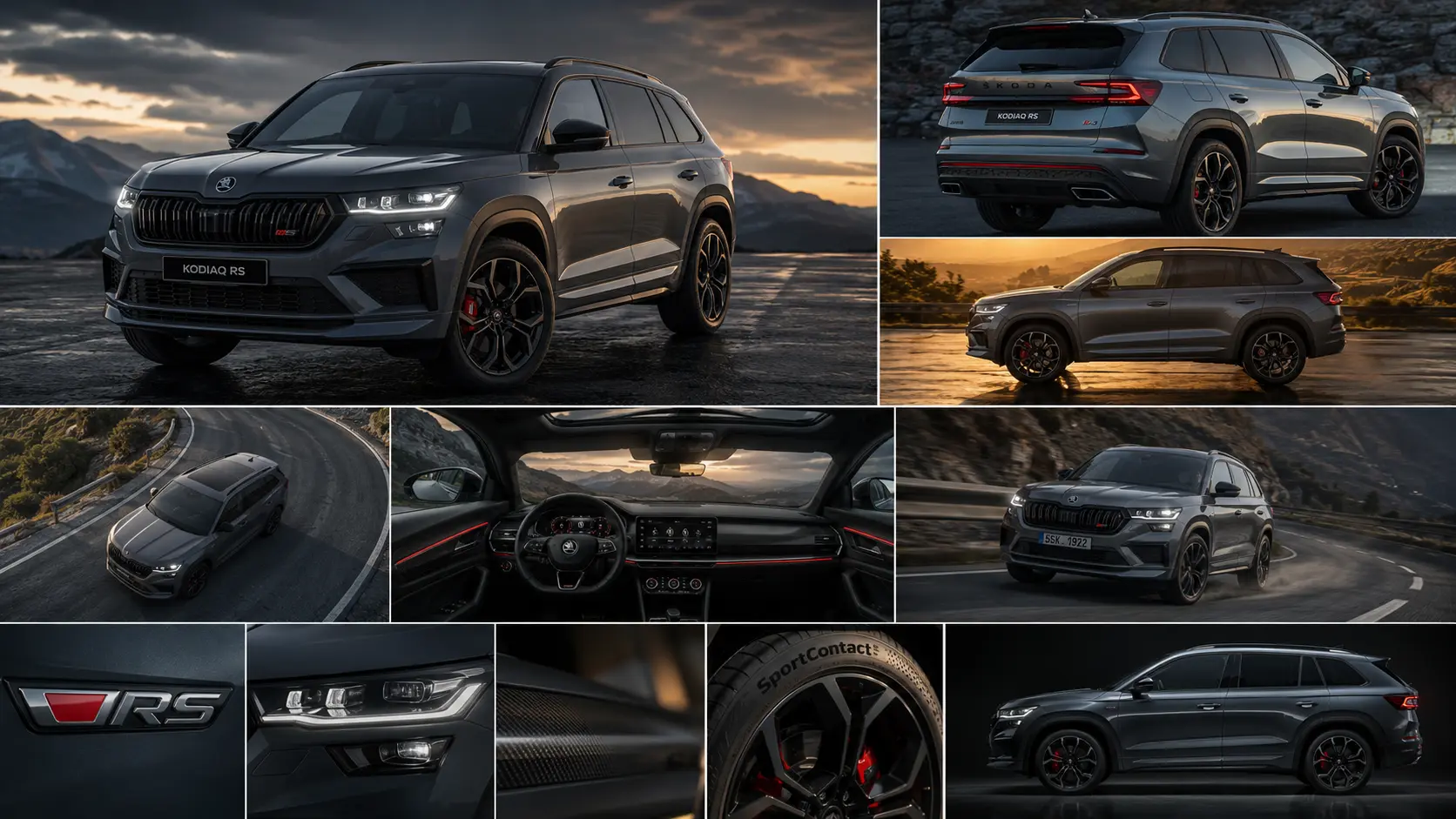
Straight up front, the India-spec Skoda Kodiaq RS looks noticeably more aggressive than the standard Kodiaq. It gets a blacked-out grille with RS badging, revised bumpers, and several sporty styling elements that highlight its performance-focused character. While the regular Kodiaq leans more towards luxury and sophistication, the RS is aimed at buyers looking for a more driver-focused experience.
The second-generation Kodiaq’s design was already a significant evolution from its predecessor — lower, longer, with a more fastback-influenced profile that moved it away from the traditional upright SUV stance. The RS treatment takes this already more athletic base and applies performance-specific visual elements that communicate the car’s character before you have heard the engine note or felt the throttle response.
The Skoda Kodiaq RS takes the clean and premium design of the standard Kodiaq and injects it with a sporty and performance-oriented personality. While the basic proportions are largely similar to the standard car, the RS treatment makes the compact SUV look planted lower and wider. Up front, the Kodiaq RS stands apart with a gloss black version of Skoda’s signature butterfly grille. There’s a distinctive RS badge on the grille to denote that you’re driving the sportier version. The bumper is redesigned with larger air intakes, sharper lines, and a more sculpted look.
The gloss black grille — where the standard Kodiaq uses a chrome treatment — is the single most impactful exterior change at the front. Chrome signals luxury. Gloss black signals intent. The combination of the RS badge in the centre, the reshaped bumper with larger functional air intakes, and the blacked-out surround creates a front face that communicates aggression with restraint — exactly the tone that premium performance vehicles aim for and frequently miss.
The RS version stands out with a blacked-out grille, lower bumper air intakes and a cool-looking segmented DRL that runs between the grille’s slats and extends into the headlight daytime running lamps. At the rear, the tail-lights have a cool split and mirrored look, the lower half extending into a reflector bar across the boot lid, with Skoda’s lettermark replacing the logo. The rear windshield is topped by a deep spoiler and flanked by fins that are finished in black. Skoda says these aid airflow around the car, helping reduce the drag coefficient of the new-gen Kodiaq from 0.31 to 0.28.
The segmented DRL — running through the grille’s slats and extending outward into the headlamp DRL units — is the Kodiaq RS’s most distinctive and exclusive design element. No other Kodiaq variant gets this treatment. At night, it creates a layered light signature that is immediately recognisable to anyone who understands their RS heritage. During the day, it adds a depth and complexity to the front face that photography cannot fully capture.
The aerodynamic fins flanking the rear windscreen deserve special acknowledgement. The drag coefficient reduction from 0.31 to 0.28 — a 9.7 percent improvement — requires genuine engineering investment in underbody panels, rear spoiler geometry, and mirror design. These fins are not decorative. They generate real airflow management improvements that enhance both high-speed stability and fuel efficiency. At 200 kmph, the difference between 0.31 and 0.28 Cd is measurable in both fuel consumption and directional stability.
From the side, the Kodiaq RS stands out with its stylish 20-inch alloy wheels and red brake callipers, both of which add to its sporty appeal. The Kodiaq gets a blacked-out D-pillar that creates a floating roof effect. Its slim body cladding gives it an elegant look despite the sportiness.
The floating roof effect — created by blacking out the B, C, and D pillars — is a design technique that simultaneously makes the car look lower and the glasshouse appear more premium. On the standard Kodiaq, this is achieved with chrome. On the RS, the all-black pillar treatment is more dramatic, more contemporary, and more consistent with the performance character.
At the rear, the Kodiaq RS continues its sporty design with redesigned bumpers, mesh-style inserts, and dual exhaust outlets. The LED taillamps are connected by a light strip, with Skoda lettering positioned between them, giving the SUV a modern and premium look. The blacked-out exterior accents and the rear design help distinguish the RS from the standard Kodiaq.
The dual exhaust outlets — visible and symmetrically placed within the redesigned rear bumper — are functional exits for a genuinely uprated exhaust system, not cosmetic inserts covering a single central pipe. Combined with the mesh-style insert in the lower bumper section and the Skoda lettermark between the connected tail lamps, the rear of the Kodiaq RS looks properly premium in a way that communicates craft rather than cost-cutting.
The four colour options — Moon White, Magic Black, Velvet Red, and Steel Grey — are well-chosen. Magic Black with the full black exterior treatment, where the sills, mirrors, pillars, and grille create a monochromatic dark canvas with only the red callipers providing colour contrast, is the definitive visual specification. Velvet Red is the dramatic choice that photographs most dynamically. Steel Grey is the subtle, intelligent option that will age most gracefully.
Overall exterior verdict: the Kodiaq RS looks genuinely more aggressive than the standard car without resembling a body kit afterthought. The aerodynamic work is real, the visual differentiation is systematic rather than random, and the overall impression is of a large bear moving with unexpected athleticism.
Interior Design and Cabin: Where Performance and Practicality Share the Same Space
The inside is an all-black affair, from the headliner to the carpets. You can choose between suede or leather trim on the sports seats, dashboard, door pads and centre armrest, but only in one colour — black.
The all-black interior of the Kodiaq RS is a deliberate design choice that serves the performance identity while simultaneously solving a genuine practical problem. Parents with young children who have experienced the horror of light-beige SUV interiors after a school run involving snacks, mud, and school bags will appreciate the dark theme’s forgiving nature daily.
Its interiors get the sporty black upholstery with red accents throughout. It gets red stitching across the seats along with RS motifs on the headrest. Other notable visual details include the RS-spec three-spoke steering wheel, two large infotainment displays, and sporty seats.
True to its identity, the Skoda Kodiaq’s cabin carries a noticeably sportier theme compared to the standard Kodiaq. It features red accents across the dashboard, contrasting black and red elements on the steering wheel, and an RS badge on the lower spoke of the steering wheel. It gets well-bolstered RS-embossed sport seats and multi-colour ambient lighting.
The RS-embossed front sport seats are the interior element that most immediately communicates the car’s performance character when you first settle into the driver’s position. The bolstering — more pronounced laterally than the standard Kodiaq’s comfortable but neutral chairs — holds you in position through corners with the kind of grip that tells your body this car expects to be driven. For a vehicle of this size and weight, good lateral support is not a luxury. It is a safety tool that helps you maintain proper driving posture during the kind of spirited cornering the 265 hp and AWD encourage.
Its front seats come equipped with ventilation, heating, a massage function, thigh-support extension, and memory features.
Ventilation, heating, massage, thigh support extension, and memory — simultaneously. These features seem contradictory in a performance context, but the Kodiaq RS is not a track-only car. It is a car that will be used for a 300-plus km road trip on Saturday and a daily school run on Monday. The massage function during three hours of highway driving reduces driver fatigue measurably. The ventilated seats in Indian summers are essential. The memory function means that if the driver seat is adjusted for the school run and someone else needs to take the car, it returns to your position with a button press.
For entertainment, the Kodiaq RS offers a 12.9-inch touchscreen infotainment system with wireless Android Auto and Apple CarPlay. You get a banging 13-speaker Canton sound system with 725W output, 10.25-inch digital driver’s display, multi-colour ambient lighting, powered tailgate, as well as front seats with heating, ventilation and massage function.
725 watts across 13 Canton-tuned speakers in a family performance SUV. Canton — the German audio engineering company — has developed a consistent standard across the Kodiaq lineup that fills the car’s generous cabin with genuinely high-fidelity audio at motorway speeds without requiring volume levels that compromise conversation. For a car that will carry families on long road trips, audio quality is a daily quality-of-life feature, not a premium gimmick.
The 12.9-inch touchscreen paired with the 10.25-inch digital instrument cluster creates a genuinely modern cockpit that matches what you would find in purpose-built premium vehicles at significantly higher prices. The RS-specific display theme — with red accents and RS-branded widgets in the instrument cluster — reinforces the performance identity without requiring you to change any settings.
Other features include a 360-degree camera, a 13-speaker Canton sound system, and special Skoda umbrellas in the driver’s door compartment.
The Skoda umbrellas in the door compartments — a quirky brand tradition that Kodiaq owners consistently mention with fond surprise when they discover them — are exactly the kind of detail that makes owning a Skoda feel like membership in a club with its own personality. It is small, it is thoughtful, and it is entirely unnecessary in the most charming possible way.
The three-zone automatic climate control — with independent temperature settings for driver, front passenger, and rear occupants — is the feature that makes the Kodiaq RS genuinely liveable as a daily family vehicle. When the driver wants 22 degrees, the front passenger wants 24 degrees, and the rear passengers want cool air but not cold — the three-zone system accommodates all three preferences simultaneously without negotiation.
Rear seat space reality deserves honest assessment:
There’s loads of space all around; the rear legroom and headroom are impressive. The inside is an all-black affair, from the headliner to the carpets. Most of my time was spent driving, but having inspected the second row, it seemed comfy enough despite the 40:20:40 split, which sometimes tends to make the individual seats too small.
Despite the sporty theme, the Kodiaq RS will continue to offer 7 seats. The second row will be super spacious and great for a chauffeur-driven purpose, while the third row will be good enough for kids or your pet.
The 40:20:40 second-row split creates narrower individual seat sections than a 60:40 arrangement. Two adults in the outer sections of the second row sit in genuine comfort with impressive legroom. Three adults across the second row will find the centre section somewhat constraining. And the third row — as with virtually every seven-seat SUV at any price — is the preserve of children or shorter adults on trips under 90 minutes.
Without the third row, boot space is a massive 910 litres, and even with it in place, there’s 340 litres. There’s also a spare tyre and a space for the cargo cover beneath the floor.
910 litres without the third row. For a large family road trip with four adults, their luggage, and the dog — the Kodiaq RS’s boot is one of the most genuinely useful in any performance-oriented vehicle globally at any price. The practical capacity here exceeds most estate cars and all dedicated performance SUVs.
Engine and Powertrain: 265 Horsepower With a Personality to Match
The people buying the Skoda Kodiaq RS will buy it for what’s underneath the skin and bonnet. And if you’re one of those people, you’ll be happy to know that the Kodiaq RS gets the same 2-litre turbo-petrol engine that powers the fabled Octavia RS. But the difference will be, while the sedan is a front-wheel drive vehicle, the Kodiaq RS will provide better traction and grip with its all-wheel-drive system.
This is the detail that makes the Kodiaq RS genuinely extraordinary as a mechanical proposition. The 2.0L TSI engine from the Octavia RS — a unit that has earned worldwide respect from automotive journalists and track day enthusiasts — combined with AWD rather than the sedan’s FWD layout. More power, more traction, better cornering grip, in a body that seats seven and carries 910 litres.
The Kodiaq RS uses the same 2.0-litre turbo-petrol engine and seven-speed dual-clutch automatic transmission found in the standard model, but with significantly higher output. While the regular Kodiaq produces 201 bhp and 320 Nm of torque, the RS version delivers an impressive 261 bhp and 400 Nm.
The power increase — approximately 60 bhp and 80 Nm over the standard Kodiaq — is not achieved through a simple ECU remap. It requires different turbocharger hardware, revised fuel injection calibration, higher-flow intercooler, updated engine management software, and in some cases reinforced internal components to handle the increased stress. This is a properly engineered performance upgrade, not a software trick.
The Skoda Kodiaq RS can sprint from 0 to 100 kph in just 6.3 seconds, with a top speed of 231 kph.
6.3 seconds in a 4,761 mm, seven-seat full-size SUV. Let that number settle.
A BMW 5 Series diesel does 0–100 in approximately 6.7 seconds. A Volkswagen Golf GTI takes approximately 6.3 seconds. The Kodiaq RS — which seats seven people and swallows their luggage simultaneously — matches a performance hatchback in the sprint while carrying an interior the hatchback would never dream of accommodating. This is the engineering achievement that defines the Big Bear review’s premise.
The Kodiaq RS, being a performance SUV, also comes equipped with Dynamic Chassis Control (DCC), which continuously adjusts the suspension settings to balance ride comfort and handling, allowing drivers to choose between a more comfortable or sportier driving experience.
Dynamic Chassis Control — the electronic system that manages the electronically controlled adaptive dampers — is the technical element that makes the Kodiaq RS’s dual character possible. In Comfort mode, the dampers are tuned for maximum absorption of road imperfections, allowing rear passengers to sleep through potholed stretches. In Sport mode, the dampers stiffen to minimise body roll through corners, allowing the driver to exploit the AWD system’s grip without the car leaning heavily into bends. The transition between these modes is available at the touch of a button on the DCC selector — and the difference between Comfort and Sport is immediately, dramatically perceptible.
Dynamic Chassis Control is a game changer. You get 3 levels of settings comprising suspension, steering, AC, headlights, and engine performance. This makes the drive so comfortable. Select the Comfort mode for the glide-like experience and Sports mode when you want to run on the highway.
The DCC system on the RS controls not just suspension but the full drive character matrix — throttle response, steering weight, AC fan intensity, headlamp swivel range, and engine performance mapping all adjust together when you change modes. In Sport, the throttle becomes more aggressive, the steering heavier, and the DSG shifts more urgently. In Comfort, everything softens for relaxed cruising. Individual mode allows mix-and-match between components.
The 7-speed DSG gearbox — managing the RS’s 265 hp output — is the same transmission family that handles the Volkswagen Golf R’s performance in European markets. At this power level, it has been calibrated for rapid, decisive shifts in Sport mode with paddle-responsive engagement in manual mode. The shift speed in Sport is genuinely impressive — comparable to what you experience in dedicated performance vehicles rather than the measured, unhurried shifts of a comfort-oriented automatic.
The AWD system — Haldex-based, distributing torque between front and rear axles — operates primarily in front-wheel drive under normal conditions for efficiency. Under hard acceleration, in corners where front wheel slip is detected, or in low-traction scenarios, the rear axle is engaged progressively and automatically. The result is the combination of FWD fuel efficiency in cruise mode and AWD stability and grip when the performance credentials are needed.
Real-world fuel efficiency will likely fall between 9 and 13 kmpl in mixed Indian driving conditions, based on the standard Kodiaq’s ARAI-rated 14.86 kmpl and the RS’s additional performance tuning. The honest advice: if fuel cost is a primary ownership concern at this price bracket, the financial impact of a few kmpl difference at Rs 60 lakh investment is unlikely to be decision-altering. If it is, there are better-suited vehicles at lower prices.
Features and Technology: The Full Specification Story
Basics are covered with equipment like keyless entry, push-button start/stop, three-zone automatic AC, and electric auto-folding ORVMs. For entertainment, the Kodiaq RS offers a 12.9-inch touchscreen infotainment system with wireless Android Auto and Apple CarPlay. You get a banging 13-speaker Canton sound system with 725W output, 10.25-inch digital driver’s display, multi-colour ambient lighting, powered tailgate, as well as front seats with heating, ventilation and massage function.
Features include a 13-inch infotainment, a 10.25-inch driver’s display, a panoramic sunroof and dual wireless phone chargers.
Dual wireless phone chargers — one for the driver, one for the front passenger — in a family SUV at Rs 60 lakh. In 2026, when every family member carries a smartphone and the daily recharging battle in cars with single charging solutions is a real ownership friction, dual wireless charging eliminates the conversation entirely. Both front occupants’ phones charge simultaneously, wirelessly, without cable clutter.
Its front seats come equipped with ventilation, heating, a massage function, thigh-support extension, and memory features.
The thigh-support extension on the front seats is a detail that only long-distance drivers truly appreciate. After 300 km of highway driving, the ability to extend the seat base forward to provide under-thigh support reduces fatigue measurably — preventing the discomfort that develops when the seat edge cuts into the thigh on vehicles without this feature. Skoda’s inclusion of this feature signals genuine ergonomic investment.
You also get Level-2 ADAS features that were recently added to the standard Kodiaq as well.
Level 2 ADAS — lane change assist, blind spot detection, rear cross-traffic alert, and adaptive cruise control — transforms highway driving from a continuously active manual task to a supervised one. On India’s expanding network of expressways and national highways, where 200 to 400 km drives are increasingly common for weekend family trips, adaptive cruise control reduces driver fatigue significantly. The blind spot detection is particularly valuable when making lane changes on congested highways where the Kodiaq RS’s 1,864 mm width needs to be navigated among close-running traffic.
The panoramic sunroof floods the all-black cabin with natural light — a feature that significantly improves the interior’s perceived spaciousness. In a car with a dark headliner, the glass panel’s natural light contribution is the primary source of visual airiness for rear passengers, making the cabin feel genuinely larger than it would with a closed roof.
Intelligent Park Assist — which takes over steering control for parallel and perpendicular parking — is genuinely valuable for a vehicle measuring 4,761 mm in length and 1,864 mm in width. India’s parking environments — mall multi-level structures, narrow street-side bays, tight apartment building car parks — challenge vehicles of this footprint daily. The automated steering assistance reduces the cognitive load of parking significantly.
The Skoda umbrellas in the door compartment. A small detail. An entirely unnecessary one. And exactly the kind of brand personality gesture that makes owning a Skoda feel like being part of something with character rather than simply owning a product.
Safety Features: Nine Airbags, Five Stars, and Engineering That Goes Beyond Compliance
Skoda doesn’t hold back when it comes to safety, and the Kodiaq RS is no different with features like 9 airbags, ABS with EBD, hill hold control, 360-degree camera with front and rear parking sensors.
Nine airbags — including a centre airbag between the front passengers — is the Kodiaq RS’s most significant passive safety differentiation from most competitors at any price. The centre airbag deploys from the side of the driver’s seat into the space between driver and front passenger during lateral impact scenarios, preventing head-to-head contact that is a significant injury mechanism in side collisions not covered by side curtain airbags. Few premium vehicles globally include this feature. The Kodiaq RS provides it as standard.
Safety equipment includes nine airbags, including one between the front passengers. There’s ESC, hill descent control, ISOFIX child seat mounts, and more. It’s a Euro NCAP 5-star rated car.
The Euro NCAP 5-star rating — achieved under the updated 2024 testing protocols — provides independently verified structural safety confirmation. The 2024 NCAP protocols are more stringent than previous versions, incorporating more complex impact scenarios, improved assessment of occupant kinematics in oblique frontal impacts, and updated evaluation of driver assistance technology integration. A 5-star result under these updated criteria represents genuine engineering investment, not simple regulatory compliance.
The Kodiaq RS, being a performance SUV, also comes equipped with Dynamic Chassis Control (DCC), which continuously adjusts the suspension settings to balance ride comfort and handling.
DCC’s active safety contribution extends beyond ride quality management. By continuously monitoring and adjusting damper stiffness in response to body motion sensors, DCC maintains optimal tyre contact with the road surface during emergency manoeuvres — the rapid lane changes and emergency swerves where improper damper management allows excessive weight transfer on a large, heavy SUV. The system’s ability to instantly firm up damping in response to detected sudden lateral body movement improves the Kodiaq RS’s emergency handling behaviour beyond what fixed-damper setups of comparable tuning achieve.
Hill descent control — which automatically regulates braking on steep downhill surfaces to maintain a safe, controlled descent speed — is a capability that will be exercised in the Himalayan foothills, Western Ghat passes, and mountain road destinations that the Kodiaq RS’s likely buyer profile will regularly visit. The standard Kodiaq owner’s observation that the Dynamic Chassis Control is a game changer applies equally to the RS, where the system’s enhanced Sport mode capability adds genuine performance margin to its existing comfort and safety contributions.
Ride Quality and Real-World Driving Experience: When the Bear Decides to Move
There’s a massive amount of space all around and the option of three rows of seats. It’s comfortable and rides well, and you can expect the India car to be well-equipped with all the expected safety bits, too. So, it’s got family SUV off pat. But what about the sporty side that the RS badge promises? It’s not light and nimble for sure, but it’s plenty quick in a straight line, and the 4×4 drivetrain gives you ample grip in corners. Plus, the engine sounds fun. So, for that money, then, there really is nothing quite like it.
That Autocar India verdict is the most concise and accurate summary of the Kodiaq RS’s driving character available from any review. Not light and nimble — the weight is real, the size is real, the physics are physics. But plenty quick in a straight line, ample grip in corners, and an engine that sounds fun. The Big Bear’s character in one paragraph.
In everyday driving — school runs, urban commuting, highway cruising — the Kodiaq RS in Comfort mode is a magnificent long-distance companion. The adaptive dampers’ continuous adjustment eliminates the compromise between sporting handling and comfortable ride that fixed-damper performance vehicles demand. The Comfort mode rides with the same smooth, plush character that makes standard Kodiaq owners rave about their car’s ability to make Indian roads feel smoother than they are.
Riding is super smooth, and you will not feel tired in long drives. Acceleration is super good and you can race with it. The Canton Sound system is awesome. Dynamic Chassis Control is a game changer. You get 3 levels of settings comprising suspension, steering, AC, headlights, and engine performance. Select the Comfort mode for the glide-like experience and Sports mode when you want to run on the highway.
This owner observation from a standard Kodiaq user captures the DCC system’s transformative effect on daily experience. The RS’s DCC implementation expands both ends of this spectrum — softer in Comfort, more committed in Sport — while maintaining the seamless transition between them.
In Sport mode — DSG in its performance programme, DCC firmed, throttle mapping sharpened, AWD biased to engage rear drive earlier in cornering — the Kodiaq RS’s character transforms with a completeness that is genuinely impressive for a vehicle of this size and weight.
The 0–100 kmph claim of 6.3 seconds is the number that requires the most digestion — and the one that makes the most dramatic impression on those who experience it for the first time. At full throttle from standstill, the AWD’s ability to deliver all 265 hp without wheelspin creates an acceleration that pins occupants firmly in their seats. The DSG’s rapid shifts keep the engine in its power band through each gear change. And the engine note — a genuine, audible, four-cylinder turbo under full load — provides an aural accompaniment that makes the performance feel involving rather than sterile.
2.0 TSI is a happy cruiser and can deliver strong acceleration, but you can feel it working hard. The Kodiaq RS packs the VW Group’s familiar 2.0-litre TSI engine.
The honest acknowledgement that you can feel the engine working hard at full throttle is important context. This is a four-cylinder unit producing 265 hp — at maximum output, it communicates its effort audibly in a way that a six-cylinder or eight-cylinder unit at similar outputs would not. The sound is fun rather than refined under hard acceleration. For buyers who prioritise absolute engine refinement over performance engagement, a six-cylinder alternative at higher prices delivers a more cultured experience. For buyers who want performance with personality — and at Rs 60 lakh versus BMW M territory at double the price — the Kodiaq RS’s four-cylinder is entirely appropriate.
High-speed stability is one of the RS’s most confidence-inspiring real-world attributes. The aerodynamic improvement from 0.31 to 0.28 Cd — combined with the DCC’s continuous damper adjustment at high speeds — creates a vehicle that feels completely composed at motorway velocities. At 150 to 180 kmph — achievable on appropriate road environments — the Kodiaq RS demands no driver correction and generates none of the directional nervousness that large SUVs with high centres of gravity sometimes produce.
The cornering behaviour — while limited by the vehicle’s mass and geometry — is managed with impressive composure through the DCC and AWD combination. The 4×4 drivetrain gives you ample grip in corners. The rear axle’s engagement under load allows later braking and earlier acceleration through bends than a FWD-only configuration achieves, and the car communicates this capability progressively — telling the driver when the limits are being approached rather than suddenly revealing them.
One characteristic that first-time drivers of the Kodiaq RS must understand: this is a 1,980 kg vehicle with the performance characteristics of something half its weight. The mass is always present in direction changes, in the effort required to load the outside tyre during cornering, and in the physics of stopping from high speeds. The engineering manages this mass brilliantly. But it does not eliminate it. Drive within the physics and the Kodiaq RS is extraordinary. Drive against them and they assert themselves clearly.
Skoda Kodiaq RS — Complete Price and Specification Table
| Parameter | Skoda Kodiaq RS | Standard Kodiaq L&K | Standard Kodiaq Sportline |
|---|---|---|---|
| Price (Ex-Showroom) | Rs 58–62 lakh (est.) | Rs 46.99 lakh | Rs 41.99 lakh |
| Engine | 2.0L TSI Turbo Petrol | 2.0L TSI Turbo Petrol | 2.0L TSI Turbo Petrol |
| Peak Power | 265 hp | 201 hp | 201 hp |
| Peak Torque | 400 Nm | 320 Nm | 320 Nm |
| Transmission | 7-Speed DSG | 7-Speed DSG | 7-Speed DSG |
| Drive | AWD (4×4) | AWD (4×4) | AWD (4×4) |
| 0–100 kmph | 6.3 sec | 7.8 sec | 7.8 sec |
| Top Speed | 231 kmph | 213 kmph | 213 kmph |
| DCC Adaptive Suspension | Yes (RS-tuned) | Optional | Optional |
| Seating | 7 | 7 | 7 |
| Boot (3rd row down) | 910 litres | 910 litres | 910 litres |
| Front Seat Massage | Yes | Yes | Yes |
| Canton Audio (13-speaker) | Yes (725W) | Yes (725W) | Yes (725W) |
| Red Brake Callipers | Yes | No | No |
| 20-inch RS Alloys | Yes | No | No |
| RS Interior Theme | Yes (black/red) | No | Partial |
| Drag Coefficient | 0.28 | 0.31 | 0.31 |
| India Units Available | 50 (all sold) | Ongoing | Ongoing |
| CBU / CKD | CBU | CKD (local assembly) | CKD (local assembly) |
Competitor Comparison: The Kodiaq RS in Its Competitive Landscape
| Parameter | Skoda Kodiaq RS | VW Tayron R-Line | BMW X3 M40i | Jeep Meridian | MG Majestor |
|---|---|---|---|---|---|
| Price (Ex-Showroom) | Rs 58–62 lakh | Rs 49–55 lakh (est.) | Rs 75.50 lakh | Rs 35–42 lakh | Rs 39–46 lakh |
| Engine | 2.0L Turbo Petrol | 2.0L Turbo Petrol | 3.0L Inline-6 Turbo | 2.0L Turbodiesel | 2.0L Turbo Petrol |
| Peak Power | 265 hp | 205 hp | 360 hp | 170 hp | 218 hp |
| Peak Torque | 400 Nm | 320 Nm | 500 Nm | 370 Nm | 360 Nm |
| 0–100 kmph | 6.3 sec | ~7.8 sec | 4.5 sec | ~9.5 sec | ~7.5 sec |
| Drive | AWD | AWD | AWD | 4WD | FWD |
| 7-Seat Option | Yes | No | No | Yes | Yes |
| DCC Suspension | Yes | No | Adaptive (M) | No | No |
| Euro NCAP | 5-Star (2024) | Not tested | 5-Star | Not tested | Not tested |
| Boot (max) | 910 litres | ~540 litres | 550 litres | ~630 litres | ~450 litres |
| Front Seat Massage | Yes | No | Yes | No | No |
| Canton / Premium Audio | Yes (725W, 13-spk) | TBC | Harman Kardon | Alpine | Not confirmed |
| 9 Airbags | Yes | Not confirmed | Yes | No | No |
If you’re not 100% in need of the extra 60 hp that you get from the Kodiaq RS, the Volkswagen Tayron R-Line, with a 205 hp version of the same engine, should offer more than enough performance at a much more reasonable price.
This honest advice from Autocar India deserves inclusion in any fair review. The Tayron R-Line, expected at Rs 10 to 15 lakh less than the Kodiaq RS, uses the same platform and engine family and delivers adequate performance for most real-world scenarios. If you are considering the Kodiaq RS primarily for its visual differentiation and the RS badge rather than the additional 60 hp and 0.6-second faster century sprint, the Tayron offers better financial logic.
But here is the honest competitive context for buyers who understand what the RS premium actually delivers. No seven-seat vehicle at any price in India currently matches the Kodiaq RS’s combination of 265 hp, AWD, DCC adaptive suspension, 6.3-second century time, 910-litre boot, nine airbags, five-star Euro NCAP rating, 725W Canton audio, and front seat massage plus ventilation. The BMW X3 M40i at Rs 75.50 lakh is faster but has no seven-seat option and a smaller boot. The Jeep Meridian and MG Majestor are both significantly slower with less technology. The Kodiaq RS occupies a genuinely unique performance-practicality position in India’s automotive market.
Pros and Cons: The Definitive Assessment
Pros:
- India’s first RS-badged Skoda SUV — historical significance and genuine brand prestige in a market where Octavia RS demand proved buyer appetite for performance Skodas
- 265 hp and 400 Nm — the most powerful Skoda vehicle ever officially sold in India
- 6.3-second 0–100 kmph in a seven-seat, 4,761 mm full-size SUV is a genuinely extraordinary engineering achievement
- DCC adaptive suspension enables Comfort and Sport modes — the same car is a family vehicle on weekdays and a performance machine on weekends with a button press
- Seven seats and 910 litres of boot maintained — zero practicality sacrifice for significant performance upgrade
- Nine airbags including centre airbag — safety engineering meaningfully beyond regulatory requirements
- Euro NCAP 5-star rating under updated 2024 protocols — independently verified structural integrity
- 725W 13-speaker Canton audio — genuinely high-fidelity sound for a family performance vehicle
- Front seat massage, heating, ventilation, thigh-support extension, and memory — complete occupant wellness package
- 12.9-inch touchscreen with 10.25-inch digital cluster — properly modern connected car experience
- Dual wireless phone chargers — eliminates daily charging cable argument
- Level 2 ADAS — lane change assist, blind spot detection, rear cross-traffic alert
- Aerodynamic coefficient improved to 0.28 — genuine engineering rather than cosmetic claim
- Red brake callipers, segmented DRL, 20-inch RS alloys, floating roof effect — visual differentiation is systematic and justified by engineering
- Special Skoda umbrellas in door compartment — the brand personality detail that makes ownership feel special
- Exclusivity: 50 India units, all sold in six minutes — rarity is part of the proposition
Cons:
- All 50 initial India units sold — requires waiting for second allocation or paying premium in secondary market
- Rs 58 to 62 lakh ex-showroom — significant premium over standard Kodiaq L&K at Rs 46.99 lakh; requires genuine performance enthusiasm to justify Rs 11 to 15 lakh differential
- CBU import route means India-EU FTA benefits will not apply when they eventually arrive
- Four-cylinder engine is audibly working hard at full throttle — lacks the cultured refinement of six-cylinder alternatives at higher prices
- Fuel efficiency will likely fall below 12 kmpl in real-world mixed driving
- 40:20:40 second-row split creates narrower centre section — three adults across the second row is a compromise
- Third row is for children or shorter adults on shorter journeys only
- Vehicle mass of approximately 1,980 kg is always present in direction changes — not light and nimble despite the performance credentials
- No diesel option in a market where some buyers at this price specifically require diesel for running cost management at high monthly mileage
- After-sales service for RS-spec components requires specialist expertise not uniformly available at all Skoda authorised service points
Who Should Buy the Skoda Kodiaq RS?
Buy it if you have been the buyer described in this review’s opening paragraphs — the enthusiast who started a family and has been waiting for a vehicle that does not require choosing between driving passion and family practicality. The Kodiaq RS is the cleanest, most complete solution to that specific dilemma currently available in India at any price.
Buy it if you currently own either a performance car and a family SUV separately — and the cost and complexity of two vehicles is something you want to consolidate. The Kodiaq RS does both, genuinely, without the usual compromises that “do-it-all” vehicles make.
Buy it if you regularly entertain clients or colleagues in the rear seat and want a vehicle that impresses from the outside, accommodates in the back, and gives you something to look forward to on the solo drives to and from those engagements.
Watch for the second allocation announcement from Skoda India if you missed the six-minute booking window. The demand has been demonstrated. A second batch is the logical commercial response.
Who Should Avoid the Skoda Kodiaq RS?
Avoid the Rs 11 to 15 lakh premium if the additional 60 hp is going to remain theoretically rather than practically engaged in your daily life. If you are buying the RS primarily for the badges and visual differentiation, the standard Kodiaq L&K at Rs 46.99 lakh delivers 95 percent of the daily ownership experience — the same Canton audio, the same massage seats, the same boot space, the same three-zone climate, the same Euro NCAP rating — at a significantly lower price.
Avoid it if diesel is genuinely non-negotiable for running cost management. At this purchase price, buyers who cover 2,500-plus km monthly will accumulate meaningful fuel cost differences between petrol and diesel over five years of ownership.
Avoid it if you expected seven-seat comfort for tall adults on four-hour journeys. The third row is for children. This is not a Kodiaq RS limitation — it is a physics reality for every seven-seat vehicle at any price that packages a third row within a 4.7-metre body.
Expert Verdict: Does the Big Bear Deserve Its Name — And Its Price?
There really is nothing quite like it for that money.
Autocar India’s verdict from their international review of this car is the most concise and accurate assessment possible. And after going through every specification, every design decision, every safety credential, and every dynamic characteristic of the Skoda Kodiaq RS, I agree with it completely.
The Big Bear is an appropriate nickname. Like its namesake — the largest bear species, a creature of enormous power and surprising agility — the Kodiaq RS commands respect through its sheer capability while moving with a confidence and fluency that its size should make impossible.
It is aimed at buyers who find the standard Kodiaq refined but want more punch, sharper handling, and a more aggressive character, all while retaining family-friendly seven-seat practicality.
For those buyers, the Kodiaq RS is not just good value. It is the only vehicle in India that answers their specific brief. Nothing else carries seven seats and 910 litres, makes 265 hp through AWD, and does 0–100 in 6.3 seconds, while offering a Canton sound system, massage front seats, nine airbags, five-star Euro NCAP credentials, and DCC adaptive suspension at anywhere near this price.
The gaps — the four-cylinder’s character under full load, the mass that physics will always make felt in direction changes, the limited third-row accommodation for adults on long journeys — are real. They deserve honest acknowledgement. They do not diminish the achievement.
Fifty units. Six minutes. India’s performance SUV buyers knew. Now you know too.
Frequently Asked Questions About the Skoda Kodiaq RS
Q1. What is the price of the Skoda Kodiaq RS in India?
The Skoda Kodiaq RS is expected to be priced around Rs 60 lakh (ex-showroom) when it arrives in India. The Skoda Kodiaq RS price is expected to be in the range of Rs 50 to 55 lakh. Various sources indicate Rs 55 to 62 lakh ex-showroom, reflecting the CBU import premium. Official pricing will be confirmed at the India launch. All 50 units of the Kodiaq RS have been sold out in under 6 minutes of bookings opening on June 22, 2026.
Q2. What is the performance of the Skoda Kodiaq RS?
The Skoda Kodiaq RS is powered by a 2.0-litre TSI turbo-petrol engine producing 265 hp and 400 Nm, mated to a 7-speed DSG automatic transmission and AWD. The Skoda Kodiaq RS can sprint from 0 to 100 kmph in just 6.3 seconds, with a top speed of 231 kmph.
Q3. Does the Skoda Kodiaq RS have 7 seats?
Yes. Despite the sporty theme, the Kodiaq RS will continue to offer 7 seats. The second row will be super spacious and great for a chauffeur-driven purpose, while the third row will be good enough for kids. Without the third row, boot space is a massive 910 litres, and even with it in place, there’s 340 litres.
Q4. How does the Skoda Kodiaq RS differ from the standard Kodiaq?
The Kodiaq RS is powered by a retuned version of the same 2.0-litre turbo-petrol (TSI) engine, which puts out 265 hp and 400 Nm — 61 hp and 80 Nm more than the regular Kodiaq. Additional RS-exclusive elements include DCC adaptive suspension, 20-inch alloy wheels, red brake callipers, blacked-out grille and exterior accents, segmented DRL design, aerodynamic fins at the rear improving the drag coefficient to 0.28, dual exhaust outlets, RS interior with all-black theme and red contrast stitching, RS-embossed sport seats, and limited CBU import availability of 50 units.
Q5. What safety features does the Skoda Kodiaq RS have?
The Kodiaq RS features 9 airbags, ABS with EBD, hill hold control, and 360-degree camera with front and rear parking sensors. You also get Level 2 ADAS features. The nine airbags include a centre airbag between the front passengers — a rare safety feature even in premium vehicles. The Euro NCAP 5-star rating under 2024 testing protocols confirms independently verified structural safety.
Q6. Can I still buy a Skoda Kodiaq RS in India?
All 50 units of the Kodiaq RS have been sold out in under 6 minutes of bookings opening. Interested buyers should contact Skoda India or authorised dealerships to register interest in a potential second allocation, to be placed on a waitlist for buyer cancellations, or to monitor announcements from Skoda India about additional unit imports.
Q7. Is the Skoda Kodiaq RS worth it over the standard Kodiaq L&K?
The Skoda Kodiaq RS is an enticing proposition, which combines the practicality of the 7-seat Kodiaq with the performance of the Octavia RS sharper handling. Thanks to specially tuned suspension and adaptive dampers, it doesn’t make too many compromises to comfort in the process. The Rs 11 to 15 lakh premium over the L&K buys 64 additional hp, 6.3 versus 7.8 second century time, DCC adaptive suspension, red brake callipers, 20-inch RS alloys, aerodynamic improvements, and RS-specific interior and exterior treatments. If genuine performance engagement is your motivation — yes. If the visual differentiation and badge are the primary draw — the L&K at Rs 46.99 lakh delivers the same practical family SUV experience at a more justifiable price.