Toyota Ebella Review: Ciao Bella — Toyota’s First Electric SUV for India Has Arrived. It’s Beautiful, Sensible, and Imperfect in Ways That Tell You Everything About Who Should Buy It

Advertisement
Toyota Took Its Time. Nearly Thirty Years After the RAV4 EV, Japan’s Most Trusted Brand Is Finally in India’s EV Race. The Question Is Not Whether It Is Late. It Is Whether It Is Ready.
Let me tell you about a very specific type of Indian buyer that Toyota has been thinking about for a long time.
Advertisement
This buyer drives a Hyryder or a Fortuner. They service it at the same Toyota dealer they have visited for the past eight years. They know the service manager by name. When something goes wrong with their car — which is rarely — it gets fixed without negotiation or drama. They sleep well at night knowing their vehicle will start tomorrow morning without incident, just as it has started every morning for the past several years without incident.
This buyer has been watching India’s EV market grow with a mixture of curiosity and caution. They have seen Tata push hard with volume and ambition. They have watched Mahindra arrive with extraordinary performance claims. They have considered the Hyundai Creta Electric and found it technically impressive. But every time they have come close to making a decision, one question has stopped them: if something goes wrong with this new technology, who do I call?
For this buyer — and there are millions of them in India — the Toyota Urban Cruiser Ebella launched on May 29, 2026 is not simply another electric SUV option. It is an answer to that question, wearing a badge they have trusted for decades.
The Toyota Urban Cruiser Ebella does the opposite. It doesn’t introduce itself with drama, doesn’t dress itself up as a concept car for the road, and doesn’t insist that you rethink everything you know about driving. The restraint you see in terms of design, packaging, specs, and even marketing is deliberate, and very Toyota.
This Toyota Ebella review — inspired by Autocar India’s Ciao Bella title that captures both the Italian elegance in the car’s name and the fashionably late but genuinely attractive nature of its arrival — is the complete, unfiltered account of what this car delivers, where it falls short, and most crucially, whether the Toyota badge on the steering wheel is worth the premium it commands over the mechanically identical Maruti Suzuki e Vitara.
Because that, ultimately, is the question every Ebella buyer must answer honestly before signing.
Quick Overview: What Is the Toyota Urban Cruiser Ebella?
Within Toyota’s lineup, if the Innova was the car that got Indians used to the luxury of captain seats and the Fortuner redefined road presence, the new Toyota Ebella arrives carrying the weight of immense expectations. It isn’t just another SUV; it is Toyota’s first foray into the Indian EV space.
The Toyota Urban Cruiser Ebella is a compact electric SUV launched in India on May 29, 2026. It marks Toyota’s first battery electric vehicle offering for the Indian market.
Before we go any further, it’s important to address the obvious. The Urban Cruiser Ebella is fundamentally the same car as the Maruti Suzuki e Vitara. Both are built at Maruti Suzuki’s Hansalpur plant, in Gujarat, roll off the same production line and share the same platform, battery packs and motor options under the Toyota-Suzuki global partnership. This is effectively the same engineering package wearing a different badge.
This fact — stated plainly and completely — is the most important piece of context for any Ebella review. The platform, battery packs, motors, cabin architecture, production line, and core engineering are shared with the e Vitara. Toyota’s contributions are a distinct front face, Toyota-specific interior branding, its own ownership packaging, and its service network infrastructure.
The 2026 Toyota Urban Cruiser Ebella price is Rs 23.60 lakh (ex-showroom) for the top-spec E3 61kWh variant. Urban Cruiser Ebella range is up to 543km (claimed). Front-mounted motor develops 144hp in 49kWh battery version and 174hp for 61kWh variants.
Three variants: E1 (49 kWh), E2 (61 kWh), E3 (61 kWh top-spec at Rs 23.60 lakh). E1 and E2 prices are yet to be officially announced. Now let us go through every dimension in full, earned detail.
Exterior Design: Restraint as a Strategy — and the Rear Three-Quarter as the Money Shot
Visually, the Ebella resists the temptation to look radical. There’s no excessive surfacing, no theatrics, no attempt to look completely different from other cars on the road. Instead, you get a familiar SUV silhouette with EV-specific cues worked in thoughtfully rather than aggressively.
The Ebella’s design philosophy is the most consistent story across every independent first-drive review — and it is a story that requires contextualising correctly, because “restrained” in this segment is not automatically a criticism.
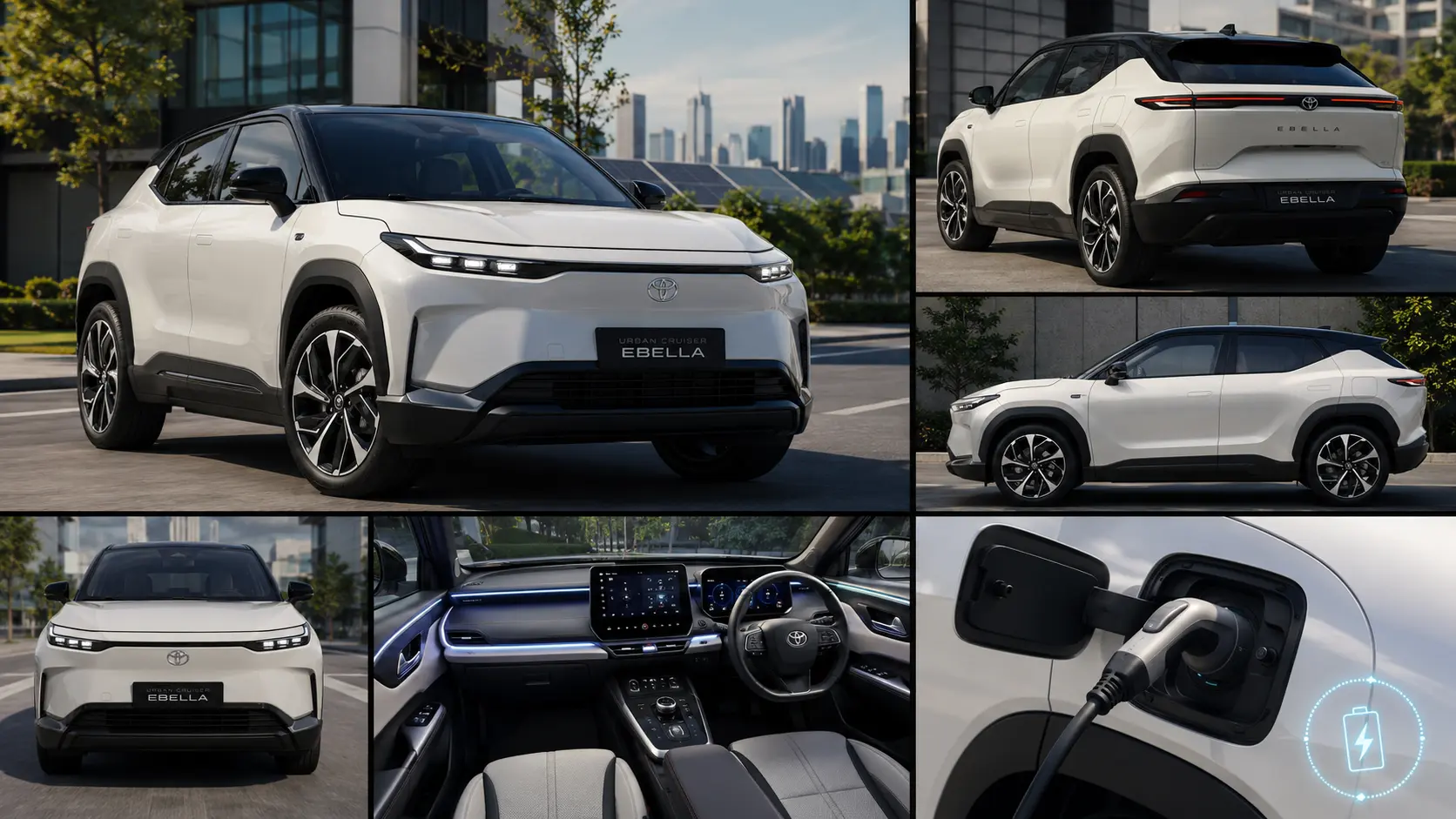
The front end is where Toyota has made its strongest visual statement. The segmented LED daytime running lamps and triangular headlamp housings give the Ebella a sharper face than its Maruti sibling. A thick black trim piece bridges the lamps, visually widening the car, while the bumper is smoother and more cohesive, flanked by vertical air vents that add some character without looking overdone.
The hammerhead front design — Toyota’s signature “shark-like appearance” according to evo India — achieves something genuinely striking at the front. The ice-cube LED DRLs, housed within triangular headlamp clusters and connected by a thick bridging trim piece, create a front face that is immediately recognisable as distinctly Toyota EV rather than generic compact SUV. In traffic at night, the segmented DRL pattern creates a distinctive light signature that turns heads without demanding them.
The LED headlamps house ice-cube DRLs that look genuinely striking, and the 18-inch aero-optimised wheels are well designed, with the silver and black fin design filling the arches appropriately.
The 18-inch aero-optimised alloy wheels — specific to the Ebella rather than carried from the e Vitara unchanged — are the most successful design element on the car’s profile. Their fin-pattern design visually implies the aerodynamic work they do, and their size fills the wheel arches in a way that prevents the car from looking top-heavy despite its 1,640 mm height.
During the shoot, I kept noticing the car from different angles and realised that its prettiest view is the rear three-quarter. The sloping roofline, wheels that fill the arches nicely, and the vertically mounted door handles all come together to give it a stance that looks both sporty and purposeful.
This evo India observation is the most important single exterior insight from any review. The rear three-quarter is the Ebella’s genuinely beautiful angle — where the sloping roofline, the filled arches, and the C-pillar-mounted door handles combine into a cohesive, purposeful stance that photographs dramatically. If you are choosing a colour and a viewing angle for your purchase decision test drive, the rear three-quarter in Sportin Red or Landbreeze Green dual-tone is the image that will make this car easiest to justify.
At the rear, the smoked tail lamps with ice cube LEDs look distinctive, and there’s a glass panel that stretches the entire width of the tailgate but doesn’t get a lightbar which is a good thing.
The deliberate absence of a connected rear light bar — when virtually every rival has added one because the trend demands it — is a design restraint decision that evo India specifically praises. The smoked tail lamps with ice-cube LED elements create their own identity without following fashion. Whether this ages better than connected light bars will be demonstrated over the next five years of ownership by early Ebella buyers.
The Ebella does not have the visual bulk or presence that many of its rivals carry. Compared to the Mahindra BE6 or even the MG Windsor, it feels understated and less substantial on the road. Still, the overall design is clean, modern and easy on the eyes, and it will likely appeal to buyers who prefer subtlety over flamboyance.
This CarWale observation is the most honest summary of the Ebella’s exterior positioning. It is a car for buyers who prefer to arrive rather than announce their arrival. For buyers who want their EV to generate conversation at traffic lights, the Mahindra BE 6 or Hyundai Creta Electric are better choices. For buyers who want a car that looks properly modern and ages gracefully — the Ebella’s restrained design ambition is exactly right.
Nine colour options are available including Landbreeze Green (dual-tone exclusive) and Sportin Red. Landbreeze Green is the most distinctive — a shade that communicates environmental consciousness without being preachy about it.
Interior Design and Cabin: Toyota’s Best Effort at This Price — With Genuine Packaging Compromises
The cabin of the Toyota Ebella is easily the best that Toyota has ever offered this side of the Camry in terms of both design and quality.
That CarDekho assessment is both the highest compliment and the clearest context for the Ebella’s interior. Within Toyota’s India portfolio — where the Fortuner’s cabin is functional but not premium, and the Hyryder’s interior is pleasant but not luxurious — the Ebella represents a genuine step upward in material quality and interior sophistication.
The cabin impresses with its fit, finish and perceived quality. Soft-touch materials, damped switchgear and the brown-black theme give it a premium feel. A single panel houses the 10.1-inch touchscreen and digital cluster; while mismatched in size, both screens are clear and well positioned. Storage is generous, thanks to the floating centre console and clever cubbies.
The damped switchgear observation from Autocar India is the detail that separates genuine interior quality from its simulation. Buttons, switches, and controls that operate with weighted resistance — rather than the lightweight, hollow feel of cheaper cabins — communicate build quality through touch rather than sight. Every time a Ebella owner operates a switch, the car reinforces its quality message. This is sustained premium feel rather than showroom impression.
Step inside and the Ebella immediately feels more premium than most Toyotas we’ve experienced in this segment. The dashboard adopts an asymmetric layout, topped by a dual-screen arrangement, a 10.1-inch digital driver’s display and a 10.25-inch central touchscreen. Controls feel tactile, and overall ergonomics are largely intuitive.
The asymmetric dashboard layout — where the driver’s side is more ergonomically focused and the passenger side has more visual expression — creates a cabin that feels genuinely designed rather than assembled from a parts bin. The squircle (square-circle hybrid) steering wheel is the interior element that most immediately communicates the car’s EV identity and modern character.
Start the car, shift to ‘D’ mode, take your foot off the brake pedal, and the car gets off the line smoothly. It will crawl forward without any accelerator input at 7 km/h. The power delivery is linear and predictable. Being an EV, there are no gearshift jerks or engine sounds, which translates to an extremely refined experience.
The cabin refinement that results from the EV powertrain — the total absence of engine sounds, gearshift jerks, and combustion vibration — is the Ebella’s most immediately transformative experience for buyers transitioning from petrol Toyota vehicles. The silence is different from the Hyryder’s quiet hybrid operation. It is complete. And it changes how every conversation in the car, every music note from the JBL system, and every road noise sounds.
The rear seat situation requires the most honest assessment of any part of this review.
Move to the rear, and legroom is genuinely generous thanks to the long wheelbase. Three adults can sit abreast without feeling overly squeezed and the seat base is well-padded. However, here’s where the Ebella’s biggest ergonomic compromise becomes apparent: rear-seat under-thigh support is virtually non-existent. The battery pack raises the floor significantly, forcing occupants into a knees-up position and the seat squab simply doesn’t extend far enough to support your thighs. Taller passengers will also find headroom tight, especially with the fixed glass roof overhead. The backrest reclines and the bench slides fore and aft, which helps tailor the space between passengers and luggage.
This Top Gear India assessment is the most precise and complete description of the Ebella’s rear seat reality available. Three adults across the bench without feeling squeezed — the 2,700 mm wheelbase delivers genuine lateral generosity. But the raised floor from battery placement creates a knees-up posture that becomes uncomfortable after 90 minutes for adults over 5’8″. The sliding rear bench partially compensates by allowing individual preference adjustment, but it cannot address the fundamental floor height consequence of the battery architecture.
The raised floor (because of the battery pack) affects under-thigh support for the driver. Taller drivers will particularly notice this. Over longer journeys, that slight lack of thigh support can translate into discomfort.
Both front and rear occupants experience the consequences of the raised floor to varying degrees. The driver’s ergonomic position is also affected — taller drivers will find that the raised floor pushes their knees higher than ideal, particularly relevant on four-hour highway drives.
The biggest disappointment is the surround-view camera quality. While the feature is useful in theory, the resolution and clarity are far below expectations, making it barely usable.
The 360-degree camera quality criticism from CarWale — specifically calling it “barely usable” — is the Ebella’s most damaging real-world feature failure. A 360-degree camera in a 2026 car at Rs 23.60 lakh should provide clear, properly resolved surround imaging. A system that reviewers characterise as barely usable is a failure of execution that no feature list inclusion can compensate for.
What the cabin gets right:
The Ebella offers large door pockets that can accommodate water bottles, decently-sized glovebox, and multiple cubby spaces around the centre console for phones, wallets and small items. The floating centre console design allows for additional open storage beneath it, which is particularly useful for keeping charging cables.
Storage thoughtfulness — the kind of consideration for how people actually use their cars daily — is one of the Ebella’s genuinely differentiated cabin qualities. The charging cable storage tray is precisely the kind of India-specific, EV-owner practical detail that makes daily ownership easier without appearing in any specification list.
Battery, Motor, and Performance: Linear, Refined, and Honest About Its Priorities
The E3 variant of the Urban Cruiser Ebella is powered by a front-mounted permanent magnet synchronous motor that generates 172 BHP and 193 Nm. The E3 variant has a kerb weight of 1,815 kg. The battery pack has an operating range from -30°C to 60°C.
The operating temperature range of -30°C to 60°C for the LFP battery is a technical specification that matters specifically for Indian buyers. At 60°C maximum operating temperature, the battery can function safely in conditions well beyond India’s peak summer temperatures — even in cities like Jodhpur or Jaisalmer where car cabin temperatures under direct sun can briefly exceed 60°C, the battery’s passive and active thermal management system maintains the pack within safe parameters.
Both battery packs power a front-mounted motor producing 193Nm. Output is 144hp (49kWh) or 174hp (61kWh). Despite weighing 1,815kg, performance is adequate rather than exciting. The Ebella does 0–100kph in 9.25 seconds and tops out at 160kph. Power delivery is smooth and linear, with Eco, Normal and Sport modes.
9.25 seconds for 0–100 kmph. In a segment where the Mahindra BE 6 achieves 6.7 seconds and the Hyundai Creta Electric does 7.9 seconds, the Ebella is the slowest among key rivals in straight-line acceleration terms. But the 9.25 second number communicates something important about Toyota’s product philosophy — this is not an EV calibrated to win drag races or impress with launch control. It is calibrated to be smooth, predictable, and confidence-inspiring for family buyers.
On the open road, as with most EVs, the Urban Cruiser Ebella provides instant torque when you press the throttle. While the car is not as fast as some other EVs I have driven, it is still quick enough to see you surge ahead of most ICE cars when the lights go green. The Urban Cruiser Ebella cruises at triple-digit speeds with ease. Whenever you need to overtake a slower vehicle quickly, just floor the accelerator and fly past it.
Team-BHP’s assessment — quick enough to surge ahead of most ICE cars, cruises at triple-digit speeds with ease — provides the practical performance context the 9.25-second figure does not. For the buyer transitioning from a petrol Hyryder or Urban Cruiser, the Ebella’s real-world urban and highway performance will feel meaningfully more capable than their previous car, despite the EV segment’s competitive benchmarks suggesting otherwise.
In a world where the Tata Curvv EV churns out upwards of 215Nm of torque, the Ebella’s 189Nm (from its 61kWh battery variant) sounds modest. But as they say, numbers are for brochures; the seat-of-the-pants feel is what truly matters when it comes to performance.
This autoX observation captures the essential character truth. The Ebella’s throttle calibration — smooth, progressive, linear from the first millimetre of pedal travel — makes the car feel more composed and confidence-inspiring than its numbers suggest. For everyday driving, this character is more useful than peak torque figures in the context of how most Indian families actually drive.
Regen has three levels but lacks one-pedal driving, and adjusting regen requires digging through menus.
This is the Ebella’s most frustrating daily-ownership limitation for EV enthusiasts. The absence of one-pedal driving — where maximum regen allows the driver to control deceleration through throttle lift rather than separate brake application — is a genuine capability gap versus the Tata Curvv EV and Hyundai Creta Electric that offer this feature as a matter of course. Combined with the menu-buried regen adjustment requirement, experienced EV drivers will find this calibration decision frustrating.
LFP battery chemistry from BYD blade cell technology:
The Urban Cruiser Ebella uses LFP blade-cell batteries sourced from BYD.
The LFP choice — versus the NMC chemistry used in the Hyundai Creta Electric — offers superior thermal stability, longer cycle life, and better performance retention across temperature extremes. For Indian buyers who cannot guarantee shaded parking or climate-controlled garages, LFP’s inherent thermal management characteristics reduce long-term battery degradation risk. This is the battery chemistry argument for the Ebella that transcends the headline range and power numbers.
Real-World Range: The Gap That Buyers Must Plan Around
The 61kWh version is rated at 543km, though early highway testing suggests around 370km in real-world conditions.
Our preliminary tests indicate a highway range of about 370km, which means you will need to charge a few times on the way to your hometown, so you need to factor that in as well.
Real Range approximately 330 single charge, less than committed.
Multiple sources independently suggest real-world highway range of 330 to 370 km from the 61 kWh battery — a 32 to 39 percent shortfall from the 543 km ARAI figure. This is a meaningful gap that is larger than what best-in-class EVs demonstrate under similar conditions. Buyers planning regular 300-plus km highway journeys must factor in a charging stop and verify station availability on their specific routes.
For urban daily use — charging overnight at home, commuting within 80 to 100 km daily — the real-world range is entirely adequate. A full overnight charge provides sufficient range for an entire working week without mid-week top-ups for most urban commuters.
The 49 kWh E1 variant’s 440 km ARAI claim will translate to approximately 280 to 310 km real-world highway range — firmly urban-use-only territory that requires daily home charging discipline.
Charging specifications:
Using a 70 kW DC fast charger (CCS2), the 61 kWh battery can be charged from 10% to 80% in approximately 45 minutes. With an 11 kW AC wallbox, a full 10% to 100% charge takes about 5.5 hours.
150kW DC fast charging capacity allows for quick top-ups which is useful on road trips.
The DC fast charging capability is the Ebella’s most important highway travel enabler. Whether the relevant specification is 67 kW DC (per Autocar India’s first drive) or 150 kW (per CarDekho) for the E3 variant should be verified with Toyota’s official specifications for your specific variant. At 67 kW, a 10 to 80 percent charge takes approximately 45 minutes. At 150 kW, this reduces significantly. Verify before purchase.
Features and Technology: A Solid List With Specific Frustrations
The Toyota Urban Cruiser Ebella will feature ventilated front seats, 10.1-inch driver’s display, 10.25-inch infotainment system, reclining and sliding rear seats, Level 2 ADAS, 360-degree camera, connected car tech and seven airbags.
The 2026 Urban Cruiser Ebella offers a 10.25-inch infotainment touchscreen, a 10.1-inch digital driver’s display, a wireless charging pad, automatic climate control, a JBL sound system, ventilated front seats, a powered driver’s seat, wireless Android Auto and Apple CarPlay, connected car tech, 12-colour ambient lighting, and more.
The JBL sound system — confirmed by multiple first-drive reviewers as genuinely impressive — is the feature that Ebella buyers consistently mention in early ownership feedback. JBL’s audio engineering delivers wide sound stage, controlled bass, and clear mid-range that fills the cabin with quality audio at all volume levels. For families spending significant time in the car, audio quality is a daily quality-of-life experience that the Ebella delivers well.
The 12-colour ambient lighting — adjustable through the infotainment system — transforms the cabin’s evening character significantly. In a cabin with the brown-black dual-tone theme, ambient lighting choices can shift the atmosphere from corporate professional to relaxed lounge depending on the driver’s preference.
Physical controls for climate and drive modes:
The Ebella strikes a balance by retaining physical buttons for critical functions like climate control and drive modes, while using a 10.1-inch touchscreen for infotainment and vehicle settings.
Physical climate controls — in an era of proliferating touchscreen integration for HVAC — represent a genuine daily-use safety advantage. Temperature and fan adjustments while driving require zero screen engagement, reducing distraction meaningfully.
The Ebella comes with a reasonably long feature list for the segment, but it doesn’t offer any segment-first features. Highlights include a single-pane fixed sunroof, connected car technology, digital instrument cluster, wireless smartphone connectivity, powered driver seat, ambient lighting and a surround-view camera system. However, there are noticeable omissions. Rear window blinds, which are becoming common in this price bracket, are missing. The front passenger seat is manually adjustable rather than electrically operated, which feels like a cost-saving move in an otherwise premium EV.
The manually adjustable front passenger seat at Rs 23.60 lakh is the feature omission that will most irritate buyers who notice it during a competitor comparison. The Hyundai Creta Electric and Mahindra BE 6 offer electrically adjustable front passenger seats at comparable price points. For a car positioned as Toyota’s premium EV debut, this feels like a specification shortcut.
The infotainment system is a weak link. Menus are unintuitive and response times are slow — even simple tasks like switching on seat ventilation require multiple steps.
It is easier to operate than the MG Windsor’s interface, which can feel cluttered at times. However, it still falls behind Hyundai’s system in the Creta EV, which remains the benchmark for usability in this segment.
The infotainment software quality — placed third in the segment hierarchy behind Hyundai’s benchmark and above MG’s clutter — is an honest competitive ranking. Toyota must invest in software improvement through over-the-air updates if the Ebella’s ownership experience is to match its purchase-day impression.
Safety Features: Seven Airbags and a Heritage to Back Them Up
The Toyota Urban Cruiser Ebella will feature Level 2 ADAS, 360-degree camera, connected car tech and seven airbags.
Advanced driver assistance system, adaptive cruise control, lane keep assist, lane departure warning, rear cross traffic alert, stagger warning, blind spot monitor, pre-collision system, adaptive high beam system.
Seven airbags on the E3 top variant — driver, front passenger, two side, two curtain, and driver knee — provide comprehensive passive protection. The driver knee airbag reduces lower-limb injury risk in frontal collisions, a meaningful safety addition that not all rivals provide at this price.
The Level 2 ADAS suite — with Toyota’s specific inclusion of a “stagger warning” (alerting the driver if the car deviates from lane alignment erratically) alongside the standard adaptive cruise, lane keeping, and blind spot monitoring — reflects Toyota Safety Sense’s global calibration heritage. Toyota has been developing and refining its driver assistance systems internationally across millions of vehicles for over a decade. The Ebella’s ADAS calibration benefits from this institutional knowledge.
The Toyota Ebella safety rating is yet to be revealed, but its badge-engineered sibling, the e Vitara, scored 5 stars in Bharat NCAP testing.
The e Vitara’s five-star Bharat NCAP result on the shared platform and production line provides the strongest available evidence for the Ebella’s structural safety credentials. The platform, body structure, and passive safety engineering are identical between the two vehicles. An Ebella-specific Bharat NCAP submission would convert this inherited confidence into confirmed verification — something Toyota should prioritise.
Ride Quality and Real-World Driving Experience: Toyota Gets the Important Thing Right
One thing Toyota usually gets right is the ride quality for Indian roads, and the Ebella continues that legacy. In fact, in terms of planted feel, it faithfully follows in the footsteps of the Innova. During the test, even at triple-digit speeds on the highway to Nandi Hills, the Ebella remained remarkably composed. With a ground clearance of 189mm, it effortlessly handled Bangalore’s notorious speed breakers without a hint of bottoming out, and it handles broken tarmac in a similar, non-fussed fashion. The suspension is taut but pliant, absorbing the sharp edges of potholes better than most heavy EVs, which often feel unsettled due to their sheer mass.
The autoX assessment from a 100 km road test through Nandi Hills — one of the most demanding test routes in southern India with winding mountain ascents and broken road surfaces — is the Ebella’s most enthusiastically positive real-world driving observation from any source. Remarkably composed at triple-digit speeds, effortlessly handling Bangalore’s speed breakers, suspension taut but pliant — these are the adjectives Toyota owners expect from their cars, and the Ebella delivers them.
The steering is light enough for a low-effort flick through tight traffic, but it weighs up nicely, inspiring confidence as the roads open up.
The progressive steering weight — light for city ease, confidently weighted for highway stability — is the calibration that makes a car feel appropriately sized for its use case. The Ebella’s 4,285 mm length and 1,800 mm width means it is a substantial car to navigate in dense traffic, and the light city steering reduces that navigation from effort to effortlessness.
However, two specific ride quality issues from Autocar India’s testing require honest presentation:
Low-speed ride is firm over sharp bumps, while highway speeds reveal a floaty rear and noticeable pitching.
The low-speed firmness over sharp, abrupt bumps — typical of potholes with sharp edges — and the floaty rear with noticeable pitching at highway speeds are genuine ride quality limitations that the autoX test on a different route did not specifically encounter. These two observations come from different test conditions and may reflect different road surfaces and speeds. The honest summary: the Ebella rides very well on typical Indian road surfaces and manages broken tarmac with composure. It can feel firm over specific sharp-edged urban impacts, and its rear suspension behaviour at sustained highway speeds shows a floatiness that better-calibrated dampers would address.
Handling is safe and predictable, and brake feel is reassuring.
Safe and predictable handling — the precise character Toyota has built its reputation on across every vehicle in its range. This is not about excitement or involvement. This is about the driver’s confidence that the car will do what they expect it to do, every time, without drama or unpredictability. For the family buyer this car targets, safe and predictable is the exact right aspiration.
The Toyota Urban Cruiser Ebella feels mature and sorted rather than experimental. The Toyota Urban Cruiser Ebella is then a sensible, well-rounded electric SUV that focuses on refinement and practicality over drama.
Mature and sorted. Not experimental. That is the most important characterisation of the Ebella’s driving experience from Times Drive, and it captures something that numbers cannot. Toyota’s first EV for India does not feel like a first attempt. It feels like a considered product from a company that watched, learned, and then delivered something calibrated for the specific buyer it is targeting.
Toyota Urban Cruiser Ebella — Complete Price and Variant Table
| Variant | Battery | Motor Power | ARAI Range | Drive Modes | Key Highlights | Ex-Showroom Price |
|---|---|---|---|---|---|---|
| E1 | 49 kWh LFP | 144 hp / 189 Nm | 440 km | Eco, Normal, Sport | LED headlamps, 7 airbags, Level 2 ADAS, auto AC, 18-inch alloys, i-Connect | To be announced |
| E2 | 61 kWh LFP | 174 hp / 189 Nm | 543 km | Eco, Normal, Sport | + JBL audio, sunroof, ventilated seats, powered driver seat | To be announced |
| E3 (Top-Spec) | 61 kWh LFP | 174 hp / 189 Nm | 543 km | Eco, Normal, Sport | Full spec + wireless charging, 360 camera, ambient lighting, sliding rear seats | Rs 23.60 lakh |
Note: All prices ex-showroom Delhi as of June 2026. Only the E3 variant’s price has been announced. E1 and E2 pricing expected shortly. Toyota offers an 8-year / 1,60,000 km battery warranty, a 60 percent assured buyback scheme, and Battery-as-a-Service option. Confirm all current pricing and scheme details with your nearest Toyota dealership.
Competitor Comparison: Where the Ebella Stands in the Compact EV Segment
| Parameter | Toyota Ebella E3 | Hyundai Creta Electric | Mahindra BE 6 | Tata Curvv EV | Maruti e Vitara (61kWh) |
|---|---|---|---|---|---|
| Ex-Showroom Price (Top) | Rs 23.60 lakh | Rs 23.25 lakh | Rs 26.90 lakh | Rs 21.99 lakh | Expected ~Rs 21 lakh |
| Battery | 61 kWh LFP | 51.4 kWh NMC | 59/79 kWh NMC | 55 kWh LFP | 61 kWh LFP |
| ARAI Range | 543 km | 473 km | 535/682 km | 585 km | 500 km (est.) |
| Real-World Range (est.) | 330–370 km | 380–400 km | 420 km (59 kWh) | 380–420 km | 330–370 km |
| Motor Power | 174 hp | 171 hp | 228 hp (top) | 167 hp | 174 hp |
| 0–100 kmph | 9.25 sec | 7.9 sec | 6.7 sec | ~8.5 sec | ~9.5 sec |
| Ground Clearance | 185–189 mm | 190 mm | 207 mm | 190 mm | 185–189 mm |
| Airbags (Top Variant) | 7 | 6 | 7 | 6 | 6 |
| ADAS Level | Level 2 (full suite) | Level 2 | Level 2 | Level 2 | Level 2 |
| Surround View Camera | Yes (quality poor) | Yes (good) | Yes | Yes | Yes |
| Ventilated Seats | Yes | Yes | Yes | No | Yes |
| JBL / Premium Audio | Yes (JBL) | Bose (top) | Sony (top) | JBL (top) | To confirm |
| One-Pedal Driving | No | Yes | Yes | Yes | No |
| Battery Chemistry | LFP (BYD blade) | NMC | NMC | LFP | LFP |
| Battery Warranty | 8 yr / 160K km | 8 yr | 8 yr | 8 yr | To confirm |
| Brand Trust India | Highest | High | Growing | High | Very High |
| Assured Buyback | Yes (60%) | No | No | No | To confirm |
| Platform Sibling | Maruti e Vitara | None | None | None | Toyota Ebella |
The comparison reveals the Ebella’s specific competitive positioning. It leads on airbag count versus most rivals, Toyota brand trust, LFP battery chemistry for longevity, assured buyback programme, and Level 2 ADAS comprehensiveness. It concedes on real-world range retention, 0–100 kmph performance, one-pedal driving availability, surround view camera quality, front passenger seat adjustment, and the infotainment software quality benchmark set by the Hyundai Creta Electric.
The Maruti e Vitara’s expected pricing at approximately Rs 21 lakh for the 61 kWh variant creates the Ebella’s most acute competitive pressure — same platform, same production line, same core engineering, Rs 2.60 lakh less expensive. The Toyota badge premium must justify itself through the service network, the ownership ecosystem, the assured buyback programme, and the brand relationship that Toyota buyers have specifically valued over decades.
Pros and Cons: The Complete Assessment
Pros:
- Toyota’s legendary brand trust and reliability reputation — the single most powerful competitive advantage in India’s EV market where after-sales anxiety remains the primary purchase barrier
- LFP blade-cell battery chemistry from BYD — superior thermal stability, longer cycle life, and better temperature performance range (-30°C to 60°C) versus NMC rivals
- 8-year / 1,60,000 km battery warranty — comprehensive long-term ownership confidence
- 60 percent assured buyback programme — removes resale value uncertainty that concerns first-time EV buyers significantly
- Seven airbags on the E3 variant — higher than the six-airbag standard most rivals provide
- Comprehensive Level 2 ADAS with Toyota Safety Sense calibration heritage — adaptive cruise, lane keeping, blind spot, pre-collision system, stagger warning
- Cabin fit and finish quality described as Toyota’s best below the Camry — damped switchgear and soft-touch materials create genuine premium feel
- JBL sound system delivers genuinely impressive audio quality — wide sound stage, controlled bass
- Physical climate controls retained — meaningfully safer than screen-integrated alternatives for in-motion adjustment
- Quiet, refined cabin — excellent sound deadening for an electric SUV at this price
- Light, progressive steering that weights up for highway confidence
- Ride quality specifically praised on Nandi Hills mountain roads — taut but pliant suspension handles Indian roads well
- Toyota’s established national service network — EV-ready infrastructure across India
- 12-colour ambient lighting transforms cabin atmosphere
- Sliding and reclining rear bench with 40:20:40 split — genuine seating flexibility
- Charging cable dedicated storage tray — India-specific practical detail
- The car feels mature and sorted rather than experimental — appropriate for Toyota’s conservative buyer profile
Cons:
- Only E3 top variant price announced at Rs 23.60 lakh — E1 and E2 pricing gap creates evaluation uncertainty
- No one-pedal driving despite three regen levels — a significant capability gap versus Hyundai Creta Electric, Mahindra BE 6, and Tata Curvv EV
- Regen adjustment requires menu navigation — daily frustration for drivers who regularly adjust regen levels in varying traffic
- Real-world highway range of 330–370 km represents 32–39 percent shortfall from 543 km ARAI claim — larger than class-leading range retention
- 9.25 second 0–100 kmph is uncompetitive in a segment where the Creta Electric does 7.9 sec and the BE 6 does 6.7 sec
- Surround view camera quality described as barely usable — resolution and clarity fall significantly below expectations for Rs 23.60 lakh
- Front passenger seat is manually adjustable — a cost-saving decision inconsistent with the car’s premium positioning
- Raised floor from battery placement creates knees-up rear seating uncomfortable for adults over 5’8″ on journeys exceeding 90 minutes
- Boot space is not class-leading — described as shallow rather than generous across multiple reviews
- Infotainment menus are unintuitive and slow — ventilated seat activation requires multiple steps
- Ground clearance at 184–185 mm is the lowest in the segment — some Indian urban speed breakers challenge this clearance
- Rear window blinds absent — increasingly standard at this price bracket
- No AWD option — FWD only for the Indian market
- Maruti e Vitara’s expected lower pricing for mechanically identical car creates the Ebella’s most acute value challenge
- Rear highway ride character shows floatiness and pitching that better suspension calibration could address
Who Should Buy the Toyota Ebella?
Buy the Toyota Ebella if you are a Toyota owner transitioning to your first EV. The service relationship, the service network, and the brand familiarity matter more in year three of ownership than in the first week of driving excitement. If you already know your Toyota dealer and trust the brand’s service commitment, the Ebella keeps you in an ecosystem you understand while delivering the electric experience you are ready to try.
Buy it if Toyota’s 60 percent assured buyback at the end of three years matters to you. Resale value uncertainty is among the top three barriers to EV adoption in India. Toyota’s financial commitment to buy back 60 percent of the ex-showroom price removes this uncertainty for the first ownership period in a way no competitor currently matches.
Buy the E3 at Rs 23.60 lakh if you want the full specification — JBL audio, ventilated seats, Level 2 ADAS, seven airbags, sliding rear seats, and the 61 kWh battery’s 330 to 370 km real-world range. If your daily commute is under 80 km and you have home charging access, this range profile more than covers your weekly driving without mid-week public charging.
Buy it if you value refinement and predictability over performance and excitement. The Ebella does not try to impress. It tries to be dependable, and it succeeds.
Who Should Avoid the Toyota Ebella?
Avoid it if regular highway driving of 300-plus km per day is your primary use case. The real-world range requires charging stop planning that the Mahindra BE 6 or a longer-range EV manages with more comfort. If the Toyota badge genuinely matters to you — wait to see if Toyota introduces a larger battery option.
Avoid it if one-pedal driving is non-negotiable. If you have experienced the Tata Nexon EV, Curvv EV, or Hyundai Creta Electric’s one-pedal mode and cannot imagine daily EV commuting without it — the Ebella’s regen-limited, menu-buried adjustment will frustrate you daily.
Avoid buying the E3 at Rs 23.60 lakh before E1 and E2 prices are announced. If the E2 61 kWh variant prices at Rs 20 to 21 lakh, buying the Rs 23.60 lakh E3 for ventilated seats and a sunroof may not represent optimal value. Wait for the complete pricing picture before committing.
Avoid it if you have tall adults regularly in the rear seat for journeys over 90 minutes. The knees-up floor position will make long trips uncomfortable. The Hyundai Creta Electric or Mahindra BE 6 offer better rear ergonomics for tall occupants on longer drives.
Expert Verdict: Ciao Bella — A Beautiful Entry That Asks You to Prioritise Trust Over Spec Sheet
Despite being late to the party, the Toyota Ebella’s cabin space, boot size, infotainment usability and ride quality fall short of expectations. However, it scores with interior quality, smooth performance and Toyota’s promise of efficiency and reliability. An 8-year battery warranty, 60 percent assured buyback and battery-as-a-service option could be game changers if priced aggressively. If Toyota gets the numbers right, the Ebella may yet carve out a niche despite its flaws.
The Toyota Urban Cruiser Ebella feels mature and sorted rather than experimental. The Toyota Urban Cruiser Ebella is then a sensible, well-rounded electric SUV that focuses on refinement and practicality over drama.
The Toyota Ebella review verdict, after digesting every independent first-drive assessment from India’s most authoritative automotive publications, is simultaneously simple and nuanced.
The Ebella is not the best electric SUV in the segment by any objective specification metric. The Hyundai Creta Electric has better real-world range retention, better infotainment, better performance, and one-pedal driving. The Mahindra BE 6 has greater performance and higher ground clearance. The Tata Curvv EV has better range claimed versus real-world alignment and one-pedal driving. On specification-by-specification comparison, the Ebella loses several rounds.
But the Ebella is not competing on specification density. It is competing on something that does not have a column in any comparison table: the cumulative weight of decades of Toyota ownership satisfaction that makes millions of Indian buyers default to this brand when they want something that will simply work, for a long time, without drama.
This is a company that has built its reputation not on revolution but on consistency — on cars that work, keep working, and rarely surprise their owners in inconvenient ways. Which makes this car less about disruption and more about adaptation.
The Ciao Bella of this review’s title is apt in the fullest sense. Beautiful — yes, particularly from the rear three-quarter. And late — yes, to a party where Tata, Hyundai, and Mahindra have been serving guests for years. But Toyota’s arrival changes the party’s character. Because when Toyota comes to the party, the serious buyers — the ones who will live with their decision for seven years, not just enjoy it for seven days — start paying attention.
The Ebella needs software updates for the infotainment. It needs a second allocation of attention to the suspension calibration for highway stability. It needs the 360-degree camera quality to match the Rs 23.60 lakh price point. And it needs the E1 and E2 pricing to be genuinely competitive rather than simply less expensive than the top variant.
If Toyota addresses these specifically — and given the company’s track record of continuous improvement, there is every reason to believe it will — the Ebella’s second year on sale will be a stronger proposition than its launch year.
Right now, the Toyota Ebella is a sensible, refined, trust-backed first EV that serves a specific, clearly defined buyer profile better than any competitor can with the same badge on the steering wheel.
Ciao, bella. Welcome to the party. The guests who care about the right things have been waiting for you.
Frequently Asked Questions About the Toyota Urban Cruiser Ebella
Q1. What is the price of the Toyota Ebella in India?
The 2026 Toyota Urban Cruiser Ebella price is Rs 23.60 lakh (ex-showroom) for the top-spec E3 61kWh variant. The Toyota Ebella top model on road price starts at Rs 25.05 lakh. Pricing for the E1 (49 kWh) and E2 (61 kWh) variants is yet to be officially announced. Toyota also offers a 60 percent assured buyback scheme and a Battery-as-a-Service option. Confirm all current pricing and scheme terms with your nearest Toyota dealership.
Q2. What is the real-world range of the Toyota Ebella?
The 61kWh version is rated at 543km, though early highway testing suggests around 370km in real-world conditions. Multiple sources including owner reports suggest real-world highway range of 330 to 370 km — approximately 32 to 39 percent below the ARAI figure. For urban mixed driving with home overnight charging, expect 350 to 400 km of comfortable daily range before the next charge is needed.
Q3. How does the Toyota Ebella compare to the Hyundai Creta Electric?
The Ebella leads on Toyota brand trust, LFP battery chemistry for thermal stability and longevity, seven airbags versus six, the 60 percent assured buyback programme, and driver assistance calibration heritage. The Creta Electric leads on real-world range retention, 0–100 kmph performance (7.9 sec versus 9.25 sec), one-pedal driving capability, infotainment software quality and usability, front passenger seat electrical adjustment, and surround view camera quality. If performance and features drive your decision — the Creta Electric. If brand trust and long-term ownership confidence drive it — the Ebella.
Q4. Does the Toyota Ebella have one-pedal driving?
Regen has three levels but lacks one-pedal driving, and adjusting regen requires digging through menus. The Ebella does not offer true one-pedal driving in any mode. Its maximum regenerative braking setting does not achieve sufficient deceleration for complete stop-without-brake-pedal operation. This is a genuine capability gap versus the Hyundai Creta Electric, Mahindra BE 6, and Tata Curvv EV that support one-pedal driving.
Q5. Is the Toyota Ebella safe? How many airbags does it have?
The E3 top variant has seven airbags including a driver knee airbag. The full Level 2 ADAS suite includes Toyota Safety Sense with adaptive cruise control, lane keep assist, lane departure warning, rear cross traffic alert, stagger warning, blind spot monitor, pre-collision system, and adaptive high beam system. The Toyota Ebella safety rating is yet to be revealed, but its badge-engineered sibling, the e Vitara, scored 5 stars in Bharat NCAP testing on the identical platform.
Q6. What is the battery warranty on the Toyota Ebella?
Toyota offers an eight-year or 160,000-kilometre warranty on the high-voltage battery pack, whichever comes first. Combined with the 60 percent assured buyback scheme and the optional Battery-as-a-Service plan, this creates one of the most comprehensive EV ownership confidence packages available in the Indian market.
Q7. Should I buy the Toyota Ebella or the Maruti e Vitara?
The Ebella and e Vitara share the same platform, production line, battery systems, motors, and core engineering. The differences are largely cosmetic and positioning-led. The Ebella adopts Toyota’s hammerhead front-end treatment, unique bumper detailing and brand-specific trims to visually distinguish itself. Toyota’s additional contribution includes its service network infrastructure, the 60 percent assured buyback scheme, and the Toyota brand relationship. If Toyota’s service network, brand reliability perception, and assured buyback programme are worth the expected price premium of Rs 2 to 3 lakh — the Ebella. If price-efficiency on identical engineering is your priority — the e Vitara.