
Advertisement
नीचे
स्क्रॉल करके
There is a moment every growing company hits — and almost nobody talks about it honestly.
You started with a small team. Everybody knew every customer. The founder handled the important relationships personally. Sales happened through trust, hustle, and reputation. Growth felt organic because it was organic — built on personal connections, word of mouth, and a tight-knit team that all shared the same mental picture of the business.
Advertisement
Then something shifted.
The team doubled. Then doubled again. New salespeople joined who did not know the customers the way the founders did. Marketing started generating leads that nobody had personal relationships with. Customer service tickets began coming in from people nobody recognized. And somewhere in the middle of all that growth, the business lost something it had not even noticed it was losing — the ability to treat every customer like the only customer.
Revenue kept growing. But the cracks were starting to show.
Deals that should have been straightforward started taking longer to close. Customer complaints began arriving about inconsistent service. The sales team was busy but the conversion numbers were frustrating. And when leadership sat down to figure out exactly what was happening and why, they realized that the answer was living in fifteen different places — someone’s inbox, a shared spreadsheet, a salesperson’s personal notes, a WhatsApp thread, a partially filled notebook on a desk.
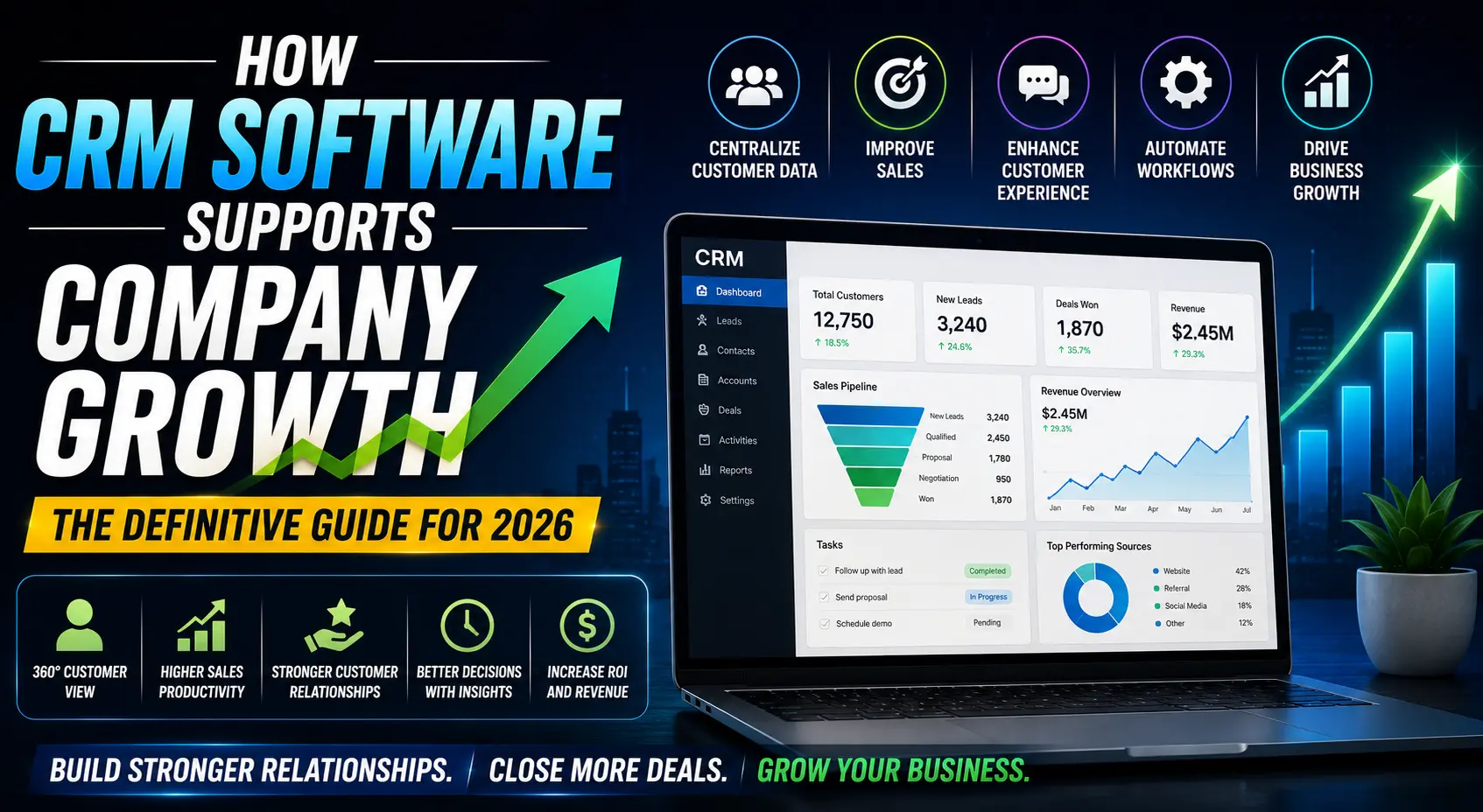
This is the inflection point where CRM software stops being a productivity tool and starts being the foundational infrastructure of company growth. And understanding exactly how CRM supports growth — not in marketing language, but in operational reality — is what this guide is about.
If your company is growing and you are wondering whether CRM software will genuinely move the needle, or if you already have a CRM and are not getting the results you expected, read this carefully. Everything you need to know is here.
Why CRM Is a Growth Infrastructure Decision, Not a Software Decision
Most businesses make the mistake of evaluating CRM software the way they evaluate any other software purchase — comparing feature lists, checking pricing tiers, reading reviews. That evaluation process misses the point entirely.
A CRM is not a tool that makes individual tasks easier. It is the infrastructure through which a company scales its most important capability: the ability to build and sustain meaningful relationships with a growing number of customers simultaneously.
Think about what makes a small business exceptional at customer relationships. The owner remembers every customer’s name, their preferences, the last conversation they had, the problem they mentioned six months ago, and the milestone they celebrated recently. That personal knowledge creates an experience that feels rare, valued, and irreplaceable — and it drives loyalty and referrals that no marketing campaign can manufacture.
Now scale that business to fifty employees, five hundred customers, and five different product lines. The personal knowledge model collapses completely. No human being can hold that much relationship context in their head. The business either builds a system to hold that context — a CRM — or it delivers an increasingly impersonal, inconsistent experience as it grows. And inconsistent customer experiences at scale are a churn machine.
This is the fundamental growth equation that CRM solves: as a company scales, the gap between the relationship quality it wants to deliver and the relationship quality it can deliver without a system widens exponentially. CRM closes that gap — and in doing so, it becomes the infrastructure that makes sustained, compounding growth possible.
In 2026, that infrastructure has become dramatically more powerful. The AI capabilities embedded in modern CRM platforms mean that your system is not just organizing relationship data — it is analyzing it, predicting from it, and acting on it in ways that make your growth engine smarter with every customer interaction.
Let us break down exactly how this works in practice.
The State of CRM for Growing Companies in 2026
The CRM market in 2026 has crossed a threshold that changes the calculus for every growing company. A few years ago, the most sophisticated CRM capabilities — predictive analytics, AI-powered lead scoring, autonomous workflow agents, conversation intelligence — were accessible only to enterprises with large technology budgets and dedicated IT teams. That era is over.
In 2026, mid-market and even small business CRM platforms include AI capabilities that were genuinely science fiction at the start of this decade. Agentic AI — systems that do not just recommend actions but take them autonomously — is now standard in platforms like HubSpot, Salesforce, Freshsales, and Zoho. These agents can engage inbound leads at any hour, update deal records based on email signals, summarize customer histories before calls, flag at-risk accounts before churn occurs, and draft personalized follow-up communications without human initiation.
The integration ecosystem has matured to the point where CRM is no longer a standalone tool but the hub of an interconnected revenue operations stack — connected to marketing platforms, customer support systems, financial software, communication tools, e-commerce platforms, and data warehouses. The value of a CRM in 2026 is amplified by every integration that makes data flow between systems without manual intervention.
Perhaps most importantly for growing companies, the barrier to adoption has fallen dramatically. Modern CRM platforms are faster to implement, easier to use, and better supported than at any previous point. A company can move from zero to a functioning, AI-powered CRM in days rather than months — removing the implementation complexity that historically made CRM a daunting investment for growth-stage businesses.
The companies that understand this shift and act on it are building a compounding structural advantage over those that do not. The gap is widening every quarter.
The Eight Ways CRM Software Directly Supports Company Growth
This is the core of what this guide is about — not abstract descriptions of CRM features, but the specific, concrete mechanisms through which CRM software drives growth. Each of these is a real, measurable lever. Understanding them changes how you think about CRM investment.
One: CRM Turns Customer Data Into a Scalable Competitive Advantage
Every interaction your company has with a customer or prospect generates data. What they bought, when they bought it, what they asked about, what they complained about, how they responded to your last campaign, how long they took to make a decision, what objections they raised. In a company without CRM, this data dissipates — it lives in someone’s memory until they leave, or gets buried in an email thread nobody will ever search.
In a company with a properly implemented CRM, this data accumulates, compounds, and becomes one of the most valuable assets your company owns. Over time, your customer data teaches you things that no amount of market research can — which customer profiles are your most valuable, which acquisition channels produce your best long-term customers, which product combinations drive the most upsell revenue, which communication approaches generate the highest response rates.
This is the growth flywheel that CRM enables. Every new customer, every new interaction, every new deal adds to a data asset that makes every future decision slightly more accurate. Companies that have been running a well-configured CRM for three years are making marketing, sales, and product decisions with a depth of customer intelligence that their data-poor competitors simply cannot access.
In 2026, AI accelerates this flywheel dramatically. Machine learning models trained on your historical customer data can surface insights that would take a team of analysts months to identify manually — and they can surface those insights in real time, in the workflow, at the moment they are actionable.
Two: CRM Standardizes Your Sales Process — Making It Repeatable and Scalable
Here is a growth problem that every scaling company faces eventually: your top two salespeople consistently outperform everyone else on the team, and nobody can fully explain why. You know they are doing something differently — something that works — but because their process lives in their heads rather than in a system, you cannot identify it, codify it, or teach it to the rest of the team.
A CRM solves this problem by making the sales process explicit, visible, and enforceable across the entire team.
When you define your pipeline stages, qualification criteria, required activities at each stage, and handoff protocols in the CRM, the process becomes the standard that everyone operates to — regardless of individual experience or habit. A new salesperson joining the team follows the same proven path that your best performers follow. A deal stuck in a stage too long triggers an automatic alert. A required activity not completed blocks progression to the next stage. The institutional knowledge of your best salespeople gets encoded in the system and replicated across the team.
Zoho CRM’s Blueprint feature is perhaps the most explicit implementation of this principle — a visual process designer that enforces every step, every required field, and every approval gate in your sales process. HubSpot’s Playbooks serve a similar function, providing in-context guidance and templates for every stage of the sales conversation. Both are tools that translate the wisdom of your best performers into systematic process that scales.
The growth impact is direct: when your sales process is standardized and enforced through the CRM, you can add salespeople without proportionally diluting the quality of your sales execution. This is the mechanism that allows a company to double its sales team without halving its close rate.
Three: CRM Eliminates the Revenue Leakage That Quietly Kills Growth
Revenue leakage — the deals and customer opportunities that slip away not because of a competitor winning or a product failing, but simply because of process failures, missed follow-ups, and poor coordination — is one of the most expensive and least visible problems in growing companies.
A prospect who expressed interest but was never properly followed up. A qualified lead that sat in someone’s inbox over a long weekend and went cold. A renewal that came due without anyone noticing and lapsed to a competitor. A customer who had an unanswell complaint that went unresolved and quietly churned. These losses are individually small but cumulatively devastating — and because they happen gradually and invisibly, most leadership teams dramatically underestimate how much revenue their company is losing to process failures.
CRM software eliminates these losses through automation and visibility. Every lead is captured automatically. Every follow-up has a due date and an owner. Every renewal approaching has a task assigned. Every customer who has not been contacted in a defined period triggers an alert. The deals that used to slip through the cracks now hit the floor and bounce — because the system catches them before they fall.
In 2026, AI detection makes this even more powerful. Platforms like Salesforce with Agentforce, HubSpot with Breeze, and Freshsales with Freddy AI analyze patterns across your entire pipeline to identify risk signals that would be invisible to manual review — a deal where email response time is lengthening, an account where usage metrics are declining, a prospect who visited your competitor’s pricing page after going quiet. These early warning signals allow your team to intervene before revenue is lost rather than analyzing the loss afterward.
Four: CRM Accelerates Sales Cycles — Getting to Revenue Faster
In every sales cycle, there is time that is genuinely value-creating — conversations that build trust, demonstrations that address concerns, proposals that respond to specific needs — and there is time that is purely administrative: researching a prospect before a call, updating a deal record after a meeting, coordinating internally about next steps, sending a follow-up that reiterates what was just discussed.
In companies without CRM, administrative time routinely consumes 40 to 60 percent of a salesperson’s day. In companies with well-configured CRM, that percentage drops dramatically — because the system handles the research, the record-keeping, the coordination, and increasingly, the follow-up communication automatically.
The result is shorter sales cycles — not because the selling gets rushed, but because the time between value-creating interactions shrinks. An AI-generated pre-call briefing replaces 30 minutes of research. Automatic email logging eliminates post-meeting data entry. Automated follow-up sequences ensure that no deal goes untouched because someone got busy. Smart scheduling tools eliminate the back-and-forth of meeting coordination.
For a company with an average sales cycle of 60 days, reducing that to 45 days through CRM-enabled efficiency is a 25 percent increase in revenue velocity — meaning the same team, with the same number of open deals, generates revenue 25 percent faster. Compounded across a full year, the growth impact is significant.
Five: CRM Enables Customer Retention — Which Is Growth’s Highest-ROI Activity
Here is a growth insight that is both well-known and systematically underinvested in: retaining an existing customer is five to seven times cheaper than acquiring a new one. Growing companies that focus exclusively on acquisition while neglecting retention are running a leaky bucket — pouring in new customers while losing existing ones at a rate that makes sustainable growth much harder than it needs to be.
CRM software is the mechanism through which customer retention becomes systematic rather than accidental. It tracks every customer relationship with the depth and continuity needed to identify customers at risk of leaving before they leave, and to create the touchpoints that make customers feel valued and engaged over time.
Customer health scores — available in most modern CRM platforms either natively or through integration with customer success tools — aggregate data about engagement levels, support ticket frequency, product usage, and payment behavior into a single metric that tells you how healthy each customer relationship is. When health scores drop, the system triggers an alert and a workflow: a check-in call from the account manager, a personal email from a senior team member, a targeted offer that addresses a known concern.
Renewal management within a CRM ensures that no subscription, contract, or service renewal slips past its date without proactive attention from the account team. Upsell and cross-sell opportunity identification — surfaced by AI models analyzing patterns across your customer base — turns your existing customers into a growth asset rather than just a retention challenge.
Companies that have built serious customer retention infrastructure within their CRM consistently show lower churn, higher net revenue retention, and faster compounding growth than those focused exclusively on acquisition.
Six: CRM Aligns Your Entire Revenue Team Around Shared Data
One of the most expensive and invisible costs of company growth is the friction created by misalignment between teams that touch the revenue process. Marketing blames sales for not following up on the leads they generate. Sales blames marketing for generating leads that are not qualified. Customer success learns about upsell opportunities weeks after sales already knew about them. Finance cannot get reliable revenue forecasts because the pipeline data is not trusted.
These are not personality problems or communication failures — they are data architecture problems. When different teams are working from different systems with different data models, misalignment is structurally inevitable.
CRM software, when properly implemented as the single source of truth for all customer-facing data, eliminates this structural misalignment. Marketing can see exactly what happens to the leads they generate after they hand off to sales — which channels produce the highest quality leads, which lead profiles convert most efficiently, which nurturing approaches produce the most sales-ready prospects. Sales can see the full marketing history of every lead before they reach out — what content they consumed, which campaigns they responded to, what behavioral signals they exhibited.
Customer success inherits a complete history of every pre-sale interaction when a deal closes. Finance gets pipeline data it can actually trust because it comes from a system with consistent data quality and a reliable update cadence. And leadership gets a single, integrated view of the entire revenue engine — from first marketing touch to customer lifetime value — rather than a fragmented collection of disconnected team-specific reports.
In 2026, the platforms that have invested most deeply in this team alignment capability — HubSpot with its unified customer platform, Zoho CRM Plus with its bundled suite, Salesforce with its Revenue Cloud — are delivering measurable competitive advantages to the companies that have adopted them. Cross-team visibility is not just an operational nicety. It is a structural growth enabler.
Seven: CRM Provides the Revenue Intelligence That Drives Smarter Strategic Decisions
Growing companies make dozens of decisions every quarter that directly determine whether growth accelerates or stalls: which markets to expand into, which customer segments to prioritize, which products to invest in, which salespeople to promote, which marketing channels to double down on, and where the pipeline is healthy enough to justify the growth targets being set.
In companies without CRM, these decisions are made primarily on intuition, anecdote, and whatever the loudest voice in the room is advocating for. In companies with a well-configured CRM, these decisions are made on data — specific, recent, directly relevant data from their own business.
Which lead sources produce the highest lifetime value customers? The CRM tells you. Which customer segments have the shortest time to close and the highest deal values? The CRM tells you. Which salespeople have the strongest close rates with enterprise accounts? The CRM tells you. Which geographic markets are showing the highest pipeline velocity? The CRM tells you.
In 2026, AI-powered analytics within CRM platforms has elevated this intelligence from descriptive — what happened — to predictive and prescriptive — what will happen and what should you do about it. Forecasting models trained on years of pipeline history can predict quarterly revenue with a precision that manual forecasting cannot approach. AI recommendation engines can identify the highest-leverage interventions for accelerating pipeline and reducing churn. Revenue intelligence dashboards surface the leading indicators of growth or risk weeks before those signals appear in lagging financial metrics.
The companies making the best strategic growth decisions in 2026 are the ones whose leadership is running on live, AI-enriched CRM data rather than monthly management accounts and gut instinct.
Eight: CRM Builds the Institutional Knowledge That Sustains Growth Through Change
Growing companies face an organizational challenge that never appears on a growth plan: staff turnover. When a key salesperson leaves, they take with them years of relationship context — the inside knowledge of how to deal with a particular client, the history of negotiations with a major account, the informal understandings that make a customer relationship work. For a company without CRM, this knowledge walks out the door and the relationship has to be rebuilt from scratch. Sometimes it cannot be.
CRM software institutionalizes relationship knowledge — making it independent of any individual and durable through organizational change. Every call, every email, every meeting note, every deal decision, every customer preference, every complaint resolution is recorded in the system and attached to the relevant customer record. When a salesperson leaves, the new person inherits not just a contact name but a complete relationship history — everything they need to pick up exactly where their predecessor left off.
This continuity of institutional knowledge is one of the most underappreciated growth benefits of CRM. It means that company growth is not undermined by the inevitable reality of employee turnover. It means that customer relationships belong to the company rather than to the individual. And it means that every person who joins your company can operate with the full benefit of everything their predecessors learned — without a single conversation being required to transfer it.
Best CRM Platforms for Supporting Company Growth in 2026
With a clear picture of how CRM drives growth, let us evaluate the platforms that deliver these capabilities most effectively in 2026.
HubSpot CRM — The Growth Platform by Design
HubSpot is not just a CRM that growing companies use — it is a platform that was architecturally designed to power the specific growth challenges that companies encounter as they scale from startup to mid-market and beyond.
The philosophical foundation of HubSpot — that marketing, sales, and customer service should operate from unified customer data rather than siloed systems — is directly aligned with the team alignment growth driver identified earlier. When your entire revenue team works in HubSpot, every handoff between teams is frictionless because the data is already there, already current, and already accessible to whoever needs it next.
Breeze AI, HubSpot’s artificial intelligence layer in 2026, powers growth support across every stage of the customer journey. Breeze Prospecting Agents identify and engage potential customers who match your ideal profile. Breeze Content Agents generate personalized outreach, follow-up emails, and proposals. Breeze Intelligence enriches every contact and company record with data sourced from a database of hundreds of millions of business profiles — giving your team the research depth they need without the manual effort.
The pipeline intelligence features at the Sales Hub Professional tier include predictive deal scoring, pipeline health metrics, deal velocity analysis, and AI-generated forecast summaries that tell leadership not just what the pipeline looks like but what is likely to happen to it. This is the revenue intelligence capability that transforms gut-feel forecasting into data-driven strategic planning.
For growing companies, HubSpot’s scalability is a specific advantage. The free CRM provides a real foundation — not a crippled demo version — that grows with you into paid tiers as your needs develop. The growth path from free to Starter to Professional to Enterprise is smooth, data-preserving, and does not require platform migration at any stage.
Pricing for Sales Hub Professional is approximately $100 per user per month billed annually in 2026, with bundled CRM Suite options offering better economics for companies that want marketing and service capabilities included.
Best for: B2B and B2C companies scaling from 15 to 500 employees, revenue teams that want marketing, sales, and service unified, and organizations prioritizing fast adoption and quality of user experience.
Zoho CRM — The Growth Enabler for Value-Focused Companies
Zoho CRM’s growth support credentials in 2026 are more impressive than its marketing presence suggests, and for Indian companies specifically, it represents the most compelling combination of capability and pricing available in the market.
Zia AI, Zoho’s intelligence layer, contributes to company growth across multiple dimensions simultaneously. Zia’s predictive sales forecasting analyzes historical pipeline patterns to project quarterly outcomes with meaningful accuracy — reducing the strategic uncertainty that undermines good growth planning. Zia’s deal prediction feature tells sales managers which opportunities are most likely to close and which are at risk, enabling targeted coaching and resource allocation. Zia’s anomaly detection flags unusual patterns — a geographic market underperforming, a product segment suddenly gaining momentum, a sales rep’s numbers diverging from their historical baseline — creating the kind of early visibility that allows leadership to respond to emerging situations rather than react to them after the fact.
The Blueprint process enforcement tool is the mechanism through which Zoho CRM standardizes sales processes across growing teams — one of the critical growth levers identified in this guide. As your company adds salespeople, Blueprint ensures they execute the correct process from their first day rather than developing their own variations.
Zoho CRM’s Territory Management feature becomes increasingly valuable as companies grow into new geographic markets or customer segments. Territories can be defined by geography, industry, revenue size, or custom criteria, and leads are automatically routed to the right team based on those rules — ensuring that expansion does not create the coordination chaos that so often accompanies it.
For Indian growing companies, Zoho’s native integration with Zoho Books creates a seamless connection between CRM pipeline data and accounting reality — giving leadership an integrated view of revenue from first prospect contact through invoice collection that is genuinely rare at this price point.
Enterprise plan pricing at approximately ₹2,400 per user per month (billed annually) makes this the most accessible enterprise-grade CRM in the Indian market.
Best for: Indian growing companies seeking maximum value, organizations scaling multi-city or multi-territory operations, and businesses wanting a unified platform across sales, marketing, accounting, and customer service.
Salesforce Sales Cloud — The Scalable Foundation for Ambitious Growth
For companies with genuine enterprise-scale growth ambitions — targeting hundreds of salespeople, multiple business units, complex multi-geography operations — Salesforce Sales Cloud remains the most scalable CRM foundation available.
Agentforce, Salesforce’s agentic AI platform, has changed the growth support calculus significantly in 2026. AI agents that can autonomously handle lead engagement, deal progression updates, customer health monitoring, and renewal management mean that Salesforce in 2026 is not just managing your growth data — it is actively participating in your growth process. Early adopters of Agentforce report meaningful reductions in sales cycle length and administrative overhead as agents handle the routine while human salespeople focus on the relationship-building that drives conversion.
Einstein’s forecasting capabilities are the most mature in the market — built on millions of enterprise sales cycles and continuously refined. For companies where revenue predictability is a strategic priority — whether for investor reporting, hiring decisions, or operational planning — Einstein’s forecast accuracy represents a meaningful competitive advantage.
The Salesforce ecosystem — 7,000-plus AppExchange applications, thousands of certified implementation partners, industry-specific clouds for financial services, healthcare, manufacturing, and more — means that whatever your company’s specific growth context, there is a Salesforce solution for it.
The honest evaluation for growing companies: Salesforce at the Professional tier ($80 per user per month) and above is a significant investment. Growing companies should evaluate whether they have the deal volume, deal values, and internal capability to extract the full return on that investment — and be honest about it. For companies on that trajectory, there is no better long-term foundation.
Best for: Companies with 50-plus salespeople or clear trajectory there, organizations in industries with Salesforce-specific vertical solutions, and businesses where scalability over a 5-plus year horizon is the primary selection criterion.
Freshsales — The AI-Powered Growth Accelerator
Freshsales has established itself in 2026 as the growth CRM for companies that want AI-powered sales intelligence at mid-market pricing — and it delivers on that positioning more consistently than most alternatives.
For growing companies specifically, Freshsales’ growth support comes from two directions. The intelligence direction: Freddy AI continuously analyzes your pipeline to surface deal risk signals, identify patterns in successful deals, and predict conversion probabilities — giving sales managers the diagnostic visibility needed to coach teams and allocate resources intelligently. The productivity direction: built-in telephony, automated email logging, AI-generated call summaries, and streamlined pipeline management tools reduce the administrative burden per deal, allowing growing sales teams to handle more volume without proportionally increasing headcount.
The contact timeline feature provides every salesperson with a complete, chronological history of every interaction with every contact — emails, calls, meetings, website visits, support tickets — in a single scrollable view. This is the “know every customer as well as the founder did” capability that CRM is supposed to deliver at scale, and Freshsales executes it cleanly.
WhatsApp Business integration, native in Freshsales in 2026, is a meaningful growth enabler for Indian companies where WhatsApp is increasingly the primary channel for customer communication. The ability to manage WhatsApp conversations within the CRM, log them against the correct contact record, and trigger automated workflows based on WhatsApp interactions is a genuine competitive advantage for businesses operating in markets where this channel matters.
Enterprise plan at approximately $69 per user per month delivers the full AI suite, advanced analytics, territory management, and custom modules at a price that compares favorably with HubSpot and Salesforce.
Best for: Sales-driven growing companies, organizations where AI-assisted pipeline management is a priority, Indian businesses where WhatsApp integration is a core requirement, and companies seeking enterprise-grade AI without enterprise pricing.
Pipedrive — The Pipeline Clarity Engine for Growing Sales Teams
As sales teams grow, pipeline visibility becomes one of the most pressing management challenges. Who owns which deals? Which opportunities have been neglected? Where is the pipeline healthy and where is it at risk? What does the next 90 days of revenue actually look like?
Pipedrive answers these questions more clearly and intuitively than any other platform in its price range — and for growing companies where sales pipeline management is the primary CRM use case, this focused excellence has real value.
The Activity-Based Selling framework embedded in Pipedrive’s design means that as your team grows, the system consistently surfaces the next action required on every deal for every salesperson — reducing the cognitive load on individual reps and making it virtually impossible for deals to go quiet without a manager noticing.
The AI Sales Assistant in 2026 analyzes pipeline patterns and proactively identifies where deals are stalling, which reps are on track and which need coaching attention, and where the biggest opportunities for pipeline improvement lie. This is the kind of management intelligence that allows a sales leader to effectively manage a growing team without being in every conversation personally.
Revenue forecasting in Pipedrive’s Professional and Power plans provides the forward visibility growing companies need for planning — deal-by-deal projections, probability-weighted pipeline totals, and historical win rate analysis that contextualizes current pipeline health.
Best for: Sales-led growing companies with defined pipeline processes, organizations scaling from 10 to 75 salespeople who want pipeline clarity above all else, and businesses that prefer best-of-breed integration approaches.
Pricing Comparison: CRM Platforms for Company Growth in 2026
| Platform | Free Tier | Growth Tier | Per User/Month (Annual) | AI Included | Best for Growth Stage |
|---|---|---|---|---|---|
| HubSpot Sales Hub | Yes (unlimited users) | Professional | ~$100 | Yes (Breeze AI from Pro) | 15 to 500 employees |
| Zoho CRM | Yes (3 users) | Enterprise | ~₹2,400 (~$29) | Yes (Zia AI from Enterprise) | 10 to 200 employees |
| Zoho CRM Plus | No | All-inclusive | ~$57 | Yes (Zia AI) | 20 to 300 employees |
| Salesforce Sales Cloud | No (trial only) | Professional / Enterprise | $80 to $165 | Yes (Einstein / Agentforce) | 50 to unlimited |
| Freshsales | Yes (limited) | Enterprise | ~$69 | Yes (Freddy AI) | 15 to 200 employees |
| Pipedrive | No (14-day trial) | Professional / Power | $49 to $64 | Yes (AI Assistant) | 10 to 100 salespeople |
Feature Comparison: How Each Platform Supports Company Growth
| Growth Driver | HubSpot Pro | Zoho Enterprise | Salesforce Pro | Freshsales Enterprise | Pipedrive Professional |
|---|---|---|---|---|---|
| Process Standardization | Playbooks | Blueprint | Flows / Process Builder | Sequences + Modules | Activity Framework |
| AI Revenue Forecasting | Yes (Breeze) | Yes (Zia) | Yes (Einstein) | Yes (Freddy) | Yes |
| Churn / Retention Signals | Yes | Yes (SalesSignals) | Yes | Yes | Limited |
| Team Alignment Features | Excellent (unified platform) | Excellent (CRM Plus) | Excellent | Good | Limited |
| Agentic AI Workflows | Yes (Breeze Agents) | Partial | Yes (Agentforce) | Yes (Freddy Agent) | No |
| Institutional Knowledge Capture | Excellent | Excellent | Excellent | Good | Good |
| Territory Management | Yes | Yes | Yes (advanced) | Yes | Yes |
| Revenue Intelligence Dashboards | Excellent | Excellent | Excellent | Good | Good |
| WhatsApp Integration | Via third party | Native | Via third party | Native | Via third party |
| Scalability Ceiling | High | High | Unlimited | High | Moderate |
| Implementation Speed | Fast | Moderate | Slow | Fast | Fast |
| Ease of Adoption | Excellent | Good | Moderate | Excellent | Excellent |
Pros and Cons of CRM Software for Company Growth
Pros
- Creates a scalable foundation for customer relationships that maintains quality as the company grows — solving the fundamental problem that growth creates without a system
- Standardizes sales processes across growing teams, ensuring that institutional knowledge becomes repeatable rather than individual
- Eliminates revenue leakage from missed follow-ups, unmanaged pipeline, and poor lead routing — recovering revenue that was previously being lost invisibly
- Accelerates sales cycles by removing administrative burden and enabling faster, more consistent customer engagement
- Provides leadership with the revenue intelligence needed to make confident strategic decisions rather than educated guesses
- Enables customer retention at scale through systematic health monitoring, renewal management, and relationship continuity — protecting the compounding value of the existing customer base
- Aligns revenue teams around shared data — ending the structural misalignment between marketing, sales, and customer success that grows more expensive as companies scale
- Builds institutional knowledge that survives individual employee turnover — making the company’s relationship assets durable rather than fragile
Cons
- Implementation quality directly determines outcomes — a CRM set up poorly will deliver poor results regardless of how good the platform is
- Cultural adoption is not automatic — teams that have operated without CRM discipline for years can resist the change, and leadership must manage this actively
- Data quality must be maintained as a continuous discipline — the value of CRM compounds with clean data and degrades with dirty data, and cleaning large volumes of bad data is expensive
- Platform selection mistakes are costly — choosing a CRM that fits today but not the company’s three-year trajectory creates migration costs and business disruption
- Over-configuration is a real risk — companies that try to implement every feature simultaneously often produce a system so complex that adoption collapses under the weight of it
- AI capabilities require data volume to perform — newly implemented CRMs without sufficient historical conversion data will produce less accurate predictive outputs in the early months
- Subscription costs compound with growth — what costs ₹50,000 per month for a team of 20 can reach ₹3 lakhs per month for a team of 120, making total cost planning important
How to Implement CRM for Maximum Growth Impact
The selection decision matters — but the implementation decision matters more. Here is the framework for implementing CRM in a way that actually drives the growth outcomes described in this guide.
Start With Process Design, Not Technology Configuration
Before opening your new CRM and starting to configure, invest time in mapping your current sales process — from the moment a lead enters your awareness to the moment a customer is fully onboarded. Identify every stage, every required action, every qualification criterion, every handoff point. Note where the process currently breaks down, where leads are being lost, where communication is inconsistent.
This process map becomes the blueprint for your CRM configuration. Every pipeline stage, every required field, every automation rule should directly reflect a conscious process decision — not a default that came with the software.
Implement in Phases, Not All at Once
The single most common cause of CRM implementation failure is trying to turn on every feature simultaneously. The team gets overwhelmed, adoption collapses, and the CRM becomes a cautionary tale rather than a growth engine.
Phase one should focus exclusively on the core workflow: lead capture, contact management, pipeline tracking, and basic follow-up task management. Get the team using this consistently before adding anything else. Phase two introduces email sequences, lead scoring, and basic automation. Phase three adds analytics, forecasting, and advanced AI features. This phased approach ensures adoption at each stage before adding complexity.
Make CRM the Only Approved System for Customer Data
The death of CRM adoption is parallel systems. When salespeople maintain their own spreadsheets, their own personal contact lists, their own WhatsApp groups because the CRM is “extra work,” the system loses its value as a single source of truth and the team loses the alignment benefits that justify the investment.
Establish a clear policy: if it is not in the CRM, it does not exist for operational purposes. Deals not in the CRM do not receive support. Leads not in the CRM do not receive commission credit. Activities not in the CRM are not counted in performance reviews. This is not bureaucracy — it is the cultural infrastructure that makes the system work.
Measure Adoption Before Measuring Outcomes
In the first 90 days of CRM implementation, the primary metric is adoption — are people using the system as intended? Data completeness, activity logging rates, pipeline update frequency, and sequence enrollment rates tell you whether the system is actually being used. These leading indicators predict whether the revenue outcomes will follow. If adoption is low at 90 days, fix the adoption problem before expecting the revenue results.
Who Gets the Most From CRM-Supported Growth
Companies at the most critical growth inflection point — where the personal relationship model is breaking down but formal enterprise processes have not yet been implemented — extract the highest immediate value from CRM adoption. This is typically the 15 to 75 employee stage, where the original team’s informal coordination methods are visibly failing but the company has not yet built the operational infrastructure to replace them.
Companies in relationship-intensive industries — professional services, financial services, B2B technology, real estate, healthcare, hospitality, manufacturing with long sales cycles — see particularly strong growth outcomes from CRM because the quality of relationship management is directly correlated with both conversion and retention in these sectors.
Companies with multiple revenue streams — new business sales, upsell and cross-sell, renewals, partnerships — benefit enormously from the unified customer view that CRM provides, because the same customer appears in multiple revenue conversations simultaneously and coordination without a shared system is nearly impossible.
Expert Verdict: The CRM That Will Best Support Your Company’s Growth in 2026
Here is the direct, honest recommendation — organized by growth context rather than by company size alone.
For companies building a unified revenue operation where marketing and sales grow together: HubSpot Sales Hub Professional. The platform’s philosophical alignment with how modern revenue teams should work, combined with the quality of its AI and the strength of its user experience, makes it the default recommendation for most growing companies evaluating CRM in 2026.
For Indian companies that want to build a sophisticated, AI-powered growth infrastructure without enterprise pricing: Zoho CRM Enterprise or Zoho CRM Plus. The value delivered relative to cost is unmatched in the Indian market, and the ecosystem depth — Zoho Books, Zoho Desk, Zoho Analytics — creates a unified operational platform that supports growth across every function.
For companies where sales execution is the primary growth driver and the CRM needs to maximize the productivity of a growing sales team: Freshsales Enterprise. The AI depth, the built-in telephony, and the intuitive interface make it the most effective pure-sales growth tool in the mid-market.
For companies with ambitious growth trajectories and the budget to invest in the most scalable foundation: Salesforce Sales Cloud with Agentforce. The upfront investment is significant but the scalability, the ecosystem, and the AI capabilities compound in value as the company grows.
For sales-led companies at an early growth stage that need pipeline clarity above all else at a rational price: Pipedrive Professional. The focus, the simplicity, and the quality of the pipeline management experience deliver immediate growth value without overwhelming a team that is still building its CRM discipline.
The meta-recommendation across all of these: whichever platform you choose, choose it with your three-year trajectory in mind and implement it with the discipline it deserves. A CRM that is mediocrely used is an expensive contact database. A CRM that is properly implemented and consistently maintained is a compounding growth engine — one that gets more valuable with every customer interaction, every deal closed, and every year of operation.
That is the growth investment case for CRM software in 2026. The question is not whether it is worth making. The question is whether you are ready to make it with the intention it requires.
Frequently Asked Questions
How does CRM software directly increase company revenue?
CRM increases revenue through several simultaneous mechanisms. It eliminates lead and deal leakage by ensuring every opportunity is captured and systematically followed up. It accelerates sales cycles by removing administrative burden and enabling faster, more consistent engagement. It improves close rates by ensuring the right lead reaches the right salesperson with the right context at the right time. It reduces churn by creating systematic customer health monitoring that identifies and addresses retention risk before it becomes revenue loss. And it enables upsell and cross-sell by surfacing opportunities within the existing customer base that manual management would miss. Together, these mechanisms typically produce 20 to 40 percent improvements in revenue outcomes for companies that implement CRM properly.
How long does it take to see growth results from CRM implementation?
The timeline varies by implementation quality and starting point. Companies implementing basic lead capture and follow-up automation typically see measurable improvements in response rates and lead conversion within 30 to 60 days. Pipeline visibility improvements and sales cycle acceleration become visible within 60 to 90 days of consistent use. The compound benefits — improved data quality, better forecasting accuracy, higher team alignment — typically become clear within two to three quarters. The full growth impact, including customer retention improvements and strategic decision-making quality, compounds over 12 to 24 months of consistent use.
What is the biggest risk in CRM implementation for a growing company?
The biggest risk is not choosing the wrong platform — it is choosing the right platform and implementing it wrong. Specifically, the two most common failure modes are: implementing too many features simultaneously, which overwhelms the team and collapses adoption; and failing to establish CRM usage as a non-negotiable operational standard, which allows parallel systems to persist and undermines the data quality that makes the system valuable. Both risks are manageable with deliberate implementation planning and consistent leadership commitment.
Should a growing company build its CRM around sales, marketing, or customer success?
The most effective answer in 2026 is to build it around the customer — using a unified platform where sales, marketing, and customer success all operate from the same customer record. HubSpot, Zoho CRM Plus, and Salesforce all support this unified model. For companies that cannot afford a fully unified platform initially, starting with sales as the CRM anchor — because sales process quality is typically the most immediate revenue lever — and adding marketing and customer success capabilities over time is a sensible approach.
How do I measure whether my CRM is actually supporting company growth?
Track four categories of metrics. Pipeline health metrics: conversion rate by stage, average sales cycle length, win rate, pipeline coverage ratio. Revenue metrics: revenue per salesperson, average deal value, quota attainment rate. Retention metrics: churn rate, net revenue retention, renewal rate, customer lifetime value. Operational metrics: CRM data completeness, activity logging rates, sequence enrollment and completion rates, response time to new leads. Improvement across these categories, correlated with consistent CRM usage, demonstrates that the system is delivering on its growth support potential.
How does CRM help a company grow into new markets or geographies?
CRM supports geographic and market expansion specifically through territory management — defining which teams handle which regions or segments and automatically routing leads and accounts accordingly. It supports expansion by making the company’s successful sales process in existing markets replicable in new ones, rather than requiring new market teams to develop their own approaches from scratch. It supports expansion by giving leadership visibility into new market pipeline health and trajectory in real time, enabling rapid diagnosis and response when expansion is underperforming. And it supports expansion by maintaining institutional knowledge about early customers in new markets — building the relationship asset in a new geography from day one rather than depending on individual knowledge.
The Final Word: CRM Is Not a Cost. It Is How Growth Compounds.
The companies that are growing most confidently and most sustainably in 2026 share a common characteristic. They have built the infrastructure to know their customers deeply, serve them consistently, retain them reliably, and make strategic decisions with the intelligence their customer relationships generate.
CRM software is that infrastructure. It is the system that turns the messy, complex, human reality of customer relationships into an organizational capability that scales — that gets stronger, not weaker, as the company grows.
The platforms in this guide will deliver that capability in the right context, implemented with the right discipline. The choice of platform matters. The quality of implementation matters more. And the organizational commitment to using the system as the single source of truth for every customer relationship matters most of all.
Growing companies that make this investment in 2026 are not just buying software. They are building the compounding infrastructure that every customer interaction, every closed deal, and every retained relationship makes more valuable over time.
That is not a cost. That is how growth compounds.
Start building it now.