Tata Harrier Petrol Review: Replacement for Displacement — Six Years of Diesel Exclusivity End. Does India’s Favourite Diesel SUV Translate to Petrol?

Advertisement
The Harrier Was Born Diesel. It Lived Diesel. And Then, On December 9, 2025, Everything Changed — For Every Buyer Who Had Been Waiting.
Let me tell you what happened for six years.
Advertisement
Every month, thousands of Indian buyers walked into Tata showrooms, looked at the Harrier’s commanding design, touched the panoramic sunroof switch, sat in the rear seat and found it genuinely spacious, discovered the five-star Global NCAP safety rating, read the feature list, fell in love — and then found out there was no petrol engine. And walked out.
Not because the diesel was bad. The Kryotec 2.0L diesel’s 350 Nm was genuinely magnificent for highway driving. Not because the car was badly designed or poorly featured. The Harrier has always been one of the best-designed, most feature-rich mid-size SUVs in India at any price.
But because in 2025 and beyond, diesel in urban India is a complicated personal calculation that a growing number of buyers have already made. Higher maintenance intervals. Cold start behaviour in winter months. Particulate filter concerns. And — most importantly — the simple, growing preference among younger Indian buyers who have grown up filling petrol and want to continue filling petrol.
Tata Motors understood this. And on December 9, 2025, after six years of the Harrier being exclusively diesel, they launched the Hyperion 1.5L turbo-petrol Harrier.
The question this Tata Harrier petrol review — inspired by Autocar India’s own title for their first drive — asks is the most important question about any powertrain transition: does the engine replacement actually work? Is 1.5 litres and 280 Nm a genuine replacement for 2.0 litres and 350 Nm? Can refinement compensate for displacement? And was the six-year wait worth it?
The short answer is yes, with nuance.
The long answer follows.
Quick Overview: The Harrier Petrol’s Essential Context
Tata says around 30 percent of sales in the high-SUV segment that the Harrier and Safari compete in now come from petrol-powered vehicles, and so naturally, it wants a piece of that action. To this end, the Harrier now gets Tata’s new 1.5-litre Hyperion turbo-petrol engine, which recently debuted on the Sierra.
That 30 percent figure is the commercial reality that makes this powertrain addition not just desirable but genuinely necessary for the Harrier’s continued relevance. When nearly a third of your segment’s sales are petrol buyers — and the Harrier has no petrol option — that is not a niche you are ignoring. That is a large, growing segment of customers you are actively turning away.
Harrier petrol’s 1.5-litre turbocharged unit makes 10hp more than in the Sierra. Under the hood is the Hyperion 1.5-litre turbo-petrol engine that debuted on the Sierra, but Tata has tuned it specifically for this application. Power figures reflect this, with 170hp at 5,000rpm and 280Nm from 1,750 to 3,500rpm — 10hp and 25Nm more than the Sierra. Crucially, Tata has profiled the power and torque curves to account for the Harrier’s heavier weight, and the engine here makes a healthy 160Nm at a low 1,000rpm.
This tuning detail — 170 hp and 280 Nm, calibrated specifically for the Harrier’s heavier body, with 160 Nm available at 1,000 rpm — is the engineering decision that determines whether the 1.5L engine is adequate or genuinely impressive in this application. We will return to it in full detail in the performance section.
This 1.5L 4-cylinder Turbo Petrol engine is capable of generating 170 PS of peak power and 280 Nm of peak torque, mated to a 6-speed Manual or a 6-speed AISIN-sourced torque converter automatic. This engine runs on Miller Cycle with segment’s highest compression of 11.5. Tata Motors mentioned that Safari Petrol has segment’s best NVH at just 37.8 db, while the closest rival is at 40.7 db.
The Miller Cycle operation — which uses a longer expansion stroke than compression stroke to improve thermal efficiency while reducing pumping losses — is a technical sophistication that budget engines do not receive. And the 37.8 dB NVH claim — nearly three decibels quieter than the nearest rival’s 40.7 dB — translates into a genuine, meaningful real-world quietness advantage that the review numbers will confirm.
January 7, 2026: The Tata Harrier’s petrol variant prices are announced. It ranges between Rs 12.89 lakh and Rs 24.69 lakh (ex-showroom).
Available in seven trims — Smart, Pure X, Adventure X, Adventure X+, Fearless X, Fearless X+, and Fearless Ultra — with six-speed manual and the AISIN-sourced six-speed torque converter automatic.
Now the complete story.
Exterior Design: Iconic, Unchanged, and Still the Best-Looking Mid-Size SUV in India
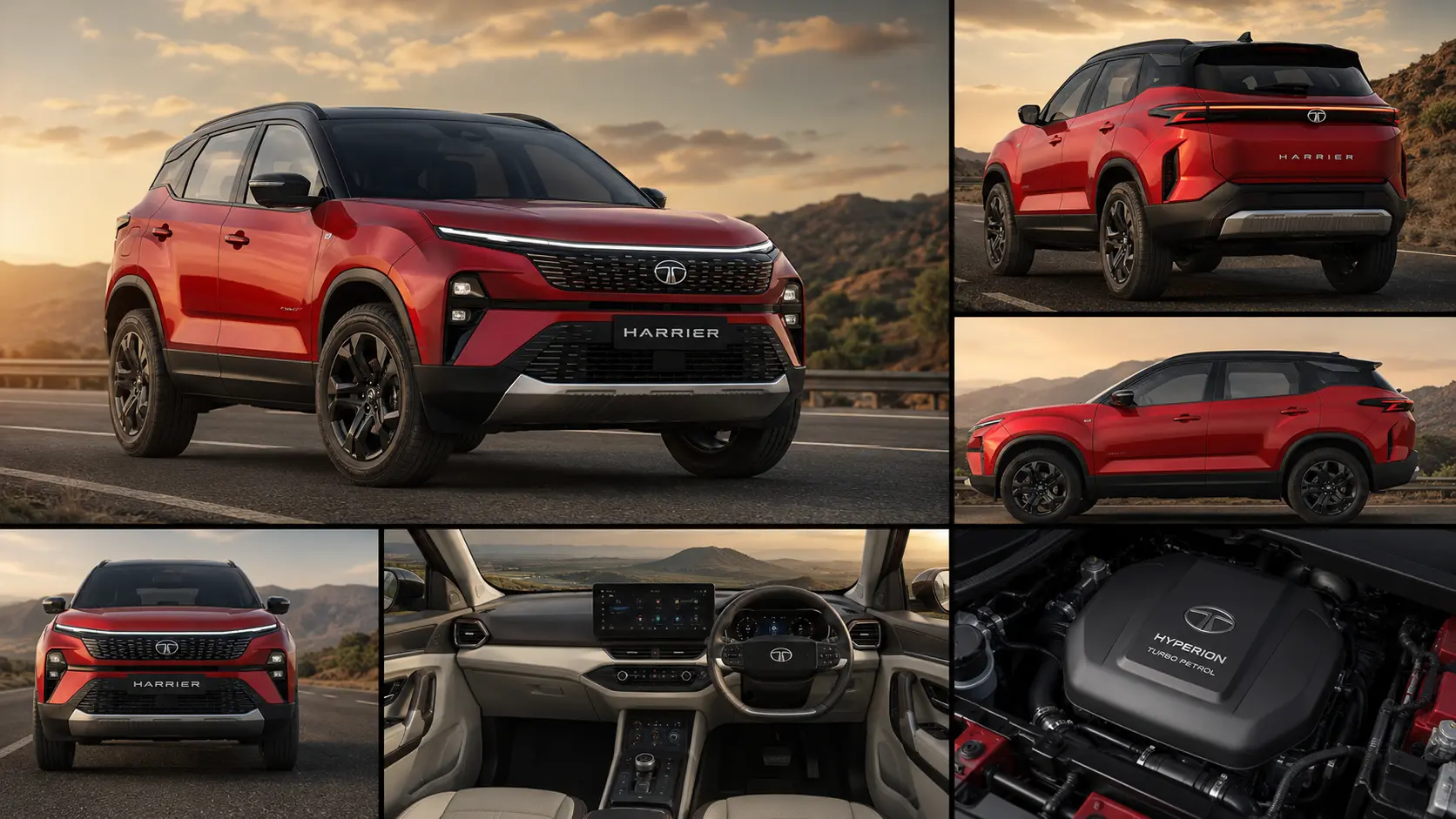
Save for a new Nitro Crimson shade exclusive to the Harrier Fearless Ultra variant, there isn’t anything to distinguish the petrol Harrier from the diesel. Wheel sizes still range between 16 and 19, and their designs are familiar too. No petrol-specific badging is present on the exterior, either.
Visually, the Harrier Petrol remains unchanged — and that’s no bad thing. It still looks muscular and road-dominant. Tata has added a new Nitro Crimson colour, which looks particularly striking under artificial lighting.
Tata’s decision not to change anything about the Harrier’s exterior for the petrol launch is the most confident design statement the brand could have made. When you have a car that Autocar India’s own readers voted as the best-designed Indian SUV, you do not change it because you changed the engine.
The Harrier’s Impact 2.0 design language — introduced with the facelift that brought the car’s design into contemporary alignment with Tata’s global design ambitions — remains one of the most cohesive, premium-looking exteriors in the mid-size SUV segment at any price.
The Harrier cuts a sharp, modern figure with a bold front end defined by a large grille with metal-like accents and slim, connected DRLs that incorporate a light bar and welcome animation. Vertically stacked LED headlamps sit within angular bumper cutouts, while an aero channel guides air from the bumper to the wheel wells. A wide air dam and chunky scuff plate add to the SUV’s visual heft. At the rear, tail-lamps are linked by a full-width light bar and a sculpted bumper completes the look.
The welcome and goodbye LED animation — where the lighting sequences play as you approach or leave the car — is one of those ownership details that never fully loses its novelty for owners. It is the kind of theatrical personalisation that makes the Harrier feel like it knows you own it, which sounds whimsical until it becomes part of your daily ritual.
The 4,598 mm length and 205 mm ground clearance give the Harrier physical dimensions that communicate authority without being discussed. Standing next to a Hyundai Creta (4,300 mm), the Harrier simply looks like the bigger, more serious vehicle. Standing next to an MG Hector (4,655 mm), the Harrier’s design makes the Hector look slightly bloated by comparison. This is the confidence of a well-proportioned design operating correctly.
Standard Accomplished Ultra variants get 18-inch wheels. Unpainted body cladding on a flagship SUV feels inconsistent, especially when Sierra and Curvv get painted units.
This honest criticism from multiple reviewers deserves acknowledgement. The unpainted plastic cladding on the wheel arches and lower body sections — while practical for protecting against parking lot scratches and kerb contact — does look inconsistent with the Harrier’s otherwise premium visual presentation. The Sierra and Curvv’s painted cladding treatment would elevate the Harrier’s appearance, and this is an upgrade Tata should implement.
Fourteen colour options including the new Nitro Crimson, Seaweed Green, and multiple dual-tone configurations. Nitro Crimson under artificial lighting — as reviewers specifically note — achieves a deep, almost liquid red that is genuinely unusual and eye-catching. Seaweed Green is the nature-influenced choice for buyers who want something distinctive without being loud. Daytona Grey Dual Tone is the sophisticated choice that ages best.
Interior Design and Cabin: The Most Important Improvement Is an Engine
The Harrier’s front seats are large and comfortable, and the high seating position delivers a commanding view. Both front seats are powered and ventilated, with memory for the driver. Cabin quality is generally strong, with good fit and finish and premium-feeling touchpoints, though some hard plastics remain, and the heavy use of gloss-black surfaces may prove prone to scratches and smudges.
The commanding driving position — a consequence of the 205 mm ground clearance and the Omega Arc platform’s tall cabin architecture — is one of the Harrier’s most immediately appreciated characteristics for buyers transitioning from hatchbacks or sedans. The elevated view of traffic ahead, the sense of controlling a substantial vehicle rather than navigating a small one, and the psychological confidence of height combined with the physical reality of 4,598 mm of body length — these combine into a daily driving experience that makes the commute feel less like a chore and more like a choice.
Dual-tone Titan-Wood dashboard for refined luxury and a warm ambiance. “Hidden until Lit” command centre that lets you control functions of your car while staying focused on the driving. Steer in style with multifunctional steering wheel with illuminated logo.
The “Hidden until Lit” command centre is the Harrier’s most distinctive interior technology feature and one that only makes full sense when experienced rather than described. The touch panel embedded in the dashboard appears as a smooth, seamless surface in normal cabin light. When activated by the car’s proximity sensors or when a hand approaches, the controls appear as a back-lit panel revealing themselves progressively. This is theatre that serves a purpose — the controls are hidden when not in use, reducing visual clutter, and revealed when needed, maintaining driver attention on the road.
The illuminated Tata logo on the steering wheel — a warm backlit treatment that glows in the dark — is another detail that sits at the intersection of theatre and premium feel. It is not functionally significant. But it contributes to the sense that the Harrier’s designers were paying attention to every interaction rather than just the major components.
The petrol SUV’s top-spec Fearless Ultra trim and its Red Dark edition, neither of which is offered with the diesel, come with a bigger 14.53-inch QLED touchscreen and Dolby Atmos.
This is the Harrier petrol’s most significant interior advantage over any diesel configuration — and it represents genuine technology leadership, not incremental improvement. A 14.53-inch QLED Samsung panel is nearly three additional inches of screen diagonal over the standard 12.3-inch unit. More importantly, QLED technology — which uses quantum dot LED backlighting for dramatically improved brightness, colour gamut, and contrast ratio — delivers a display experience that is qualitatively superior in Indian conditions where direct sunlight regularly overwhelms standard LCD panels.
Dolby Atmos on the top petrol trim is the audio feature that requires explanation to be fully appreciated. Standard automotive audio systems play music from speaker locations — the subwoofer is at the bottom, the tweeters are at the front, and audio has directionality based on where the speakers physically sit. Dolby Atmos uses processing algorithms to create a three-dimensional sound field that surrounds the listener with audio coming from multiple heights and angles simultaneously, independent of speaker physical location. The result is the difference between sitting in front of a sound system and sitting inside one.
The Tata Harrier Petrol gets several upgrades, including a QLED touchscreen, Dolby Atmos audio and a Digital IRVM.
The Digital IRVM (Inside Rear View Mirror) — which uses a small camera mounted at the rear of the car to display a clean, unobstructed rear view on the mirror’s surface — directly addresses one of the Harrier’s visual design compromises. The thick C-pillars and the roof taper that create the Harrier’s distinctive fastback rear profile inevitably reduce traditional mirror visibility. The Digital IRVM bypasses this entirely, replacing the limited conventional mirror view with a full, unobstructed camera image.
The rear seat — the Harrier’s strongest practical argument against segment rivals — remains unchanged and continues to be genuinely generous.
Three passengers can easily be seated comfortably at the rear. The Tata Harrier has a boot space of approximately 445 litres, making it quite practical for an SUV of its size.
Three adults across the rear bench without compromise is the statement the Harrier makes in competitive comparison. The Hyundai Creta’s narrower 1,780 mm width makes three rear adults genuinely tight. The Kia Seltos’s 1,800 mm is marginally better. The Harrier’s 1,890 mm gives the rear bench the physical width to accommodate three adults with comfortable shoulder room.
One honest cabin limitation that reviewers consistently identify:
No adjustable under-thigh support, despite being offered on smaller Tata models.
The absence of adjustable under-thigh support on the front seats — a feature available on smaller Tata vehicles like the Nexon — means that taller drivers who need the seat base extended to provide proper leg support must manage without adjustment. This is a genuine ergonomic gap for drivers above 6 feet who will feel the front seat’s inadequate under-thigh support after one to two hours of highway driving.
The gloss-black surface usage throughout the cabin — while visually premium in showroom conditions — is a maintenance concern that long-term owners will encounter. Fingerprints, scratches, and smudges accumulate on gloss black panels at a rate that matte surfaces do not approach. Over a five-year ownership period, this visual deterioration will make the cabin feel older than equivalent cars with more resilient surface materials.
Engine and Powertrain: The 1.5 Litre That Thinks It Is Bigger
This is the section that determines whether the Tata Harrier petrol review verdict is genuinely positive or merely politely encouraging. Because the powertrain transition from a 2.0L diesel to a 1.5L petrol — in India’s largest-bodied mid-size SUV — is the specification change that concerned the most buyers before driving.
Doubters might still say that a 1.5-litre engine in a large SUV is inadequate, but in practice, it is anything but. For a petrol, the engine only revs to a low 5,000rpm, and it doesn’t have the mid-range turbo punch or the top-end that some other turbocharged engines deliver, but it certainly isn’t lacking in performance. The engine has a strong bottom end and helps the Harrier pick up speed effortlessly.
Autocar India’s first drive assessment — the same publication whose title inspired this review — is the most authoritative verdict on the engine’s adequacy: not lacking in performance, strong bottom end, effortless speed pickup. These observations come from experienced reviewers who drove the car in real Indian conditions including peak Delhi winter fog.
Combination of 1.5L Hyperion engine and the AISIN 6-speed torque converter works remarkably well, offering buyers an exhilarating driving experience. This is a strong engine and does not feel underpowered for a vehicle like Harrier. Acceleration is on point too with 0-100 km/h coming up in well under 10 seconds.
There’s no getting around it — the Harrier Petrol does not feel underpowered. Acceleration is brisk, throttle response is strong and the engine pulls cleanly across the rev range.
Two independent first-drive sources — RushLane and CarbikeGPT — reaching the same conclusion independently: the Harrier does not feel underpowered with this engine. That consistency across multiple reviewers across different driving conditions is the strongest possible evidence for the engine’s real-world adequacy.
The 160 Nm at 1,000 rpm specification deserves its own paragraph because it is the number that makes the 1.5L’s adequacy possible in a car of the Harrier’s weight.
Tata has profiled the power and torque curves to account for the Harrier’s heavier weight, and the engine here makes a healthy 160Nm at a low 1,000rpm.
Most turbo-petrol engines in the mid-size SUV segment build their peak torque above 1,500 to 2,000 rpm. The build-up is smooth and substantial, but there is a discernible lag between throttle input and torque arrival at very low revs. In urban driving — where traffic speeds are often below 30 km/h and the engine is routinely below 1,500 rpm — this lag requires anticipation rather than reaction.
160 Nm at 1,000 rpm eliminates this entirely. At engine speeds that most cars are barely generating 50 to 80 Nm from, the Hyperion is already producing more than half its peak torque. This means the Harrier picks up from low speeds with confidence that the numbers do not predict and the driver genuinely appreciates in daily use.
The Miller Cycle operation — which extends the power stroke relative to the compression stroke to improve thermal efficiency — is the engineering technique that allows the Hyperion to deliver this low-rpm torque while maintaining fuel efficiency that approaches diesel levels. And the 11.5:1 compression ratio — the segment’s highest for a turbo-petrol engine — extracts maximum thermal energy from each combustion event.
The petrol tells a different story. Despite its 1.5-litre capacity, the Hyperion turbo delivers strong low-end performance, making this heavy SUV feel surprisingly quick off the line. There’s no mid-range turbo shove or top-end zing, but performance is more than adequate, with most of the power concentrated low down. Refinement is significantly better than the diesel, though a mild drone creeps in around 1,500rpm.
The honest limitation from Autocar India’s comparative assessment: no mid-range turbo shove, no top-end zing, and a mild drone at 1,500 rpm. These are real characteristics worth acknowledging. The Hyperion engine is not trying to be an exciting, characterful unit. It is trying to be a refined, adequate, and accessible tool. On those terms it succeeds. Buyers seeking the visceral involvement of a high-revving engine will find the Hyperion somewhat uninspiring above 3,500 rpm. Buyers seeking daily driving ease and refinement will find it perfectly calibrated.
The AISIN 6-speed torque converter automatic:
The new AISIN-sourced 6-speed torque converter offers great drivability and the shifts were almost DCT-like.
AISIN is one of the world’s most respected automatic transmission suppliers — their gearboxes appear in Toyota, Volvo, BMW, and other premium vehicles globally. The Harrier petrol’s AISIN TC6 unit delivers shifts that are described as “almost DCT-like” in speed — which, given the AISIN’s inherent smoothness advantage over DCTs in urban stop-go conditions, makes it the best of both worlds: smooth torque converter character in heavy traffic, rapid shift response when the road opens up.
It picks up speed effortlessly and feels grunty in city driving, and even on the highway, it does not run out of breath. We also tried the same engine in the Tata Safari with six people on board and the AC on, and even then, performance was more than adequate.
The six-person, AC-on test in the Safari — which is heavier than the Harrier and requires the same engine to move significantly more mass — is the most demanding real-world scenario possible. If performance is adequate under those conditions, it will be more than adequate for the Harrier carrying a typical family of four.
Mileage and Real-World Fuel Efficiency: The Number Nobody Could Confirm
Tata has yet to reveal the claimed fuel efficiency figures for the Harrier petrol, and our short test didn’t allow us to measure it independently. Tata does claim best-in-class efficiency and has even set an India Book of Records-certified figure of 25.9kpl in controlled conditions; however, this is far from representative of real-world usage. Oddly, though, throughout our testing, the average fuel efficiency readout didn’t budge from 8.0kpl.
Tata Harrier mileage claimed by ARAI is 16.8 kmpl.
Real-world fuel efficiency will not be great, expect single digits in the city. The diesel will offer better efficiency and is a more proven powerplant, and if you are driving huge mileages, then it is the better choice.
These three observations, taken together, paint an honest fuel efficiency picture that every Harrier petrol buyer must fully understand before purchase.
The ARAI claimed figure of 16.8 kmpl is the regulatory number. The India Book of Records 25.9 kmpl is a controlled-condition marketing exercise. The first-drive readout of 8.0 kmpl — stuck throughout media testing in Delhi winter conditions — is the early real-world data point.
Based on the engine’s characteristics, platform weight, and comparable turbo-petrol SUV efficiencies in the segment, realistic real-world expectations are:
City driving (heavy traffic, AC on): 8 to 10 kmpl Mixed city-highway: 11 to 13 kmpl Highway cruise at 80 to 100 kmph: 14 to 16 kmpl
An early owner who purchased on Navratri reported 8.07 kmpl after 550 km over 10 days of mixed driving — consistent with the first-drive readings.
Hi, I was waiting for Tata Harrier AT in petrol for last couple of years, and I bought it on Navratri, and it was the first petrol Harrier in city. Man amazing pickup, super chill AC, effortless gear shifts driven about 550 km in 10 days, getting mileage of 8.07 kmpl tankful to tankful. Mileage will increase after 1st and 2nd service.
The owner’s observation that efficiency should improve post-service as the engine breaks in is realistic — turbocharged engines typically improve 10 to 15 percent from initial running to fully bedded-in operation. Expect 9 to 10 kmpl city efficiency after break-in for average driving styles.
The honest diesel comparison: the diesel Harrier returns approximately 13 to 15 kmpl in similar mixed conditions. The petrol’s city efficiency shortfall versus the diesel is approximately 3 to 5 kmpl — which translates to approximately Rs 2 to 3.50 more per kilometre at current fuel prices depending on the city’s fuel price differential.
Over 1,500 km monthly, this differential represents approximately Rs 3,000 to 5,000 per month more in fuel costs for the petrol versus the diesel. Over five years, that is Rs 1.80 to 3 lakh in additional fuel expenditure. For high-mileage drivers, this calculation matters. For buyers doing 800 to 1,000 km monthly, it is manageable.
Features and Technology: The Petrol Goes Above the Diesel
Depending on the trim level, the Harrier offers features like a 12.3-inch touchscreen, a four-spoke steering wheel with a backlit Tata Motors logo, a drive selector with a digital display, dual-zone climate control, a 10-speaker JBL-tuned sound system, rear window shades, a 360-degree camera, a panoramic sunroof, up to 7 airbags, ADAS, hill-hold control, and more. 14.53-inch QLED touchscreen, Dolby Atmos, and camera washers offered only with the top-spec Harrier petrol trims.
The three features exclusive to the top petrol trims — and absent from any diesel variant — are the Harrier petrol’s clearest competitive advantage over its diesel sibling and over segment rivals.
The 14.53-inch QLED touchscreen at the top petrol trim is genuinely impressive. This is not simply a larger version of the standard touchscreen — it is a fundamentally different display technology. QLED’s wider colour gamut, higher peak brightness (critical for Indian summer afternoon readability), and superior contrast ratio make it visually superior in all lighting conditions. The screen’s size alone — at 36.9 cm diagonal — transforms map navigation from a glanceable interface to an immersive information environment.
Camera washers — small nozzles mounted adjacent to the front and rear cameras that spray cleaning fluid on demand — address a genuine and persistent real-world camera quality issue. In Indian conditions, particularly during monsoon travel, road spray and mud accumulate on camera lenses within minutes of leaving a clean car park. The resulting degraded image quality affects parking assistance and ADAS camera inputs precisely when they are most needed. Camera washers restore clarity instantly and maintain consistent camera performance across all driving conditions.
The Harrier is known to be a feature-rich SUV, and its petrol line-up carries that forward.
Level 2 ADAS on higher variants:
Level 2 ADAS: Lane Keep Assist, Blind Spot Detection, Auto Emergency Braking, and adaptive cruise control.
The ADAS suite’s implementation in the Harrier — radar and camera-based, calibrated for Indian highway conditions — includes a blind spot detection system that is particularly valuable given the Harrier’s wide body of 1,890 mm. At highway speeds, the combination of the Harrier’s width, the thick C-pillars, and the traffic-dependent blind spot creates situations where blind spot detection provides meaningful real-world safety intervention rather than simply ticking an ADAS specification box.
Voice-assisted Panoramic Sunroof with Mood Lighting — for open and airy cabin views. iRA Connected Car Tech: Remote AC, vehicle tracking, over-the-air updates.
The voice-assisted panoramic sunroof — allowing “open sunroof” or “close sunroof” commands without physical interaction — is the feature that most directly demonstrates Tata’s understanding of how people actually drive in Indian urban conditions. When both hands are on the wheel navigating complex traffic, voice-controlled sunroof operation is both safer and more convenient than reaching for a physical control.
Over-the-air software updates mean the Harrier petrol you buy today will have meaningfully better software in 12 months than the day of delivery. Tata’s track record of substantial OTA updates — which have added features and improved interfaces across the Nexon EV, Tiago EV, and Punch EV — provides confidence that the current software quirks will be addressed rather than accepted.
Safety Features: Five Stars, Seven Airbags, Verified for Petrol
Safety? It’s a GNCAP 5-star SUV, with the highest adult (33.05/34) and child (45/49) scores in India.
The Tata Harrier’s petrol variant has scored a five-star rating in BNCAP crash safety tests.
The petrol variant’s independent five-star Bharat NCAP result — not assumed from the diesel but independently tested — is the most important safety confirmation in this review. Any significant powertrain change requires safety revalidation because the engine’s mass and placement affects how the car behaves in frontal collision scenarios. Tata submitted the petrol Harrier for independent testing and achieved five stars.
The adult occupant score of 33.05 out of 34 is the highest recorded for any Indian car at the time of testing. The child occupant score of 45 out of 49 is similarly excellent. These are not borderline five-star results — they are comprehensive, genuine demonstrations of structural engineering excellence.
The Tata Harrier comes equipped with loads of safety features including 7 airbags, electronic stability control, ABS with EBD and traction control. Level 2 Advanced driver assistance systems are also available on higher variants. These include features such as lane departure warning, adaptive cruise control and autonomous emergency braking.
Seven airbags — including the driver knee airbag that reduces lower-limb injury risk in frontal collisions — are available on higher trims. The standard six airbags across the range provide baseline passive protection that exceeds what most rivals offer at entry-level pricing.
ESC, ABS with EBD, and traction control as standard across all variants mean that no budget-limited Harrier buyer is purchasing a vehicle without basic active safety foundations. These electronic interventions — operating invisibly in the background — prevent incidents that inexperienced drivers or unexpected road situations would otherwise convert into accidents.
Ride Quality and Real-World Driving Experience: The Land Rover Heritage Earns Its Keep
High-speed ride and handling is a highlight of the Harrier petrol, like its diesel counterpart. In true Tata fashion, the Harrier petrol rides superbly — just like the diesel. The platform shows its Land Rover roots with a reassuring sense of robustness over rough surfaces. There is an underlying firmness when crawling through broken tarmac, but at no point does it become uncomfortable, and on the highway, it really comes into its own.
What hasn’t changed with Harrier Petrol is the robust ride quality from its Land Rover D8 derived OMEGA Arc platform.
The Land Rover D8 architecture — over-engineered for Indian conditions precisely because it was designed for the global market’s most demanding scenarios — produces a ride quality that remains the Harrier’s single most distinctive competitive advantage. No compact SUV at the Harrier’s price has this platform underneath.
Built on the OMEGA Arc platform (derived from Land Rover’s D8 architecture), the Harrier Petrol retains the rock-solid ride quality it’s known for.
The “robustness over rough surfaces” that Autocar India and multiple other reviewers note is a specific, earned characteristic. It is not soft compliance — the Harrier does not absorb potholes by swallowing them. It is controlled firmness — the platform manages the impact energy and disperses it through the suspension geometry without allowing it to translate into cabin occupant disturbance. The distinction is perceptible to anyone who has experienced both types.
The Harrier is a family SUV meant to be driven in a relaxed manner, but when put in a situation where it needs to handle corners, it can hold its own. At high speeds, it remains stable during sudden lane changes, and the steering’s response along with its weight inspires confidence.
On the whole, the Harrier is a very well-rounded SUV, and the petrol broadens its appeal further by bringing a level of refinement the diesel never could.
The 80 kg weight reduction versus the diesel provides measurable dynamic benefit:
The petrol Harrier is claimed to be 80kg lighter than the diesel, which may help it feel more agile on twisty roads.
80 kilograms on a vehicle of approximately 1,900 kg represents a 4.2 percent mass reduction. In direction changes, the Harrier petrol responds with marginally greater willingness. On ghat roads and mountain passes, it carries its weight through corners with slightly better body control. This is not a transformation — the Harrier remains a family SUV, not a performance car. But the agility improvement is real and appreciated on roads where the diesel felt heavier than necessary.
The steering calibration:
The well-calibrated electric steering feels light at low speeds, weighing up progressively to provide confidence at high speeds.
Progressive electric steering — light in parking lots, weighted for highway confidence — is the calibration that makes a large SUV feel both easy to place in tight urban spaces and planted on fast open roads. The Harrier’s steering achieves this balance with a naturalness that some rivals’ speed-sensitive electric systems fail to replicate.
One ride quality limitation acknowledged by reviewers:
Its low-speed ride quality feels slightly hard.
The firmness at low speeds over sharp-edged urban bumps is the Harrier petrol’s most consistent real-world criticism from CarWale’s assessment and multiple owner reports. This is a suspension calibration characteristic — not a structural limitation — that manifests specifically on abrupt, sharp-edged impacts like concrete expansion joints and high-speed-breaker impact. It is manageable and does not make the car genuinely uncomfortable, but buyers who prioritise maximum urban plushness should test drive the Harrier specifically on broken urban surfaces before purchasing.
NVH performance:
In real-world driving, the Harrier Petrol feels impressively insulated, with engine noise well suppressed and vibrations almost absent.
The 37.8 dB cabin noise claim — nearly three decibels below the nearest rival’s 40.7 dB — has real perceptual significance. Three decibels represents approximately a 50 percent reduction in perceived loudness to the human ear. The Harrier petrol’s cabin is measurably, substantially quieter at the engine level than any rival claims. Combined with the platform’s good road noise suppression, the petrol Harrier is the most acoustically refined cabin in its segment.
Tata Harrier Petrol — Complete Price and Variant Table
| Variant | Engine | Transmission | Key Features | Ex-Showroom Price |
|---|---|---|---|---|
| Smart | 1.5L Hyperion | 6-Speed MT | 17-inch alloys, LED headlamps, 7-inch display, auto AC, all power windows | Rs 12.89 lakh |
| Pure X | 1.5L Hyperion | 6-Speed MT | + 12.3-inch touchscreen, sunroof, 6 airbags, wireless connectivity | Rs 14.99 lakh (approx.) |
| Adventure X | 1.5L Hyperion | MT | + Ventilated seats, 18-inch alloys, 360 camera, rear window shades | Rs 16.49 lakh (approx.) |
| Adventure X AT | 1.5L Hyperion | 6-Speed AISIN AT | Same as Adventure X with AISIN automatic | Rs 17.53 lakh onwards |
| Adventure X+ | 1.5L Hyperion | MT / AT | + Level 2 ADAS, JBL audio, powered driver seat, ambient lighting | Rs 18.49–19.49 lakh |
| Fearless X | 1.5L Hyperion | MT / AT | + Panoramic sunroof, 7 airbags, 19-inch alloys, dual-zone AC, iRA | Rs 20.49–21.49 lakh |
| Fearless X+ | 1.5L Hyperion | MT / AT | + Dolby Atmos, camera washers, Digital IRVM | Rs 22.49–23.49 lakh |
| Fearless Ultra | 1.5L Hyperion | AT | Full spec + 14.53-inch QLED, Nitro Crimson exclusive colour | Rs 24.69 lakh |
Note: Prices are ex-showroom Delhi as of June 2026. Tata Motors announced a 1.5 percent price increase effective July 1, 2026. Confirm current pricing and available offers with your nearest Tata dealership. On-road prices vary significantly by state based on registration and road tax differences.
Competitor Comparison: Harrier Petrol vs The Mid-Size SUV Segment
| Parameter | Tata Harrier 1.5L Petrol AT | Hyundai Creta 1.5T DCT | Kia Seltos 1.5T DCT | Mahindra XUV700 Petrol AT | MG Hector 1.5T |
|---|---|---|---|---|---|
| Price Range (AT Mid) | Rs 17.53–21.49 lakh | Rs 17.30–20.45 lakh | Rs 17.00–20.95 lakh | Rs 15.50–22.99 lakh | Rs 15.99–21.99 lakh |
| Engine | 1.5L GDI Turbo | 1.5L Turbo | 1.5L Turbo | 2.0L Turbo | 1.5L Turbo |
| Peak Power | 170 hp | 160 hp | 160 hp | 200 hp | 143 hp |
| Peak Torque | 280 Nm | 253 Nm | 253 Nm | 380 Nm | 250 Nm |
| Low-RPM Torque | 160 Nm @ 1,000 rpm | ~80 Nm @ 1,000 rpm | ~80 Nm @ 1,000 rpm | ~120 Nm @ 1,000 rpm | ~80 Nm @ 1,000 rpm |
| Gearbox | 6-Speed TC Auto (AISIN) | 7-Speed DCT | 7-Speed DCT | 6-Speed TC Auto | 8-Speed DCT |
| Body Length | 4,598 mm | 4,300 mm | 4,365 mm | 4,695 mm | 4,655 mm |
| Ground Clearance | 205 mm | 190 mm | 190 mm | 207 mm | 192 mm |
| Boot Space | 445 litres | 433 litres | 433 litres | 520 litres | 587 litres |
| BNCAP Rating | 5-Star (petrol specific) | Not rated | Not rated | 5-Star | Not rated |
| Level 2 ADAS | Yes | Yes | Yes | Yes | Yes |
| Panoramic Sunroof | Yes | Yes | Yes | No | Yes |
| Ventilated Seats | Yes | Yes | Yes | Yes | No |
| Airbags (Top Variant) | 7 | 6 | 6 | 7 | 6 |
| QLED Screen (Top) | 14.53-inch | Dual 10.25-inch | 10.25-inch | 10.25-inch | 14-inch |
| Dolby Atmos | Yes (top petrol) | No | No | No | No |
| Camera Washers | Yes (top petrol) | No | No | No | No |
| NVH (Claimed dB) | 37.8 dB (best segment) | Not claimed | Not claimed | Not claimed | Not claimed |
| Diesel Option | Yes | Yes | Yes | Yes | Yes |
The comparison table reveals the Harrier petrol’s specific competitive advantages with clarity. It leads on power output (170 hp), low-RPM torque (160 Nm at 1,000 rpm), ground clearance (205 mm), BNCAP safety rating confirmation, NVH levels (37.8 dB claimed), QLED screen size at the top variant, Dolby Atmos exclusivity, and camera washer availability. It concedes on DCT gearbox (the torque converter is smoother but shifts more slowly than DCT rivals under hard acceleration), real-world fuel efficiency (approximately 1 to 2 kmpl below diesel and below some petrol rivals), and boot space versus the Hector and XUV700.
Pros and Cons: The Definitive Assessment
Pros:
- 170 hp and 280 Nm from a 1.5L engine — the most powerful petrol in the mid-size SUV segment, 10 hp more than Creta and Seltos
- 160 Nm available at 1,000 rpm — eliminates low-RPM hesitation and makes urban driveability genuinely excellent
- 37.8 dB cabin NVH — segment’s best claimed cabin noise level, nearly three decibels quieter than the nearest rival
- Five-star Bharat NCAP safety rating confirmed specifically for the petrol variant — structural integrity independently verified
- Seven airbags available on higher trims — exceeds the six-airbag standard most rivals provide
- Land Rover-derived OMEGA Arc platform ride quality — planted highway stability and composed rough-road management remain class-defining
- AISIN-sourced 6-speed torque converter automatic — smoother than DCTs in stop-go traffic with near-DCT shift speed when needed
- 14.53-inch QLED touchscreen exclusive to top petrol trims — segment-best screen technology and size
- Dolby Atmos audio processing exclusive to petrol top variants — unavailable at any comparable price in any rival
- Camera washers on top variants — practical engineering for Indian conditions
- 80 kg lighter than the diesel — measurably more agile on twisty roads
- Miller Cycle with 11.5:1 compression — sophisticated engineering that maximises efficiency from the smaller displacement
- Road presence unmatched in segment at 4,598 mm length with 205 mm ground clearance
- Voice-assisted panoramic sunroof — safety-forward convenience during active driving
- Digital IRVM on top petrol variants — compensates for the design’s reduced conventional mirror view
- iRA connected technology — remote access, OTA updates, smartwatch connectivity
- Petrol pricing typically Rs 50,000 to 80,000 below equivalent diesel variants — lower acquisition cost
- Genuine three-adult rear seat comfort — 1,890 mm width provides real lateral space
Cons:
- Real-world city efficiency of 8 to 10 kmpl is significantly below the 16.8 kmpl ARAI claimed figure and below diesel’s city efficiency
- Petrol per-kilometre fuel cost is Rs 2 to 3.50 more than diesel at current price differentials — approximately Rs 3,000 to 5,000 more monthly at 1,500 km usage
- Manual gearbox quality noted as notchy with longer throws — automatic strongly recommended
- No mid-range turbo shove or top-end excitement — the engine character is refined rather than involving
- Mild drone at 1,500 rpm noted by Autocar India — not unpleasant but perceptible during certain throttle positions
- Low-speed ride over sharp-edged bumps is slightly firm — not uncomfortable but not class-best
- Unpainted body cladding on flagship variants feels inconsistent with the premium design intent
- No adjustable under-thigh support on front seats — genuine ergonomic gap for taller drivers over one hour of highway driving
- Gloss-black interior surfaces accumulate scratches and smudges over time — maintenance burden for perfectionist owners
- No AWD or 4WD option — FWD only across the entire petrol range
- No mild hybrid or strong hybrid option — efficiency ceiling is lower than hybrid alternatives could achieve
- Tata service quality varies significantly by dealership and state — potential ownership experience inconsistency
- Engine reliability track record for the Hyperion is still being established — limited long-term data available
- Boot space at 445 litres is adequate but below the MG Hector (587 litres) and Mahindra XUV700 (520 litres)
Who Should Buy the Tata Harrier Petrol?
For large SUV buyers whose running isn’t high enough to justify a diesel, the petrol-powered Harrier makes a compelling case.
Buy the Harrier petrol if you have been specifically waiting for a petrol option since the car launched in 2019. If the Harrier’s design, safety credentials, platform quality, and feature list were always your first choice but diesel was your dealbreaker — your car has arrived, and the six years were worth waiting through.
Buy it if your monthly mileage falls below 1,500 km and your driving is predominantly urban. At lower mileage, the fuel cost differential between petrol and diesel compresses to a manageable monthly difference that the petrol’s refinement advantage — that 37.8 dB cabin quietness — more than justifies.
Buy the Adventure X AT at approximately Rs 17.53 lakh if you want the best value-for-money proposition in the range — AISIN automatic, 360-degree camera, ventilated seats, and 18-inch alloys without paying for the top tier’s exclusive features.
Buy the Fearless Ultra at Rs 24.69 lakh if the 14.53-inch QLED screen and Dolby Atmos are genuinely valuable to your daily usage. They are not marketing features — they are daily-use technology that is perceptible, meaningful, and unavailable at this price in any rival.
Buy it if you want the most refined, quietest cabin in the mid-size SUV segment. The 37.8 dB NVH achievement — nearly three decibels below the nearest rival — makes every commute, every highway drive, and every family conversation inside the car measurably more pleasant.
Who Should Avoid the Tata Harrier Petrol?
Avoid it if your monthly mileage consistently exceeds 2,000 km. At that usage level, the diesel’s efficiency advantage accumulates to Rs 5,000 to 7,000 per month in fuel savings — approximately Rs 3 to 4.2 lakh over five years. The diesel remains the economically rational choice for high-mileage users.
Avoid the manual transmission variant if your primary driving environment involves heavy urban traffic. The gearbox’s notchy character and longer throws become a daily irritation in the constant gear changes that city driving demands. The AISIN automatic is worth every additional rupee.
Avoid the Harrier entirely if you need seating beyond five. The Safari — which receives the same Hyperion petrol treatment — is the choice for families needing six or seven seats. The Harrier’s excellent rear seat serves exactly five people, and no configuration changes that.
If you are still concerned about reliability, we suggest you look at the Kia Seltos.
Avoid it if engine reliability certainty over the long term is your non-negotiable priority. The Hyperion engine has been publicly available for limited months, and long-term reliability data is not yet established. Autocar India’s own advice for reliability-first buyers recommends the Kia Seltos — whose Theta2 1.5 TGDi engine has an extensive global track record. The Hyperion’s Miller Cycle operation and higher compression ratio suggest sophisticated engineering — but sophisticated engineering requires time to prove itself in Indian conditions.
Expert Verdict: Was Six Years of Waiting Justified? Absolutely.
As a package, the Harrier petrol is very well rounded. Its core strengths — strong street presence, an excellent ride and a roomy, feature-packed cabin — remain intact, and the petrol powertrain now broadens its appeal. The engine really exceeds expectations, delivering performance far better than its cubic capacity suggests and finally bringing a level of refinement the diesel never could.
That Autocar India verdict — the publication whose review title inspired this article — is the most honest and complete summary of the Tata Harrier petrol review available. Performance that exceeds expectations. Refinement the diesel never could provide. Core strengths intact.
The Tata Harrier Petrol is not just a new variant — it’s a reimagining of what the Harrier can be. Faster, smoother and more feature-rich, it broadens Tata’s flagship SUV appeal like never before. If you were waiting for a petrol Harrier worth buying, this is it.
The replacement for displacement title asks a specific, honest question: can a 1.5L turbo petrol replace a 2.0L diesel without compromising the Harrier’s essential character?
The answer, after examining every dimension of this car, is yes — with specific qualifications.
The 170 hp and 280 Nm with 160 Nm at 1,000 rpm provides adequate, often impressive urban performance that the numbers do not fully predict. The 37.8 dB NVH delivers a cabin quietness the diesel could never achieve. The 80 kg weight reduction makes the car more agile. The Miller Cycle and 11.5:1 compression represent genuine engineering investment rather than simply less displacement. The QLED screen and Dolby Atmos at the top make the petrol Harrier’s technology story better than any diesel variant.
What the displacement replacement does not deliver: the diesel’s superior highway efficiency, its 350 Nm torque sensation, and the proven long-term reliability of a powerplant with years of Indian market data behind it.
But for the buyer profile this car targets — the urban-primary, refinement-seeking, feature-valuing Indian family that has been walking away from the Harrier showroom for six years — the petrol’s advantages are precisely the ones that matter most.
Harrier and Safari are probably the best-looking mid-size SUVs on sale in India. With the launch of 1.5L Hyperion Petrol engine options, the appeal of Harrier and Safari have broadened. They have more magnetism now than ever before attracting buyers craving for more performance than what was associated with Harrier before.
More magnetism now than ever before. That is the definitive answer to whether the replacement for displacement was worth the wait.
It was. Emphatically.
Frequently Asked Questions About the Tata Harrier Petrol
Q1. What is the price of the Tata Harrier petrol in India?
The Tata Harrier’s petrol variant prices range between Rs 12.89 lakh and Rs 24.69 lakh (ex-showroom), announced on January 7, 2026. The Smart base variant starts at Rs 12.89 lakh, while the top Fearless Ultra is priced at Rs 24.69 lakh. Note Tata Motors announced a 1.5 percent price hike effective July 1, 2026. Confirm current pricing with your nearest Tata dealership.
Q2. Is the Tata Harrier petrol engine powerful enough for a large SUV?
Doubters might still say that a 1.5-litre engine in a large SUV is inadequate, but in practice, it is anything but. The engine has a strong bottom end and helps the Harrier pick up speed effortlessly. There’s no getting around it — the Harrier Petrol does not feel underpowered. Acceleration is brisk, throttle response is strong and the engine pulls cleanly across the rev range. The 160 Nm available at just 1,000 rpm is the key specification that makes the 1.5L adequate in daily conditions.
Q3. What is the real-world mileage of the Tata Harrier petrol?
Tata Harrier mileage claimed by ARAI is 16.8 kmpl. Real-world efficiency based on first-drive testing and early owner reports is significantly lower: 8 to 10 kmpl in city driving, 11 to 13 kmpl in mixed conditions, and 14 to 16 kmpl on smooth highway cruise. An early owner reported 8.07 kmpl over the first 550 km. Efficiency typically improves after the first one to two services as the engine breaks in.
Q4. Should I buy the Tata Harrier petrol or diesel?
The diesel will offer better efficiency and is a more proven powerplant, and if you are driving huge mileages, then it is the better choice. For monthly mileage below 1,500 km with primarily urban driving — choose petrol for refinement and quietness. For monthly mileage above 2,000 km or primarily highway driving — choose diesel for efficiency and proven reliability.
Q5. Is the Tata Harrier petrol safe? What is its safety rating?
It’s a GNCAP 5-star SUV, with the highest adult (33.05/34) and child (45/49) scores in India. The Tata Harrier’s petrol variant has scored a five-star rating in BNCAP crash safety tests. The petrol specifically achieved five stars under BNCAP testing — not inherited from the diesel. Seven airbags are available on higher trims, and Level 2 ADAS is available on Fearless X and above variants.
Q6. What exclusive features does the Tata Harrier petrol offer over the diesel?
The petrol SUV’s top-spec Fearless Ultra trim and its Red Dark edition, neither of which is offered with the diesel, come with a bigger 14.53-inch QLED touchscreen and Dolby Atmos. Additionally, camera washers and the Nitro Crimson colour option are exclusive to the top petrol variants. These three feature categories are genuinely unavailable on any diesel Harrier configuration.
Q7. Which Tata Harrier petrol variant offers the best value?
The Adventure (petrol manual) delivers the best balance, packing a sunroof, touchscreen, ADAS-ready hardware, and premium comfort at a sensible Rs 17–18 lakh on-road, without the top-end price tag. For automatic buyers, the Adventure X AT at Rs 17.53 lakh onwards provides the AISIN automatic gearbox, 360-degree camera, ventilated seats, and 18-inch alloys at the best feature-to-price ratio in the range. The Fearless X+ is the sweet spot for buyers who want QLED and Dolby Atmos without paying the full Fearless Ultra premium.